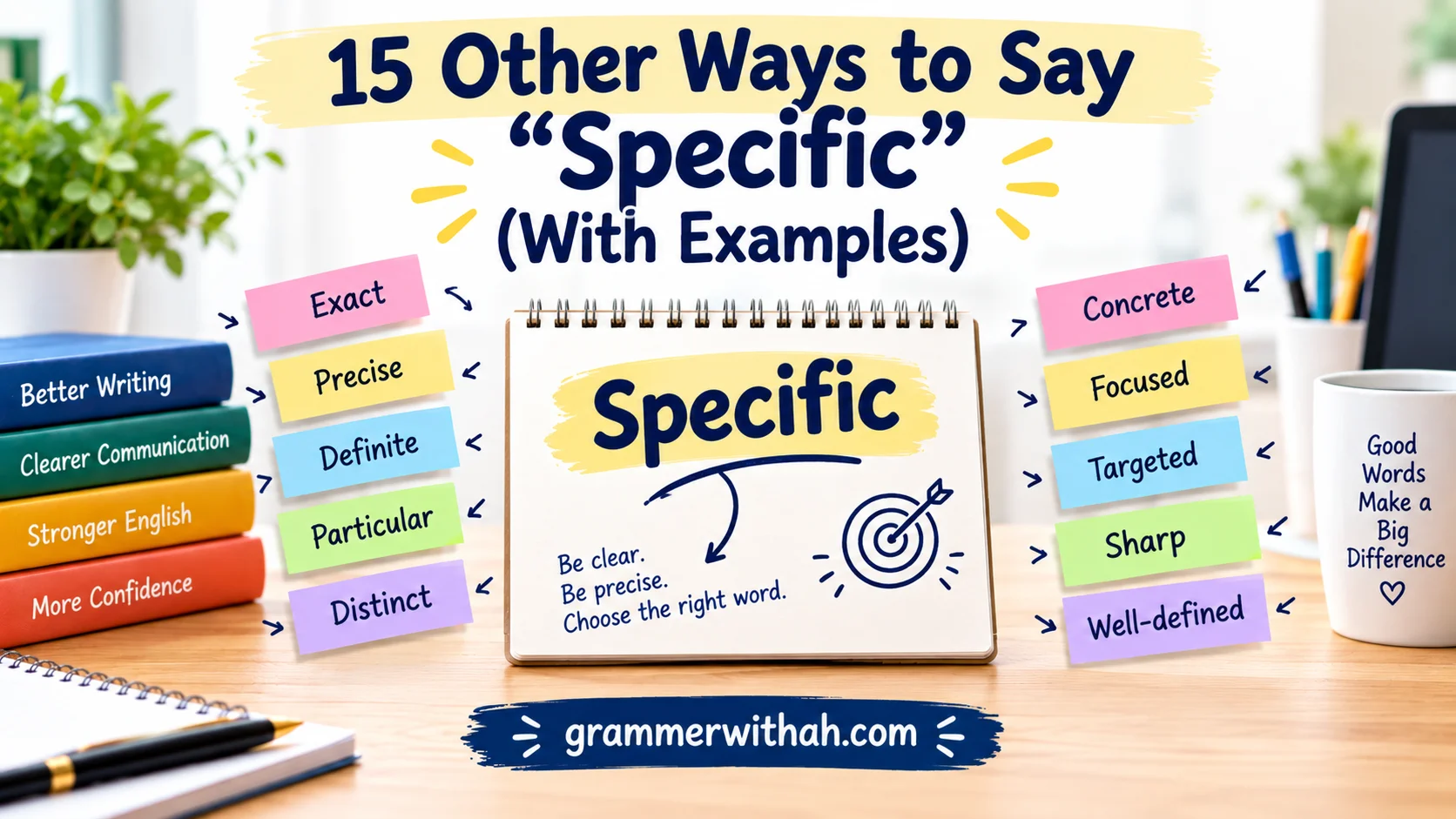
The words we choose can change how clearly a message comes across. Sometimes specific is exactly right, but another expression may sound more natural, precise, formal, or conversational depending on what you mean. Discover 15 other ways to say “Specific” with clear examples, useful synonyms, and natural phrases to make your writing more precise today!!
Knowing different ways to say specific can help you explain an idea without sounding repetitive. In this guide, you’ll learn 15 useful alternatives, what each one means, where it works best, and how to use it naturally in everyday and professional communication.
What Does “Specific” Mean?
Specific means clearly identified, defined, or limited to a particular person, thing, situation, detail, or purpose. When someone asks for a specific answer, they usually want information that is exact and clearly focused, rather than something broad or general. For example, “Do you have a specific question?” asks whether there is one particular question the person wants answered.
The word can also describe something that has been carefully identified. If a manager gives a specific deadline, the deadline is clearly stated rather than left open-ended. In everyday English, specific often communicates the idea of being precise, focused, or particular about something.
Common Situations Where “Specific” Is Used
People use specific in many forms of communication. In everyday conversation, you might ask someone for a specific reason, example, location, date, or detail when a general answer is not enough.
It is also common in workplace communication. A manager may give specific instructions, a customer may request a specific product, or a colleague may ask for specific information before completing a task. In school and academic writing, the word often appears when discussing particular examples, requirements, evidence, or topics.
The word also works well in emails, text messages, social media, instructions, and formal writing. However, another expression may sometimes sound more natural. For example, “a particular reason” can sound softer than “a specific reason,” while “precise information” emphasizes accuracy more strongly.
Is It Professional or Polite to Say “Specific”?
Yes. Specific is a neutral and professional word. It does not normally sound rude, overly casual, or overly formal. It is suitable for emails, workplace discussions, academic writing, customer service, instructions, and everyday conversations.
The tone depends partly on how you use it. Saying, “Could you provide specific details?” is professional and direct. In a friendly conversation, “Is there anything in particular you need?” may feel more relaxed and conversational.
In some situations, alternatives such as particular, exact, or precise can communicate a slightly different shade of meaning. The best choice depends on whether you want to emphasize selection, accuracy, detail, or focus.
Advantages and Disadvantages of Saying “Specific”
Advantages
The biggest advantage of specific is clarity. It tells the listener or reader that you are talking about something clearly identified rather than general. It is also versatile enough to work in casual, professional, academic, and formal settings.
Another benefit is that the word is easy to understand. Someone can quickly recognize the difference between a general request and a specific one. For example, “Tell me about your problem” is broad, while “Give me specific details about the error” clearly narrows the request.
Disadvantages
Although specific is useful, repeated use can make writing feel less varied. If the word appears several times in a short paragraph, alternatives can make the wording smoother.
The word can also be slightly direct in some personal conversations. Asking, “Do you have a specific reason?” may sound more probing than “Is there something in particular you’re concerned about?” The difference is small, but context matters.
Synonyms for “Specific”
- Particular
- Exact
- Precise
- Definite
- Clearly Defined
- Focused
- Detailed
- Explicit
- Distinct
- Individual
- Identified
- Targeted
- Well-Defined
- Narrow
- Certain
1. Particular
Meaning
Particular refers to one specific person, thing, situation, or choice rather than something general. It is one of the most natural alternatives to specific, especially when you are identifying one item from a larger group.
Definition
Particular means relating to or referring to one clearly identified person, thing, or situation.
Detailed Explanation
“Particular” often sounds slightly softer and more conversational than “specific.” It works especially well when asking about someone’s preference, concern, reason, or choice. While the two words can often be exchanged, “particular” can emphasize selection rather than exactness.
Scenario Examples
Scenario: A friend seems worried about something.
Example: “Is there anything in particular that’s bothering you?”
Scenario: A customer wants one item from a large collection.
Example: “Are you looking for a particular model?”
Scenario: A teacher asks students to focus on one issue.
Example: “Is there a particular point you want to discuss?”
Best Use
Best for everyday conversation, personal messages, customer communication, and friendly questions.
Tone
Tone: Friendly, natural, conversational
It often sounds less rigid than “specific,” making it useful when you want to ask a focused question politely.
2. Exact
Meaning
Exact emphasizes correctness and accuracy. It is useful when you mean that something must be precisely identified, measured, stated, or located.
Definition
Exact means completely correct, accurate, or matching a particular detail without difference.
Detailed Explanation
“Exact” is not always a direct replacement for “specific.” It is stronger when the main idea is accuracy. For example, an exact time means a precise time, while a specific time could simply mean one selected time.
Scenario Examples
Scenario: Someone needs the correct meeting time.
Example: “Can you tell me the exact time the meeting starts?”
Scenario: A customer needs a precise amount.
Example: “Please enter the exact amount shown on your receipt.”
Scenario: Someone is trying to find a location.
Example: “Do you know the exact address?”
Best Use
Best for dates, times, numbers, measurements, addresses, quotations, amounts, and factual details.
Tone
Tone: Direct, precise, factual
The word highlights accuracy, so it is stronger than “specific” when correctness matters.
3. Precise
Meaning
Precise describes something that is highly accurate, carefully stated, or clearly limited.
Definition
Precise means exact and accurate, with little or no uncertainty.
Detailed Explanation
“Precise” is particularly useful when discussing information, language, measurements, instructions, or descriptions. It often sounds more formal than “specific.” Someone may ask for precise wording when they want the language to communicate an idea without ambiguity.
Scenario Examples
Scenario: A colleague needs clearer instructions.
Example: “Could you give me more precise instructions for this step?”
Scenario: A scientist records a measurement.
Example: “The report provides precise measurements for each sample.”
Scenario: A writer wants to improve a sentence.
Example: “We need more precise language to explain the issue.”
Best Use
Best for professional communication, academic writing, technical subjects, measurements, instructions, and careful descriptions.
Tone
Tone: Professional, accurate, formal
“Precise” places greater emphasis on accuracy and careful wording.
4. Definite
Meaning
Definite describes something that is clear, settled, certain, or clearly established.
Definition
Definite means clear and certain rather than uncertain, vague, or undecided.
Detailed Explanation
“Definite” overlaps with “specific,” but it often focuses more on certainty or firmness. A definite answer is clear and certain, while a specific answer is focused on a particular detail. Because of this difference, the words are not interchangeable in every sentence.
Scenario Examples
Scenario: Someone wants confirmation about an appointment.
Example: “Do we have a definite date for the event?”
Scenario: A manager has made a firm decision.
Example: “We need a definite answer before Friday.”
Scenario: Someone is unsure about future plans.
Example: “I don’t have any definite plans for the weekend.”
Best Use
Best for plans, decisions, answers, dates, arrangements, and situations involving certainty.
Tone
Tone: Clear, firm, neutral
It emphasizes certainty, rather than simply identifying one particular detail.
5. Clearly Defined
Meaning
Clearly defined means something has been explained, identified, or limited in a way that leaves little confusion.
Definition
Clearly defined describes something whose boundaries, meaning, purpose, or requirements are easy to understand.
Detailed Explanation
This expression is useful when specific refers to something that has clear limits or requirements. It is especially common in professional, academic, and organizational communication. Unlike “specific,” it strongly suggests that the subject has been carefully explained or established.
Scenario Examples
Scenario: A company creates a new role.
Example: “The position has clearly defined responsibilities.”
Scenario: A student receives an assignment.
Example: “The project has clearly defined objectives.”
Scenario: A team discusses its goals.
Example: “We need a clearly defined plan before we begin.”
Best Use
Best for goals, roles, responsibilities, projects, requirements, rules, and processes.
Tone
Tone: Professional, organized, formal
The expression suggests clarity and structure, making it useful in workplace and academic settings.
6. Focused
Meaning
Focused describes something directed toward one particular subject, goal, task, or area.
Definition
Focused means concentrated on a particular purpose, subject, or objective.
Detailed Explanation
“Focused” works well when “specific” means narrowly directed rather than merely exact. It is especially useful for discussions, projects, strategies, conversations, and attention. It can also describe a person who concentrates strongly on one task.
Scenario Examples
Scenario: A team changes the subject of a meeting.
Example: “Let’s keep the discussion focused on the customer issue.”
Scenario: A student prepares for an exam.
Example: “She created a focused study plan for the final week.”
Scenario: A business develops a marketing campaign.
Example: “The campaign is focused on first-time customers.”
Best Use
Best for goals, discussions, projects, strategies, studies, campaigns, and attention.
Tone
Tone: Clear, purposeful, professional
It communicates direction and concentration, rather than exactness alone.
7. Detailed
Meaning
Detailed describes something that contains a lot of information about a subject.
Definition
Detailed means including many relevant facts, explanations, or pieces of information.
Detailed Explanation
“Detailed” is useful when someone uses “specific” to mean providing enough information. It does not necessarily mean that something is narrowly focused. Instead, it emphasizes the amount and depth of information included.
Scenario Examples
Scenario: A manager asks for a fuller report.
Example: “Please send me a detailed explanation of what happened.”
Scenario: A traveler plans a trip.
Example: “She created a detailed itinerary for the entire week.”
Scenario: A customer needs help understanding a product.
Example: “The website provides detailed instructions for installation.”
Best Use
Best for reports, explanations, instructions, descriptions, plans, and accounts of events.
Tone
Tone: Informative, professional, thorough
“Detailed” emphasizes depth of information, so it should not replace “specific” when exactness is the main idea.
8. Explicit
Meaning
Explicit describes something that is stated clearly and directly, without relying on the reader or listener to guess the meaning.
Definition
Explicit means clearly stated, expressed, or shown without ambiguity.
Detailed Explanation
“Explicit” is useful when clarity of expression is more important than simply identifying a particular item. It can be stronger than “specific” because it suggests that the information has been directly communicated. The word is common in instructions, rules, agreements, and formal communication.
Scenario Examples
Scenario: A company explains a workplace rule.
Example: “The handbook gives explicit instructions about data security.”
Scenario: A teacher explains an assignment.
Example: “The professor was explicit about what students needed to include.”
Scenario: Someone wants clear permission.
Example: “I need your explicit approval before making the change.”
Best Use
Best for instructions, permissions, rules, requirements, agreements, and formal communication.
Tone
Tone: Direct, formal, unambiguous
It highlights information that is clearly stated rather than implied.
9. Distinct
Meaning
Distinct describes something that is clearly different, separate, or recognizable from other things.
Definition
Distinct means clearly different or separate from something else.
Detailed Explanation
“Distinct” is not a universal synonym for “specific.” It works when the intended meaning involves difference or separation. For example, two categories can be distinct from each other, but you would not normally replace “specific instructions” with “distinct instructions.”
Scenario Examples
Scenario: A researcher separates two groups.
Example: “The study identified two distinct patterns.”
Scenario: A designer creates separate visual styles.
Example: “Each section has a distinct visual identity.”
Scenario: Someone notices different qualities in two products.
Example: “The two versions have distinct features.”
Best Use
Best for categories, features, characteristics, groups, patterns, identities, and differences.
Tone
Tone: Analytical, clear, descriptive
It emphasizes separation or difference, not merely detail.
10. Individual
Meaning
Individual refers to one person, item, or unit considered separately from a group.
Definition
Individual means relating to one particular person or thing rather than a group as a whole.
Detailed Explanation
“Individual” can replace “specific” when you want to emphasize one separate person or item. It is common in professional, educational, medical, business, and everyday contexts. However, it does not always communicate the idea of exactness.
Scenario Examples
Scenario: A teacher discusses students separately.
Example: “Each student has individual learning needs.”
Scenario: A company reviews products one at a time.
Example: “We evaluate each individual application carefully.”
Scenario: A manager gives personalized feedback.
Example: “The team members received individual feedback after the review.”
Best Use
Best for people, products, applications, needs, responsibilities, cases, and items within a group.
Tone
Tone: Neutral, professional, individualized
It emphasizes one person or thing separately, rather than general information.
11. Identified
Meaning
Identified means that a person, problem, item, cause, or factor has been recognized or determined.
Definition
Identified means recognized, named, located, or determined as a particular thing.
Detailed Explanation
“Identified” works when “specific” refers to something that has already been recognized or established. It is especially useful when discussing problems, causes, risks, people, or factors. The expression focuses on recognition rather than precision.
Scenario Examples
Scenario: A technical team discovers a problem.
Example: “The engineers identified the source of the error.”
Scenario: A report discusses risks.
Example: “The researchers identified several possible causes.”
Scenario: A manager needs to know which customer experienced an issue.
Example: “We have identified the customer involved in the case.”
Best Use
Best for problems, causes, risks, people, factors, sources, and findings.
Tone
Tone: Factual, professional, analytical
It suggests that something has been recognized or determined.
12. Targeted
Meaning
Targeted describes something deliberately directed toward a particular person, group, goal, problem, or result.
Definition
Targeted means specifically directed at a chosen person, group, problem, or objective.
Detailed Explanation
“Targeted” is useful when the meaning of “specific” involves deliberate direction. It is common in marketing, advertising, healthcare, education, communication, and strategy. The word suggests that an action or message was designed for a particular target.
Scenario Examples
Scenario: A business creates an advertisement for one audience.
Example: “The company launched a targeted campaign for local customers.”
Scenario: A teacher provides extra help.
Example: “The students received targeted support in areas where they struggled.”
Scenario: A website publishes content for a particular audience.
Example: “The article offers targeted advice for new business owners.”
Best Use
Best for marketing, campaigns, support, communication, strategies, advertising, and services.
Tone
Tone: Strategic, professional, purposeful
It emphasizes deliberate direction toward a particular target.
13. Well-Defined
Meaning
Well-defined describes something with clear boundaries, meaning, characteristics, or requirements.
Definition
Well-defined means clearly described or established so that its meaning or limits are easy to understand.
Detailed Explanation
“Well-defined” is especially useful when “specific” refers to something with clear boundaries or characteristics. It is common in academic, technical, business, and professional writing. The phrase often sounds more polished when discussing objectives, problems, categories, or concepts.
Scenario Examples
Scenario: A project manager establishes objectives.
Example: “The project needs well-defined goals before work begins.”
Scenario: A researcher explains a category.
Example: “The study uses a well-defined set of criteria.”
Scenario: A business identifies its responsibilities.
Example: “Everyone on the team has a well-defined role.”
Best Use
Best for goals, criteria, roles, concepts, projects, categories, and requirements.
Tone
Tone: Professional, structured, precise
It emphasizes clear boundaries and organization.
14. Narrow
Meaning
Narrow describes something limited to a small range, subject, group, or area.
Definition
Narrow means limited in scope, range, or focus.
Detailed Explanation
“Narrow” is useful when “specific” means limited rather than broad. It can describe a topic, question, field, focus, or definition. Because it can sometimes sound restrictive, it should be used when the limited scope is genuinely important.
Scenario Examples
Scenario: A student chooses a research topic.
Example: “She chose a narrow topic that could be explored in depth.”
Scenario: A meeting needs to focus on one issue.
Example: “Let’s narrow the discussion to the main budget problem.”
Scenario: A writer reduces a broad subject.
Example: “The article takes a narrow approach to the topic.”
Best Use
Best for topics, questions, discussions, research, focus areas, and scope.
Tone
Tone: Direct, analytical, focused
It emphasizes a limited range, so it is not always interchangeable with “specific.”
15. Certain
Meaning
Certain can refer to something particular or known, but it often emphasizes that something is definite or known rather than uncertain.
Definition
Certain means particular, definite, or known, depending on the context.
Detailed Explanation
“Certain” has several uses, so context matters. In phrases such as “certain conditions” or “certain people,” it can mean particular or specific ones. In other sentences, however, “certain” means sure or confident, which is different from “specific.”
Scenario Examples
Scenario: A policy applies only to particular situations.
Example: “The discount is available under certain conditions.”
Scenario: Someone refers to a small group without naming them.
Example: “Certain customers may receive an additional notice.”
Scenario: A person expresses confidence.
Example: “I’m certain that the information is correct.”
Best Use
Best for particular conditions, groups, circumstances, and formal writing, when the intended meaning is clear from context.
Tone
Tone: Formal, measured, sometimes indirect
It can communicate particularity without naming exactly what is being discussed, but it can also mean certainty.
FAQs
What is another way to say “specific”?
Useful alternatives include particular, exact, precise, definite, clearly defined, focused, detailed, explicit, distinct, individual, identified, targeted, well-defined, narrow, and certain. The best choice depends on whether you mean accuracy, focus, selection, certainty, or detail.
What does “specific” mean?
Specific means clearly identified, particular, or focused on one defined person, thing, situation, detail, or purpose. It is generally used when information is more focused than something broad or general.
Is “specific” professional?
Yes. Specific is a neutral word that works well in professional, academic, customer-service, and everyday communication. For example, “Please provide specific details” is a normal professional request.
What is a more polite way to say “specific”?
In some situations, particular can sound slightly softer and more conversational. For example, “Is there anything in particular you need?” may feel more relaxed than “Do you need anything specific?”
Which alternative works best in formal communication?
It depends on the intended meaning. Precise works well when accuracy matters, explicit works when something must be stated clearly, and well-defined works when discussing clear goals, requirements, roles, or boundaries. There is no single replacement that fits every use of “specific.”
Conclusion
Choosing the right alternative to specific depends on what you are actually trying to communicate. Sometimes you need accuracy, making “exact” or “precise” a better choice. In other situations, “particular” sounds more natural, while “focused,” “targeted,” or “well-defined” may better explain the purpose or scope of an idea.
The important point is that similar expressions do not always carry exactly the same meaning. Consider the context, tone, level of formality, and intended message before replacing “specific.” Whether you’re writing an email, explaining an idea, asking a question, or having a casual conversation, choosing the right wording can make your meaning clearer and more natural.