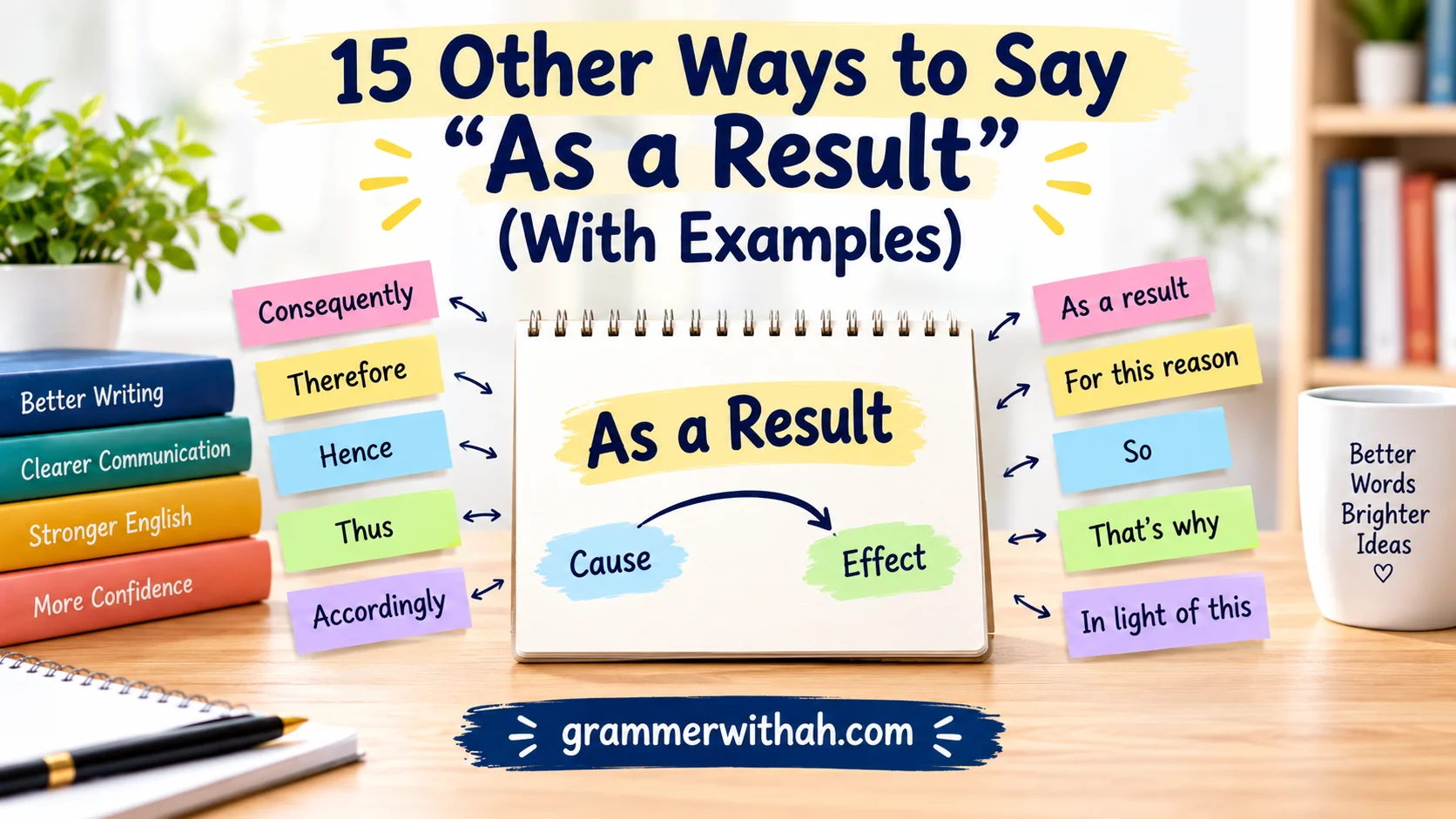
Other Ways to Say “As a Result” can make writing and speaking feel less repetitive, more clear, fresh, and natural. When the same phrase appears often, your sentences may sound predictable, dull, or uninspired. Choosing useful alternatives can make your words more interesting and help your audience stay engaged. In everyday communication, it is common to conclude thoughts or explain outcomes by showing a cause and effect relationship.
A wider vocabulary and useful synonyms can enriches how you express causality, result, and consequences. Whether you are writing an essay, email, report, or everyday message, repeating the same transition can make your writing feel predictable. Fortunately, a suitable transition can connect a cause with its effect more naturally.
The right expression often depends on the situation, context, and tone. In formal or academic writing, certain alternatives may sound more polished, while conversations and casual writing usually benefit from simpler expressions. These simple and easy choices can make your speech and writing smooth, while helping you explain outcomes without unnecessary repetition. From my experience with everyday writing, changing a repeated transition at the right point can make an article easier to read and help readers discover the intended connection between ideas.
What Does “As a Result” Mean?
“As a result” means because of something that happened earlier, another thing happened afterward. It connects a cause with its effect and helps readers or listeners understand the relationship between two events, actions, or situations.
For example, in the sentence, “The roads were covered in ice. As a result, school was canceled,” the icy roads are the cause, while the school closure is the result. The expression is commonly used when the writer or speaker wants to make a cause-and-effect relationship clear.
“As a result” is generally neutral in tone. It can be used in everyday speech, professional communication, academic writing, reports, explanations, and formal documents. It is especially useful when you want to show that the second situation happened because of the first situation, rather than simply happening afterward.
Common Situations Where “As a Result” Is Used
“As a result” appears in many kinds of communication because cause-and-effect relationships are common in everyday life. You might use it when explaining why a project was delayed, describing the effect of a decision, discussing an event, or explaining a change in circumstances.
In workplace communication, it can connect an action with its outcome: “The supplier changed the delivery date. As a result, we adjusted the schedule.” In school and academic writing, it can help explain the consequences of research findings, historical events, or scientific processes.
You can also use it in everyday conversation and personal communication. For example, someone might say, “I forgot to charge my phone. As a result, I couldn’t call you.” In casual speech, however, expressions such as “so” or “that’s why” may sound more relaxed and natural.
On social media or in a text message, “as a result” may sometimes feel more formal than necessary. The best alternative depends on whether you want to sound casual, direct, professional, academic, or conversational.
Is It Professional or Polite to Say “As a Result”?
Yes. “As a result” is professional, neutral, and grammatically appropriate in many formal situations. It works particularly well in reports, essays, business emails, presentations, research writing, and other contexts where you need to explain consequences clearly.
The expression is not rude or impolite. It simply has a somewhat structured and objective quality. It focuses on the relationship between a cause and its outcome rather than adding strong emotion.
That said, “as a result” may sound slightly formal in a relaxed conversation. If you’re talking to a friend, saying “so” or “that’s why” may feel more natural. In a formal report, however, those casual alternatives may not always provide the same polished tone.
Advantages and Disadvantages of Saying “As a Result”
Advantages
The biggest advantage of “as a result” is clarity. It immediately signals that the information that follows is an effect or consequence of something previously mentioned.
It is also versatile. You can use it in professional writing, academic work, presentations, emails, explanations, and ordinary conversation. Because it has a neutral tone, it rarely sounds overly emotional or strongly opinionated.
Another benefit is that it helps organize ideas. When several events or facts are being discussed, “as a result” makes the cause-and-effect relationship easier to follow.
Disadvantages
The main limitation is that repeated use can make writing feel predictable or repetitive. If every consequence is introduced with “as a result,” varying the wording can make the writing more engaging.
It can also sound somewhat formal in casual conversation. In a text to a close friend, “so” may be shorter and more natural.
Finally, not every alternative has exactly the same grammatical structure or strength. Some expressions, such as “therefore” or “consequently,” can sound more formal, while “that’s why” is more conversational. Choosing the wrong substitute can change the tone even when the basic cause-and-effect idea remains similar.
Synonyms for “As a Result”
- Therefore
- Consequently
- Thus
- Hence
- Accordingly
- For this reason
- Because of this
- As a consequence
- Due to this
- That’s why
- So
- As a consequence of this
- On account of this
- Which means that
- For that reason
1. Therefore
Meaning
“Therefore” shows that something is true, happens, or follows logically because of information stated earlier. It is one of the most useful formal alternatives to “as a result.”
Definition
Therefore means for that reason or because of what was just stated.
Detailed Explanation
“Therefore” is particularly useful when the connection between a cause and an outcome is logical or clearly reasoned. It is common in formal writing, academic work, business documents, and carefully structured explanations.
Compared with “as a result,” “therefore” can sound slightly more formal and concise. It is often used when the second statement represents a conclusion that follows from the first.
It can appear at the beginning of a sentence, after a semicolon, or within a sentence with appropriate punctuation.
Scenario Examples
Scenario: A manager explains why a meeting needs to be moved.
Example: “Several team members are traveling this week; therefore, we have moved the meeting to Monday.”
Scenario: A student explains a logical conclusion in an essay.
Example: “The evidence does not support the original claim. Therefore, the hypothesis needs to be reconsidered.”
Best Use
Use “therefore” in formal writing, academic essays, reports, presentations, and professional communication. It also works in everyday English when you want to emphasize a logical conclusion.
Tone
Tone: Formal, logical, professional
It sounds polished because it emphasizes a clear connection between information and its consequence.
2. Consequently
Meaning
“Consequently” means that something happened because of an earlier event or situation. It directly introduces a consequence.
Definition
Consequently means as a consequence or as a result of something previously mentioned.
Detailed Explanation
“Consequently” is very close in meaning to “as a result.” The main difference is tone: “consequently” often sounds more formal and deliberate.
It is especially useful when discussing an outcome that follows from a particular event, decision, problem, or condition. It can sometimes emphasize that the result was significant or unavoidable, although the word itself does not necessarily imply that the result was negative.
Because it is relatively formal, it may feel less natural in casual conversation.
Scenario Examples
Scenario: A company experiences a technical problem.
Example: “The payment system experienced an outage. Consequently, several orders were processed late.”
Scenario: A city receives unusually heavy rainfall.
Example: “The river rose rapidly. Consequently, several roads were temporarily closed.”
Best Use
Use “consequently” in reports, academic writing, business communication, formal explanations, and professional presentations.
Tone
Tone: Formal, objective, serious
It gives the cause-and-effect relationship a polished and structured feel.
3. Thus
Meaning
“Thus” shows that a particular conclusion, result, or consequence follows from what came before.
Definition
Thus means in this way, therefore, or as a result of the situation just described.
Detailed Explanation
“Thus” is a compact alternative to “as a result.” It is common in academic, technical, legal, and formal writing, where concise language is often useful.
Depending on the sentence, “thus” can mean either “therefore” or “in this way.” That means you should consider the context carefully rather than replacing “as a result” with “thus” automatically.
It tends to make writing sound more formal and concise, so it may feel unnatural in relaxed conversation.
Scenario Examples
Scenario: A researcher explains the outcome of a study.
Example: “The sample size was increased, thus improving the reliability of the findings.”
Scenario: A business explains a change in its process.
Example: “The company simplified the application process, thus reducing the time required for approval.”
Best Use
“Thus” works particularly well in academic writing, technical explanations, formal reports, research papers, and professional documents.
Tone
Tone: Formal, concise, academic
Its short structure gives the sentence an efficient and polished quality.
4. Hence
Meaning
“Hence” indicates that a conclusion or consequence follows from something previously stated.
Definition
Hence means for this reason, therefore, or as a consequence.
Detailed Explanation
“Hence” is a concise and relatively formal expression. It can replace “as a result” when the second idea follows logically from the first.
It is especially common in formal, academic, technical, and traditional styles of writing. In everyday American conversation, however, it may sound somewhat formal or old-fashioned compared with “so” or “that’s why.”
The word can also be used in expressions such as “hence the delay,” where it introduces the reason for a situation in a compact way.
Scenario Examples
Scenario: A report explains why a project took longer.
Example: “Several components arrived late, hence the delay in completing the installation.”
Scenario: Someone explains why an appointment was rescheduled.
Example: “The office was closed for maintenance, hence the change in schedule.”
Best Use
Use “hence” in formal writing, academic contexts, technical documents, and concise professional explanations.
Tone
Tone: Formal, concise, somewhat traditional
It can sound elegant in writing but less conversational than everyday alternatives.
5. Accordingly
Meaning
“Accordingly” shows that an action, decision, or response has been made because of a particular situation or information.
Definition
Accordingly means in a way that is appropriate to the circumstances or because of what has just been stated.
Detailed Explanation
“Accordingly” is related to “as a result,” but it is not interchangeable in every sentence. It is especially useful when the consequence is an action, adjustment, decision, or response.
For example, if new information changes a plan, “accordingly” can explain that the plan was changed in response. It therefore often has a more practical or decision-oriented meaning than “as a result.”
This makes it particularly useful in workplace and formal communication.
Scenario Examples
Scenario: A team changes a deadline after receiving new information.
Example: “The client requested additional revisions, so we adjusted the schedule accordingly.”
Scenario: A school changes a policy after reviewing attendance patterns.
Example: “Attendance has improved significantly, and the administration has revised the policy accordingly.”
Best Use
Use “accordingly” in professional emails, reports, business communication, formal notices, and situations involving decisions or adjustments.
Tone
Tone: Professional, formal, practical
It emphasizes an appropriate response to a particular situation.
6. For This Reason
Meaning
“For this reason” directly explains that the next statement follows because of something already mentioned.
Definition
For this reason means because of the situation, fact, or circumstance just described.
Detailed Explanation
This expression is very close to “as a result,” but it puts stronger attention on the reason behind the next statement. It is clear and easy to understand, making it useful for both learners and fluent speakers.
Unlike some formal alternatives, “for this reason” does not sound overly technical or academic. It can fit naturally into explanations, essays, workplace communication, and thoughtful personal messages.
It is a good choice when you want the cause-and-effect connection to be especially obvious.
Scenario Examples
Scenario: A teacher explains why students should arrive early.
Example: “The first activity begins immediately at 8:00. For this reason, students should arrive a few minutes early.”
Scenario: Someone explains a personal decision.
Example: “I wanted to spend more time with my family. For this reason, I decided to reduce my travel schedule.”
Best Use
Use it in explanations, essays, professional writing, personal communication, and everyday conversation.
Tone
Tone: Clear, neutral, thoughtful
It sounds natural without being too casual or overly formal.
7. Because of This
Meaning
“Because of this” tells the reader or listener that the next event happened because of the situation just mentioned.
Definition
Because of this means as a direct consequence of what was just described.
Detailed Explanation
“Because of this” is a straightforward and accessible alternative to “as a result.” It emphasizes the cause more directly than some formal transition words.
It works especially well when the preceding sentence describes a specific event, problem, action, or condition. The expression is common in everyday speech as well as informal and semi-formal writing.
Because it uses ordinary vocabulary, it is often a good choice when you want your writing to be easy for a broad audience to understand.
Scenario Examples
Scenario: Someone explains why they missed an appointment.
Example: “My train was delayed for nearly an hour. Because of this, I arrived late.”
Scenario: A store experiences a supply problem.
Example: “Our main supplier ran out of stock. Because of this, some products are temporarily unavailable.”
Best Use
Use it in everyday conversation, emails, explanations, customer communication, and accessible general writing.
Tone
Tone: Natural, direct, neutral
It sounds less formal than “consequently” or “therefore” while keeping the cause-and-effect relationship clear.
8. As a Consequence
Meaning
“As a consequence” introduces an outcome that follows from an earlier event or situation.
Definition
As a consequence means as an effect or result of something that happened earlier.
Detailed Explanation
“As a consequence” is one of the closest alternatives to “as a result.” The two expressions can often be used in similar situations without changing the basic meaning.
However, “consequence” can sometimes draw more attention to the effect itself, particularly when the outcome is important or significant. The expression can be neutral, but in some contexts “consequence” may sound slightly more serious than “result.”
It is suitable for formal and semi-formal writing and can also be used in careful everyday speech.
Scenario Examples
Scenario: A business changes its operating hours.
Example: “Customer demand has decreased during the evening. As a consequence, the store now closes earlier.”
Scenario: A student did not submit an assignment on time.
Example: “The assignment was submitted after the deadline. As a consequence, the student received a late penalty.”
Best Use
Use “as a consequence” in formal writing, reports, academic discussions, professional communication, and serious explanations.
Tone
Tone: Formal, serious, objective
It can give particular emphasis to the outcome of an action or event.
9. Due to This
Meaning
“Due to this” means that something happened because of the situation that was just mentioned.
Definition
Due to this means as a result of this particular circumstance or event.
Detailed Explanation
“Due to this” can express a clear cause-and-effect relationship, but its grammatical use differs somewhat from “as a result.” It is usually followed by a noun phrase or appears within a sentence rather than functioning as a simple sentence connector.
For example, “Due to this change, the schedule was updated” is natural. “Due to this, the schedule was updated” can also occur, but in many contexts “because of this” or “as a result” may sound smoother.
The expression is useful when the writer wants to focus directly on the cause.
Scenario Examples
Scenario: A company changes its office location.
Example: “Due to this change, employees now have a longer commute.”
Scenario: A website receives unusually high traffic.
Example: “Due to this increase in traffic, the server temporarily slowed down.”
Best Use
Use “due to this” in professional writing, notices, reports, explanations, and sentences where you want to identify the cause directly.
Tone
Tone: Neutral, professional, direct
It sounds practical and focuses attention on the reason something happened.
10. That’s Why
Meaning
“That’s why” explains the reason an event happened or why someone made a particular decision.
Definition
That’s why means that is the reason for the situation or action just mentioned.
Detailed Explanation
“That’s why” is one of the most natural alternatives to “as a result” in everyday spoken English. It feels conversational and often sounds warmer and more personal.
Unlike “therefore,” which often emphasizes logic, “that’s why” emphasizes the reason behind an outcome. It is especially useful when explaining personal choices, feelings, decisions, or ordinary events.
It is generally less suitable for highly formal academic or legal writing, where a more formal connector may be preferable.
Scenario Examples
Scenario: A friend explains why they stayed home.
Example: “I wasn’t feeling well this morning. That’s why I stayed home.”
Scenario: Someone explains why they chose a different route.
Example: “Traffic was completely backed up on the highway. That’s why I took the side streets.”
Best Use
Use “that’s why” in conversation, texting, personal messages, friendly emails, and informal explanations.
Tone
Tone: Casual, friendly, conversational
It sounds like something people naturally say when explaining a reason to someone they know.
11. So
Meaning
“So” can connect a cause with its result in a simple and conversational way.
Definition
So means because of that or as a consequence of what happened when it is used to connect two ideas.
Detailed Explanation
“So” is probably the most common everyday alternative to “as a result.” It is short, flexible, and natural in speech.
For example, “It was raining, so we stayed inside” communicates essentially the same cause-and-effect relationship as “It was raining. As a result, we stayed inside.” The difference is mainly one of style and structure.
“So” is excellent for casual communication, but repeated use in formal writing can make the prose feel less polished. In academic or professional writing, “therefore,” “consequently,” or “as a result” may sometimes be more appropriate.
Scenario Examples
Scenario: A friend explains why plans changed.
Example: “The restaurant was full, so we went somewhere else.”
Scenario: A parent explains a decision to a child.
Example: “It’s getting late, so we should head home.”
Best Use
Use “so” in conversation, texting, social media, casual emails, personal messages, and everyday writing.
Tone
Tone: Casual, natural, direct
Its simplicity makes it one of the easiest choices for relaxed communication.
12. As a Consequence of This
Meaning
“As a consequence of this” clearly states that an outcome happened because of the situation just described.
Definition
As a consequence of this means because this particular event, action, or condition occurred.
Detailed Explanation
This expression is a more explicit version of “as a consequence.” It identifies the preceding situation as the cause and highlights what followed from it.
It can be useful when you want to make the relationship between two ideas especially clear. However, because it is longer, it may sound unnecessarily wordy in simple sentences where “as a result” or “therefore” would be enough.
It is most effective when the preceding situation is important and deserves clear emphasis.
Scenario Examples
Scenario: A company introduces a new training requirement.
Example: “Employees now need additional certification. As a consequence of this, the training schedule has been extended.”
Scenario: A neighborhood experiences repeated flooding.
Example: “Several roads were damaged during the storms. As a consequence of this, local travel has become more difficult.”
Best Use
Use it in formal explanations, detailed reports, essays, business documents, and situations where you want to make the cause especially explicit.
Tone
Tone: Formal, explanatory, deliberate
The longer structure gives the relationship between cause and effect extra emphasis.
13. On Account of This
Meaning
“On account of this” means that something happened because of the circumstance just mentioned.
Definition
On account of this means because of this situation or for this reason.
Detailed Explanation
“On account of this” is a legitimate expression, but it is less common in everyday American English than “because of this,” “for this reason,” or “as a result.”
It can work in formal, literary, or somewhat traditional writing. Because it has a more old-fashioned flavor, it should be chosen intentionally rather than used simply because it resembles a dictionary synonym.
In modern professional communication, a simpler alternative will often sound more natural.
Scenario Examples
Scenario: A formal statement explains a cancellation.
Example: “The venue became unavailable. On account of this, the event had to be postponed.”
Scenario: A historical-style narrative explains a character’s decision.
Example: “The road was unsafe after the storm, and on account of this, the travelers changed their route.”
Best Use
Use it in formal prose, literary writing, historical-style writing, or situations where a traditional tone is appropriate.
Tone
Tone: Formal, traditional, somewhat literary
It sounds more old-fashioned than most modern alternatives.
14. Which Means That
Meaning
“Which means that” introduces an explanation of what an earlier fact or situation logically leads to.
Definition
Which means that means the information just given leads to this particular conclusion or implication.
Detailed Explanation
“Which means that” is not an exact replacement for “as a result” in every sentence. Instead, it works best when the second idea is an interpretation, implication, or practical meaning of the first idea.
It is particularly useful when explaining information to another person. It can make complicated facts feel easier to understand because it explicitly tells the reader what those facts mean.
The phrase is more conversational than “therefore” and often creates a helpful explanatory tone.
Scenario Examples
Scenario: A teacher explains a change in a school schedule.
Example: “The exam has been moved to Friday, which means that students have two extra days to prepare.”
Scenario: A manager explains a change in working arrangements.
Example: “The office will close at 4 p.m., which means that everyone needs to finish urgent tasks earlier.”
Best Use
Use it in explanations, teaching, presentations, conversations, emails, and accessible professional communication.
Tone
Tone: Conversational, explanatory, clear
It sounds helpful because it translates information into its practical implication.
15. For That Reason
Meaning
“For that reason” explains that the following statement is true or appropriate because of something previously mentioned.
Definition
For that reason means because of the particular fact or situation just discussed.
Detailed Explanation
“For that reason” is very close to “for this reason,” but “that” often points back to a specific fact or situation already established in the conversation or text.
It is a natural expression that works across formal and informal contexts. It can sound slightly more deliberate than “so” while remaining easier and less formal than “consequently.”
This makes it a useful middle-ground choice when you want clear cause-and-effect wording without making the sentence sound overly academic.
Scenario Examples
Scenario: Someone explains why they declined an invitation.
Example: “I already had another commitment. For that reason, I couldn’t attend the dinner.”
Scenario: A business explains why a product was removed.
Example: “The product no longer meets our current standards. For that reason, we have removed it from the catalog.”
Best Use
Use “for that reason” in professional emails, explanations, personal communication, essays, reports, and everyday conversation.
Tone
Tone: Neutral, clear, thoughtful
It provides a clear reason without sounding excessively formal or casual.
FAQs
What is another way to say “as a result”?
There are many natural alternatives to “as a result,” including “therefore,” “consequently,” “thus,” “for this reason,” “because of this,” and “that’s why.” The best choice depends on the situation. “Therefore” and “consequently” are more formal, while “so” and “that’s why” are more conversational.
What does “as a result” mean?
“As a result” means because of something that happened earlier, another event or situation happened afterward. It is used to show a clear cause-and-effect relationship between two ideas.
For example: “The weather became dangerous. As a result, the flight was canceled.”
Is “as a result” professional?
Yes. “As a result” is professional and neutral and works well in reports, emails, essays, presentations, and business communication. It is not limited to formal writing, although it can sound slightly more structured than casual alternatives such as “so.”
What is a more polite way to say “as a result”?
There is no single more polite replacement because “as a result” is already neutral and polite. Depending on the context, “for this reason” can sound thoughtful, while “accordingly” can sound professional when describing an action taken in response to a situation.
Which alternative works best in formal communication?
“Therefore,” “consequently,” “thus,” and “accordingly” can work particularly well in formal communication, but the best option depends on the sentence. “Therefore” is useful for logical conclusions, “consequently” highlights an outcome, and “accordingly” often works best when describing an action or decision made in response to new circumstances.
Conclusion
Choosing an alternative to “as a result” is not simply about finding a different phrase. The best wording depends on the meaning, tone, context, and relationship between the ideas you are connecting.
For formal writing, “therefore,” “consequently,” “thus,” and “hence” can provide a polished tone. In everyday communication, “so,” “that’s why,” and “because of this” often feel more natural. Expressions such as “for this reason” and “for that reason” offer a useful middle ground when you want to be clear without sounding overly formal.
Before choosing a synonym, consider what you want the reader or listener to understand. A small change in wording can make your message feel more natural, precise, professional, or conversational. The right alternative is the one that accurately expresses the relationship between the cause and its result.