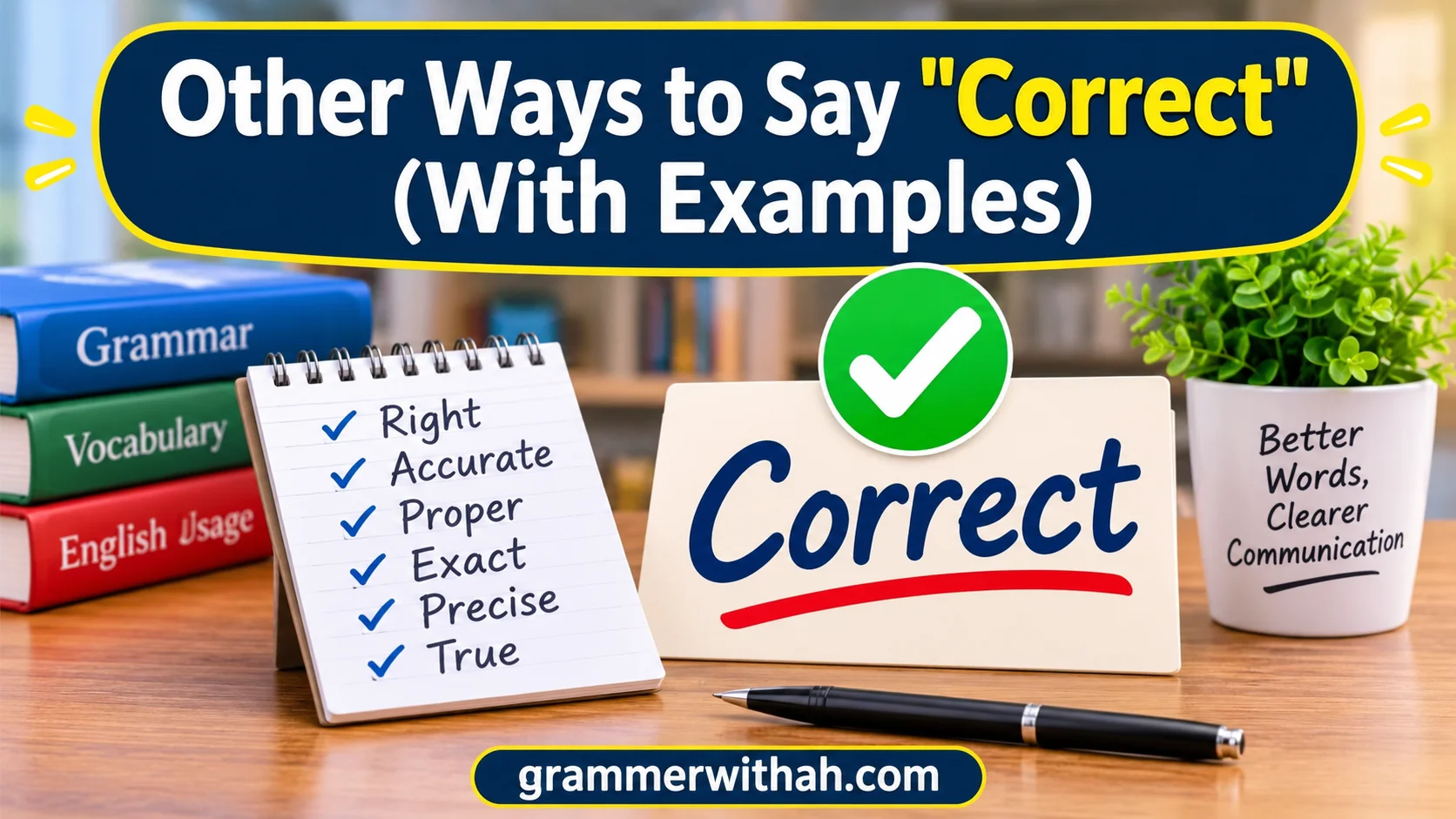
Explore Other Ways to Say “Correct” to choose clearer expressions for chats, schoolwork, emails, and professional conversations with confidence. The right words can make a big difference in how your message sounds, whether you’re talking with friends, coworkers, or English learners. Although correct is a useful word, using it too often can make your writing and everyday conversation feel repetitive.
Words such as accurate, precise, valid, and error-free offer natural expressions that help improve word variety and avoid repetition. In professional communication, workplace writing, and academic writing, choosing appropriate expressions also helps you explain facts, confirm exact answers, and show agreement or approval. Simple practices like proofreading, editing, and checking someone’s answer can make your messages more reliable, clear, and professional.
This guide shares 15 useful alternatives, their meanings, and practical examples, including formal language, informal language, and professional reaction phrases. These options can help improve your English vocabulary, speaking, writing skills, conversational skills, confidence, and fluency, so you can express yourself naturally in different situations.
What Does “Correct” Mean?
The word correct means free from mistakes, errors, or inaccuracies. It describes something that is right according to facts, rules, standards, or accepted information. For example, if a student gives the correct answer to a question, their response matches the expected answer. Similarly, a correct spelling, calculation, or statement contains no mistakes.
However, correct can have different meanings depending on the situation. It can describe information that is accurate and factual, such as a correct date or measurement. It can also refer to something that follows accepted rules or standards, such as correct grammar or proper behavior. As a verb, correct means to fix an error or make something right. Understanding these differences helps you choose an alternative that communicates your intended meaning.
Common Situations Where “Correct” Is Used
People use correct in everyday conversations, education, professional communication, and written messages. At school, teachers use it to confirm whether students have answered questions properly. Students may also ask, “Is this answer correct?” when checking their work.
In workplaces, the word commonly appears in emails, reports, documents, and discussions. Someone might confirm that a meeting time is correct or ask a colleague to check the details in a presentation. In texting and personal conversations, people use it to agree with someone or confirm information.
The word also appears in customer service, formal writing, and technical communication. For example, a customer may want to confirm whether their order details are correct. However, repeating the same word can make communication feel less natural. Alternatives such as accurate, precise, valid, or that’s right can express the intended meaning more clearly.
Is It Professional or Polite to Say “Correct”?
Yes, correct is generally a professional, polite, and widely accepted word. It works well in business emails, academic writing, workplace discussions, and everyday conversations. For example, saying “Your calculations are correct” sounds clear and respectful when confirming someone’s work.
However, the tone depends on how you use it. Saying “That’s incorrect” can sound quite direct, especially when discussing someone’s mistake. In a friendly conversation, “You’re right” or “That’s absolutely right” may feel warmer. In professional writing, accurate or valid may be more suitable when discussing information, research, or documents.
The best choice depends on your audience and purpose. If you want to confirm a fact, use a clear expression. If you want to correct someone without sounding harsh, choose more considerate wording.
Advantages and Disadvantages of Saying “Correct”
Advantages
The word correct is simple, clear, and easy to understand. Most English speakers recognize its meaning immediately, so it works in many situations. It is also suitable for formal and informal communication, making it a flexible vocabulary choice.
Another advantage is that it communicates certainty. When you say something is correct, you tell the listener that it agrees with the relevant facts, rules, or standards. It also works as both an adjective and a verb, which gives it several useful applications.
Disadvantages
Although correct is useful, repeating it too often can make your writing sound predictable. It may also lack the specific meaning needed in certain situations. For instance, precise describes exactness, while valid focuses on whether something meets the necessary requirements.
The word can also sound too direct when used to point out someone’s mistake. In personal or workplace communication, a softer expression may help maintain a respectful tone. Choosing a more specific alternative can make your message clearer and more thoughtful.
Synonyms for “Correct”
- Accurate
- Right
- Exact
- Precise
- Valid
- Proper
- Appropriate
- Factual
- True
- Legitimate
- Error-Free
- On Point
- Spot-On
- In Order
- Sound
1. Accurate
Meaning
Accurate means correct and free from errors. It is especially useful when discussing information, measurements, calculations, records, or descriptions that match the actual facts.
Definition
Accurate means providing information or results that are true, reliable, and close to the actual facts.
Detailed Explanation
Accurate is one of the strongest alternatives when you want to emphasize factual correctness. It focuses on whether information matches reality rather than simply following a rule. This expression sounds natural in professional, academic, and technical communication. Choose it when you want to highlight the reliability of information or the quality of someone’s work.
Scenario Examples
Scenario: A colleague shares a report with the latest sales figures.
Example: “The sales figures in your report are accurate.”
Scenario: A student checks the information in a research assignment.
Example: “Make sure your sources provide accurate information.”
Scenario: Someone asks whether a weather report gives reliable details.
Example: “The forecast was surprisingly accurate this morning.”
Best Use
Use accurate in professional emails, research papers, reports, scientific discussions, financial records, and everyday conversations about facts or information.
Tone
Tone: Professional, factual, confident.
It communicates reliability and suggests that the information has been checked carefully.
2. Right
Meaning
Right means correct, true, or in agreement with the facts. It is one of the most common and natural alternatives in everyday English.
Definition
Right means having the correct answer, opinion, choice, or understanding of something.
Detailed Explanation
Right is generally more conversational than correct. People frequently use it when agreeing with someone, confirming an answer, or discussing a decision. It can also refer to something morally or socially acceptable, depending on the context. Because it is simple and familiar, it works particularly well in casual conversations and friendly messages.
Scenario Examples
Scenario: Your friend correctly guesses the answer to a question.
Example: “You’re right! That’s exactly what happened.”
Scenario: A coworker confirms the meeting location.
Example: “Yes, that’s the right address.”
Scenario: Someone asks whether they made a good decision.
Example: “I think you made the right choice.”
Best Use
Use right in everyday conversations, text messages, friendly discussions, informal emails, and situations where you want to agree or confirm something naturally.
Tone
Tone: Casual, friendly, straightforward.
It sounds approachable and makes everyday communication feel natural.
3. Exact
Meaning
Exact describes something that matches a particular detail, number, measurement, or requirement without any difference. It is useful when correctness depends on getting specific details right.
Definition
Exact means completely matching a stated fact, amount, position, or requirement.
Detailed Explanation
Exact places more emphasis on precision than the general word correct. It is especially useful when even a small difference matters, such as in measurements, dates, calculations, or instructions. Unlike accurate, which can describe information that is reliable overall, exact suggests a precise match. Use it when you want to remove uncertainty about a particular detail.
Scenario Examples
Scenario: A customer asks for the precise delivery time.
Example: “The exact delivery time is 3:30 p.m.”
Scenario: A designer checks the dimensions of a product.
Example: “These are the exact measurements we need.”
Scenario: A friend asks whether you remember someone’s words.
Example: “I can’t remember his exact words, but I understand what he meant.”
Best Use
Use exact in technical instructions, measurements, calculations, schedules, business documents, and situations where specific details matter.
Tone
Tone: Precise, direct, factual.
It gives your message a clear sense of detail and leaves little room for confusion.
4. Precise
Meaning
Precise means expressed or measured with great care and attention to detail. It describes something that is specific, accurate, and clearly defined.
Definition
Precise means exact, carefully measured, or clearly stated without unnecessary uncertainty.
Detailed Explanation
Precise is particularly useful when discussing measurements, instructions, explanations, or professional work. It emphasizes attention to detail rather than simply confirming that something is correct. A precise answer gives the necessary information without being vague. Choose this expression when you want to highlight clarity, careful wording, or exactness.
Scenario Examples
Scenario: A teacher asks students to explain their answers clearly.
Example: “Please give a precise explanation of your reasoning.”
Scenario: An engineer checks the measurements of a new design.
Example: “We need precise measurements before production begins.”
Scenario: A manager asks for a clear project update.
Example: “Could you provide a more precise estimate of the completion date?”
Best Use
Use precise in academic writing, technical communication, scientific discussions, professional reports, instructions, and detailed explanations.
Tone
Tone: Professional, careful, detail-oriented.
It suggests that someone has paid close attention to the information being shared.
5. Valid
Meaning
Valid means acceptable, reasonable, or officially recognized according to particular rules or requirements. It can describe an answer, argument, document, reason, or claim that meets the necessary conditions.
Definition
Valid means having an acceptable basis or meeting established rules, conditions, or standards.
Detailed Explanation
Valid is not an exact replacement for correct in every situation. It focuses more on whether something is acceptable or supported under a particular set of rules. For example, a valid argument follows reasonable logic, while a valid ticket meets the conditions for use. It is especially helpful when discussing permissions, requirements, reasoning, and official documents.
Scenario Examples
Scenario: A student presents a reasonable argument during a class discussion.
Example: “That’s a valid point, and it deserves further discussion.”
Scenario: An employee checks whether a document can still be used.
Example: “Your identification card is valid until next year.”
Scenario: A customer questions a charge on their account.
Example: “We need to check whether your complaint is valid.”
Best Use
Use valid in legal discussions, academic arguments, customer service, official documents, business communication, and situations involving rules or requirements.
Tone
Tone: Formal, logical, professional.
It communicates that something meets an accepted standard or has a reasonable basis.
6. Proper
Meaning
Proper means suitable, acceptable, or done according to established rules and standards. It is useful when talking about correct behavior, grammar, procedures, or methods.
Definition
Proper means appropriate or in accordance with accepted rules, customs, or standards.
Detailed Explanation
Proper focuses on whether something follows the expected way of doing things. It can describe correct grammar, appropriate behavior, or an established procedure. Unlike accurate, which emphasizes factual reliability, proper often emphasizes standards and accepted practices. Use it when discussing how something should be done rather than whether a fact is true.
Scenario Examples
Scenario: A student asks how to write a formal letter.
Example: “Use the proper format for your assignment.”
Scenario: A new employee learns how to handle customer complaints.
Example: “Please follow the proper procedure when processing refunds.”
Scenario: A parent teaches a child how to behave at a formal event.
Example: “It’s important to use proper manners at the dinner table.”
Best Use
Use proper in educational settings, workplace instructions, formal writing, discussions about etiquette, and explanations of accepted procedures.
Tone
Tone: Respectful, instructional, moderately formal.
It suggests that something follows an expected standard or accepted method.
7. Appropriate
Meaning
Appropriate means suitable or right for a particular situation, audience, or purpose. It describes choices, behavior, language, and actions that fit the circumstances.
Definition
Appropriate means suitable for a specific situation or consistent with its expectations.
Detailed Explanation
Appropriate is a useful alternative when correctness depends on the situation rather than factual accuracy. For example, a phrase can be grammatically correct but inappropriate for a formal business email. This word focuses on context, respect, and suitability. Choose it when you want to explain that something fits the audience or circumstances.
Scenario Examples
Scenario: An employee prepares a presentation for company executives.
Example: “Please choose appropriate language for the presentation.”
Scenario: A friend asks what to wear to a wedding.
Example: “A formal outfit would be appropriate for the occasion.”
Scenario: A teacher reviews a student’s classroom behavior.
Example: “Your response was appropriate for the discussion.”
Best Use
Use appropriate in workplace communication, formal emails, educational settings, social situations, customer service, and discussions about professional behavior.
Tone
Tone: Polite, respectful, considerate.
It shows awareness of the audience and the expectations of a particular situation.
8. Factual
Meaning
Factual means based on real information, evidence, or events rather than personal opinions or imagination. It is useful when discussing statements, reports, explanations, and descriptions.
Definition
Factual means relating to information that is based on facts or actual events.
Detailed Explanation
Factual is closely related to correct, but the two words have different uses. Correct describes something that is free from mistakes, while factual emphasizes that information is based on reality. A statement can be factual without being a complete explanation of a subject. This expression works well when discussing research, journalism, reports, and evidence-based communication.
Scenario Examples
Scenario: A journalist prepares a news report.
Example: “The article contains factual information about the incident.”
Scenario: A student writes an essay about a historical event.
Example: “Include factual details rather than unsupported assumptions.”
Scenario: A manager reviews a company presentation.
Example: “Let’s make sure every factual statement is supported by reliable information.”
Best Use
Use factual in journalism, academic writing, research, business reports, educational content, and discussions where evidence matters.
Tone
Tone: Objective, informative, professional.
It emphasizes truth and evidence rather than personal feelings or assumptions.
9. True
Meaning
True means in agreement with reality, facts, or what actually happened. It is commonly used to confirm statements, beliefs, information, and experiences.
Definition
True means genuine, real, or consistent with the facts.
Detailed Explanation
True is a simple and familiar alternative when you want to confirm that something is not false. It is especially natural in everyday conversations and discussions about facts or personal experiences. However, it does not always mean the same thing as correct. For example, a statement may be true but incomplete, while a correct answer may also need to follow a specific instruction or standard.
Scenario Examples
Scenario: A friend shares a story about a recent event.
Example: “Yes, that story is true. I heard about it yesterday.”
Scenario: Someone asks whether a piece of information is genuine.
Example: “It’s true that the store closes early on Sundays.”
Scenario: A colleague confirms an important detail during a meeting.
Example: “That’s true, and we should include it in the final report.”
Best Use
Use true in casual conversations, personal messages, factual discussions, storytelling, and situations where you want to confirm whether something is real.
Tone
Tone: Natural, conversational, sincere.
It is easy to understand and works well when confirming information without sounding overly formal.
10. Legitimate
Meaning
Legitimate means lawful, genuine, or acceptable according to established rules and standards. It can describe claims, businesses, documents, concerns, and reasons that have a proper basis.
Definition
Legitimate means recognized as genuine, lawful, or acceptable under relevant rules or conditions.
Detailed Explanation
Legitimate is more specific than the general word correct. It focuses on whether something has a proper or recognized basis rather than simply being free from errors. For example, a legitimate business operates lawfully, while a legitimate concern has a reasonable foundation. It is a useful choice when discussing authenticity, authority, or acceptability.
Scenario Examples
Scenario: A customer receives an unexpected payment request.
Example: “Please check whether the payment request is legitimate before responding.”
Scenario: An employee raises a concern about workplace safety.
Example: “You have a legitimate reason to request a review.”
Scenario: Someone checks whether an online company is genuine.
Example: “Make sure you’re dealing with a legitimate business.”
Best Use
Use legitimate in legal discussions, business communication, customer service, online safety, official matters, and conversations about genuine claims or concerns.
Tone
Tone: Formal, serious, authoritative.
It suggests that something has a recognized basis and deserves to be accepted or considered.
11. Error-Free
Meaning
Error-free describes something that contains no mistakes or inaccuracies. It is particularly useful when discussing written work, documents, calculations, and completed tasks.
Definition
Error-free means completely free from mistakes, faults, or incorrect details.
Detailed Explanation
Error-free is a practical alternative when you want to emphasize that work has been completed without mistakes. It is more specific than correct because it focuses on the absence of errors. For example, an error-free document has no spelling or grammatical mistakes, while a correct document may simply contain accurate information. Use this expression when quality control and careful checking are important.
Scenario Examples
Scenario: An editor reviews an article before publication.
Example: “Please submit an error-free version of the final article.”
Scenario: A student checks a mathematics assignment.
Example: “I reviewed every calculation to make sure my work was error-free.”
Scenario: A company prepares customer invoices.
Example: “Our team checks each invoice to keep the records error-free.”
Best Use
Use error-free in proofreading, editing, academic work, financial records, business documents, and quality-control discussions.
Tone
Tone: Professional, precise, quality-focused.
It highlights attention to detail and the importance of avoiding mistakes.
12. On Point
Meaning
On point means relevant, appropriate, or exactly suited to the subject being discussed. It is often used to describe comments, observations, arguments, and ideas that address the matter effectively.
Definition
On point means directly relevant, well-suited, or expressed in a way that fits the situation.
Detailed Explanation
On point is an informal expression that works well when someone makes a useful observation or gives a relevant answer. It does not always mean factually correct, so it should not replace correct in every situation. Instead, it emphasizes relevance and suitability. Choose it when you want to praise someone’s contribution or explain that an idea addresses the main issue.
Scenario Examples
Scenario: A colleague makes a helpful observation during a meeting.
Example: “Your comments about the budget were right on point.”
Scenario: A friend gives useful advice about a personal problem.
Example: “That advice was really on point.”
Scenario: A student answers a discussion question with a relevant explanation.
Example: “Your response was on point and addressed the main question.”
Best Use
Use on point in casual conversations, team discussions, presentations, friendly feedback, and informal workplace communication.
Tone
Tone: Casual, positive, confident.
It sounds encouraging and shows that someone’s idea or comment fits the discussion well.
13. Spot-On
Meaning
Spot-on means exactly right or perfectly accurate. It is commonly used when someone’s answer, judgment, observation, or prediction matches the situation very closely.
Definition
Spot-on means completely accurate, appropriate, or exactly as expected.
Detailed Explanation
Spot-on is a friendly, expressive alternative that often communicates strong agreement. It sounds more enthusiastic and conversational than correct. People use it to praise an accurate observation or confirm that someone has understood something perfectly. It is less suitable for highly formal documents, but it works naturally in everyday speech and informal professional conversations.
Scenario Examples
Scenario: A friend correctly understands why someone is upset.
Example: “Your explanation of the situation was spot-on.”
Scenario: A designer presents a concept that matches the client’s request.
Example: “The new design is spot-on. It matches our vision perfectly.”
Scenario: A colleague predicts the outcome of a project.
Example: “Your prediction about the launch date was spot-on.”
Best Use
Use spot-on in friendly conversations, informal emails, team discussions, creative feedback, and situations where you want to express strong approval.
Tone
Tone: Enthusiastic, friendly, confident.
It communicates strong agreement and often makes positive feedback feel more natural.
14. In Order
Meaning
In order means properly arranged, organized, or meeting the required conditions. Depending on the context, it can describe documents, procedures, records, or arrangements that are in acceptable condition.
Definition
In order means arranged correctly or meeting the necessary requirements.
Detailed Explanation
In order is a context-specific alternative rather than a direct synonym for correct. It focuses on whether something is properly organized or meets the expected requirements. For example, paperwork that is in order has the necessary details and documents, while a correct answer simply provides the right response. Use this expression when discussing organization, preparation, and compliance with requirements.
Scenario Examples
Scenario: An office assistant checks paperwork before submission.
Example: “All the required documents are in order.”
Scenario: A manager reviews a project before approval.
Example: “Everything appears to be in order for the next stage.”
Scenario: A customer asks whether their account details are complete.
Example: “Your account information is in order, and no changes are needed.”
Best Use
Use in order in administrative communication, official paperwork, business emails, financial matters, and discussions about preparation or organization.
Tone
Tone: Professional, organized, reassuring.
It suggests that everything has been arranged properly and meets the necessary requirements.
15. Sound
Meaning
Sound means reasonable, reliable, or based on good judgment. It can describe an argument, decision, explanation, plan, or piece of reasoning that is logically acceptable.
Definition
Sound means sensible, well-founded, and supported by reasonable judgment or evidence.
Detailed Explanation
Sound is a useful alternative when correctness involves logic or good reasoning rather than a simple factual answer. A sound decision is based on careful thought, while a sound argument has a reasonable foundation. It often sounds more professional and thoughtful than correct. However, it does not necessarily mean that every detail is factually accurate, so consider the context before using it.
Scenario Examples
Scenario: A manager reviews a business proposal.
Example: “Your proposal is based on sound financial reasoning.”
Scenario: A student presents an argument during a debate.
Example: “She made a sound argument supported by reliable evidence.”
Scenario: A friend asks whether their decision makes sense.
Example: “I think that’s a sound decision given the circumstances.”
Best Use
Use sound in professional communication, academic discussions, business planning, decision-making, and situations involving logic or judgment.
Tone
Tone: Thoughtful, professional, confident.
It communicates that an idea or decision has a reasonable foundation and deserves consideration.
FAQs
What are some other ways to say correct?
Some common alternatives include accurate, right, precise, valid, proper, exact, reliable, and error-free. The best choice depends on your sentence and situation.
What is a more professional word for correct?
Words like accurate, valid, precise, and factually correct sound professional. You can use them in business emails, reports, academic writing, and workplace communication.
How can I say correct without repeating the same word?
Try using different expressions that match your meaning. For example, use “accurate” for information, “valid” for an argument, and “precise” for detailed answers.
Is accurate the same as correct?
They have similar meanings, but they aren’t always interchangeable. Accurate usually means something is free from errors or close to the truth, while correct can also mean proper or acceptable.
How do I politely tell someone their answer is correct?
You can say, “That’s absolutely right,” “You’ve got it,” “Your answer is accurate,” or “That’s exactly correct.” These expressions sound friendly and respectful.
Conclusion
Learning other ways to say correct helps you communicate with greater clarity and confidence. Instead of using the same word in every sentence, you can choose alternatives such as accurate, precise, valid, proper, or exact. Each word has a slightly different meaning, so consider your audience and the context before using it. Whether you’re writing an email, checking an answer, speaking with friends, or preparing an academic report, the right expression can make your message clearer and more natural. Practice these alternatives in everyday conversations and writing to build a stronger vocabulary and express your ideas more effectively.