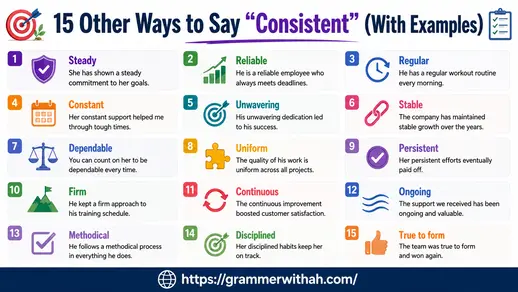
Learning other ways to say consistent helps you describe people, behavior, habits, and performance without repeating the same word. Someone who can show up on time every single day, do great work, and maintain effort, commitment, dedication, and persistence shows reliability, dependability, and responsibility. A punctual, hardworking, and trustworthy person often delivers good results and maintains steady performance and consistent quality. Other useful words include steady, reliable, constant, regular, stable, uniform, persistent, and predictable. These words describe stability, regularity, and little variation over time.
However, synonyms for consistent are not always interchangeable. Some alternative words, near-synonyms, and related words fit formal, professional, neutral, casual, or academic writing better than others. For example, dependable describes someone you can trust, while coherent describes ideas that make sense and agree with available facts, evidence, and data. Choosing the right word depends on context, sentence meaning, grammar, sentence structure, tone, and emphasis. A random synonym or wrong alternative may cause a meaning change, so consider the particular contexts and clear meanings before replacing a word.
Use these alternative expressions in everyday English, everyday conversation, business, relationships, and communication with friends and coworkers. For example, write, “She is a reliable employee,” or “His steady effort produces reliable results.” These natural examples, email examples, and sentence transformations can improve your vocabulary, writing, and natural language skills. This practical guide offers a simple explanation, grammar tips, and useful usage tips to make word choice easier. Practice learning different expressions instead of searching for a replacement just to mix things up.
What Does “Consistent” Mean?
Consistent means doing something in the same reliable way over time without frequent changes or interruptions. It describes a person, action, result, or quality that remains steady and dependable. For example, a consistent employee completes tasks regularly, while a consistent student studies and makes an effort throughout the school year.
The word can also describe something that agrees with established facts, beliefs, standards, or expectations. For instance, consistent information does not contradict itself, and consistent performance shows a steady level of quality. Depending on the context, the word can communicate reliability, stability, regularity, dedication, and dependability.
Common Situations Where “Consistent” Is Used
People use the word consistent in everyday conversations, professional communication, academic writing, and personal relationships. It is especially useful when discussing habits, progress, performance, and behavior.
- Everyday conversations: Describing someone who regularly keeps promises or follows a routine.
- Workplace communication: Recognizing employees who maintain reliable performance and meet expectations.
- School and education: Discussing students who study regularly and maintain steady academic progress.
- Relationships: Describing someone whose actions and words remain dependable over time.
- Fitness and personal development: Talking about regular exercise, healthy habits, and long-term improvement.
- Customer communication: Explaining the steady quality of a service or product.
- Formal writing: Describing results, patterns, evidence, or information that remain in agreement.
An alternative may be more useful when you want to highlight a particular quality. For example, reliable emphasizes dependability, while steady focuses on a lack of major changes.
Is It Professional or Polite to Say “Consistent”?
Yes. Consistent is a professional, polite, and widely accepted word in both spoken and written English. It works particularly well in performance reviews, business reports, academic discussions, and workplace emails. For example, saying that an employee delivers consistent results is a positive way to recognize their work.
The word also fits casual conversations and personal messages. However, another expression may communicate your intended meaning more clearly. If you’re praising someone’s character, dependable or reliable may sound warmer. If you’re discussing regular effort, disciplined or dedicated may be more suitable. The best choice depends on what you want to emphasize.
Advantages and Disadvantages of Saying “Consistent”
Advantages
The word consistent is simple, clear, and suitable for many situations. It describes regular behavior, dependable performance, and steady results without requiring complicated explanations. It also works in both professional and casual communication, making it a flexible vocabulary choice.
Another advantage is that it can describe people, habits, services, information, and outcomes. This makes it especially useful when you want to explain that something maintains the same standard over time.
Disadvantages
Although the word is useful, repeating it too often can make your writing feel predictable. It may also be too broad when you want to recognize a specific quality. For example, calling someone consistent does not always explain whether they are hardworking, dependable, disciplined, or simply regular in their actions.
In emotional or professional communication, a more specific expression can create a stronger impression. Choosing words carefully helps readers understand exactly what you appreciate or want to describe.
Synonyms for “Consistent”
- Reliable
- Steady
- Dependable
- Regular
- Constant
- Unwavering
- Persistent
- Dedicated
- Disciplined
- Predictable
- Uniform
- Stable
- Committed
- Unchanging
- Tenacious
1. Reliable
Meaning
Reliable describes someone or something you can trust to perform well or do what is expected. It is closely related to consistent because both words suggest dependability over time.
Definition
Reliable means trustworthy and able to be depended on.
Detailed Explanation
This expression focuses more on trust and dependability than regular behavior. A reliable person follows through on responsibilities and can be counted on when needed. Unlike consistent, which can describe repeated actions or patterns, reliable highlights whether someone or something meets expectations. It is especially useful when discussing professional performance and personal relationships.
Scenario Examples
Scenario: You’re recommending a coworker for an important project.
Example: “She’s a reliable team member who always delivers quality work.”
Scenario: Your friend regularly helps you when you need support.
Example: “You’re one of the most reliable people I know.”
Scenario: A customer asks about a service provider.
Example: “We work with a reliable company that meets its deadlines.”
Best Use
Use reliable when describing trustworthy people, services, employees, products, and business partners. It is suitable for professional emails, recommendations, personal conversations, and customer reviews.
Tone
Tone: Professional, reassuring, and trustworthy.
It communicates confidence in someone’s ability to meet expectations.
2. Steady
Meaning
Steady describes something that continues at a similar level without sudden changes. It relates to consistency by emphasizing balance, regular progress, and stability.
Definition
Steady means remaining firm, regular, or consistent over time.
Detailed Explanation
Steady is a natural alternative when discussing progress, effort, or performance. It suggests that something continues without major ups and downs. Compared with consistent, it often creates a softer impression of gradual progress rather than strict regularity. You can also use it to describe someone’s emotions, pace, or behavior.
Scenario Examples
Scenario: Your friend is making progress toward a fitness goal.
Example: “You’ve made steady progress with your workouts.”
Scenario: A manager discusses business growth.
Example: “Our company has maintained steady growth this year.”
Scenario: Someone remains calm during a difficult situation.
Example: “She kept a steady attitude despite the pressure.”
Best Use
Use steady when describing gradual improvement, stable performance, continuous progress, or balanced behavior. It works well in everyday conversations, workplace reports, and personal development discussions.
Tone
Tone: Calm, positive, and encouraging.
The word suggests dependable progress without making the situation sound overly strict.
3. Dependable
Meaning
Dependable refers to someone or something that can be trusted to provide support or fulfill responsibilities. It is similar to consistent when the focus is on being available and trustworthy.
Definition
Dependable means worthy of trust and capable of being relied upon.
Detailed Explanation
Dependable places greater emphasis on responsibility and trust. It describes someone who does what they promise and takes their duties seriously. While consistent focuses on maintaining a pattern, dependable highlights the confidence others have in that person. It is a particularly useful word when recognizing someone’s character.
Scenario Examples
Scenario: You’re thanking a colleague for helping with important tasks.
Example: “I appreciate having such a dependable person on the team.”
Scenario: A parent describes their child’s behavior.
Example: “He’s become more dependable with his daily responsibilities.”
Scenario: You’re recommending a service provider.
Example: “They’re a dependable team that takes customer needs seriously.”
Best Use
Choose dependable when discussing responsible employees, supportive friends, trustworthy partners, and reliable services. It fits professional recommendations and personal conversations.
Tone
Tone: Respectful, appreciative, and reassuring.
It highlights the trust someone earns through their actions.
4. Regular
Meaning
Regular describes something that happens repeatedly according to a pattern, schedule, or routine. It relates to consistency by emphasizing frequency and repetition.
Definition
Regular means happening repeatedly at expected or planned intervals.
Detailed Explanation
Regular is particularly useful when the main idea is how often something happens. For example, regular exercise means exercising according to an ongoing routine. However, regular does not always mean high quality or dependable performance. Something can happen frequently without being especially reliable. Choose this word when discussing schedules, habits, and repeated activities.
Scenario Examples
Scenario: A teacher encourages students to study outside class.
Example: “Regular practice will help you improve your writing.”
Scenario: You’re explaining your morning routine.
Example: “I make time for regular exercise before work.”
Scenario: A business sends updates to its customers.
Example: “You’ll receive regular updates about your order.”
Best Use
Use regular when discussing habits, schedules, meetings, exercise, communication, and repeated activities. It is suitable for both casual and professional settings.
Tone
Tone: Neutral, practical, and straightforward.
It describes frequency without adding strong emotional meaning.
5. Constant
Meaning
Constant describes something that continues without stopping or changing significantly. It is related to consistent because both can suggest an ongoing pattern.
Definition
Constant means continuing over time without interruption or major change.
Detailed Explanation
Constant can sound stronger than consistent because it sometimes suggests something happens continuously. For example, constant communication implies frequent or ongoing contact, while consistent communication may simply mean maintaining a dependable pattern. It can have a positive or negative meaning depending on the situation. Be careful when using it because it may suggest something excessive or overwhelming.
Scenario Examples
Scenario: You’re appreciating someone’s support.
Example: “Your constant encouragement has helped me keep going.”
Scenario: A worker describes a busy environment.
Example: “The constant changes made it difficult to organize our schedule.”
Scenario: A coach discusses ongoing training.
Example: “Constant effort is important when preparing for a major competition.”
Best Use
Choose constant when describing ongoing support, repeated activity, continuous change, or uninterrupted conditions. It works in personal messages, reports, and everyday conversations.
Tone
Tone: Strong, direct, and sometimes emotional.
Its meaning depends on whether the ongoing action is helpful or frustrating.
6. Unwavering
Meaning
Unwavering describes someone who remains firm in their beliefs, decisions, support, or commitment. It connects with consistency by emphasizing that something does not weaken or change.
Definition
Unwavering means remaining firm and determined despite difficulties or pressure.
Detailed Explanation
This expression carries a stronger emotional meaning than consistent. It suggests determination, loyalty, and firmness even when circumstances become challenging. While consistent describes regular patterns, unwavering highlights the strength of someone’s attitude or commitment. It is particularly effective when praising someone who refuses to give up on an important belief or goal.
Scenario Examples
Scenario: A friend supports you during a difficult period.
Example: “Thank you for your unwavering support throughout everything.”
Scenario: A leader stays committed to an important principle.
Example: “She showed unwavering dedication to her team’s success.”
Scenario: Someone continues working toward a personal goal.
Example: “His unwavering determination helped him overcome several setbacks.”
Best Use
Use unwavering in motivational writing, personal appreciation, leadership discussions, speeches, and meaningful messages. It is especially useful when describing strong beliefs or emotional support.
Tone
Tone: Powerful, heartfelt, and determined.
It communicates strength and loyalty rather than simple regularity.
7. Persistent
Meaning
Persistent describes someone who continues making an effort despite difficulties, delays, or setbacks. It relates to consistency because it emphasizes continued action over time.
Definition
Persistent means continuing to pursue something despite obstacles or challenges.
Detailed Explanation
Persistent focuses on refusing to stop rather than maintaining exactly the same level of performance. It often describes people who keep trying until they reach a goal. Compared with consistent, this word highlights determination and effort in challenging situations. It can be positive, although persistence may sound negative when someone refuses to respect boundaries or accept reasonable limits.
Scenario Examples
Scenario: A student keeps working on a difficult subject.
Example: “Her persistent effort helped her understand the topic.”
Scenario: A salesperson continues following up appropriately with potential customers.
Example: “He’s persistent when working toward his sales targets.”
Scenario: You’re encouraging a friend after a setback.
Example: “Stay persistent, even when progress feels slow.”
Best Use
Choose persistent when describing determination, repeated effort, goal-setting, learning, and overcoming obstacles. It works well in motivational messages and professional feedback.
Tone
Tone: Motivational, determined, and energetic.
It highlights the willingness to continue despite difficulties.
8. Dedicated
Meaning
Dedicated describes someone who gives time, attention, and effort to a particular responsibility or goal. It is connected to consistency because dedication often leads to regular effort.
Definition
Dedicated means strongly committed to a person, activity, responsibility, or purpose.
Detailed Explanation
Dedicated emphasizes personal interest and commitment rather than simply repeating an action. A dedicated employee takes their responsibilities seriously, while a dedicated student puts effort into learning. Unlike consistent, which can describe almost any repeated pattern, dedicated usually suggests a positive personal attitude. It is an excellent choice when praising someone’s work ethic.
Scenario Examples
Scenario: A manager recognizes an employee’s contribution.
Example: “She’s a dedicated professional who always takes pride in her work.”
Scenario: You’re encouraging someone learning a new skill.
Example: “Your dedicated approach to learning is making a real difference.”
Scenario: A volunteer spends time helping others.
Example: “The organization depends on dedicated volunteers.”
Best Use
Use dedicated when discussing employees, students, volunteers, professionals, and people working toward meaningful goals. It fits recommendations, appreciation messages, and performance reviews.
Tone
Tone: Appreciative, positive, and professional.
It recognizes genuine effort and personal commitment.
9. Disciplined
Meaning
Disciplined describes someone who follows rules, routines, or personal standards with control and determination. It relates to consistency because discipline helps people maintain their actions over time.
Definition
Disciplined means able to control your behavior and follow a structured plan.
Detailed Explanation
Disciplined puts the focus on self-control and personal responsibility. It suggests that someone follows a routine even when they do not feel motivated. Unlike consistent, which describes the result or pattern of behavior, disciplined often explains the attitude behind that behavior. It is especially useful when discussing fitness, education, work habits, and personal growth.
Scenario Examples
Scenario: A student follows a daily study schedule.
Example: “He’s a disciplined learner who manages his time wisely.”
Scenario: A fitness coach praises a client.
Example: “Your disciplined training routine is helping you reach your goals.”
Scenario: A business owner manages daily responsibilities.
Example: “Running a successful business requires a disciplined approach.”
Best Use
Choose disciplined when describing self-control, structured habits, study routines, fitness goals, and professional responsibility.
Tone
Tone: Focused, confident, and purposeful.
It suggests that someone has control over their actions and priorities.
10. Predictable
Meaning
Predictable describes something that happens in a way people can reasonably expect. It is related to consistency because familiar patterns make future behavior or results easier to anticipate.
Definition
Predictable means behaving or happening in an expected or familiar way.
Detailed Explanation
Predictable is not always a direct replacement for consistent. It focuses on how easily something can be expected rather than whether it is dependable or positive. For example, a predictable schedule helps people plan their time, but predictable behavior can sometimes sound boring or repetitive. Use it when the main point is that something follows an expected pattern.
Scenario Examples
Scenario: A company maintains a clear delivery schedule.
Example: “Customers appreciate our predictable delivery times.”
Scenario: You’re discussing a familiar routine with a friend.
Example: “My weekends have become pretty predictable lately.”
Scenario: A writer describes a familiar movie plot.
Example: “The story was entertaining, but the ending felt predictable.”
Best Use
Use predictable when describing schedules, patterns, routines, outcomes, and expected behavior. It works in everyday discussions, business planning, and reviews.
Tone
Tone: Neutral, practical, and sometimes critical.
It can suggest comfort and reliability or a lack of surprise, depending on context.
11. Uniform
Meaning
Uniform describes something that remains the same in appearance, quality, structure, or standard. It connects with consistency by emphasizing similarity across different parts or examples.
Definition
Uniform means having the same form, quality, or characteristics throughout.
Detailed Explanation
Uniform is more suitable for describing things that share the same standard or appearance. For example, uniform formatting means every section follows the same design. Unlike consistent, which can describe behavior over time, uniform often describes how different items or parts compare with one another. It is particularly useful in technical, academic, and professional writing.
Scenario Examples
Scenario: A company introduces a new document format.
Example: “Please use uniform formatting throughout the report.”
Scenario: A manufacturer checks product quality.
Example: “The factory aims to maintain uniform quality across every batch.”
Scenario: A teacher reviews students’ assignments.
Example: “The headings should follow a uniform style.”
Best Use
Choose uniform when discussing standards, formatting, appearance, measurements, product quality, and shared characteristics.
Tone
Tone: Formal, technical, and objective.
It works especially well when describing things that should match or follow the same standard.
12. Stable
Meaning
Stable describes something that remains secure, balanced, or unlikely to change suddenly. It is related to consistency because both words can describe situations that maintain a dependable condition.
Definition
Stable means firm, steady, and not likely to change unexpectedly.
Detailed Explanation
Stable focuses on security and the absence of major disruption. It can describe a person’s emotions, a business’s financial position, or an ongoing situation. Unlike consistent, which often refers to repeated behavior, stable emphasizes maintaining a condition over time. It is especially useful when discussing long-term situations that need balance and security.
Scenario Examples
Scenario: A business owner discusses financial progress.
Example: “The company has maintained a stable financial position.”
Scenario: A friend handles a stressful situation calmly.
Example: “She remained emotionally stable throughout the difficult experience.”
Scenario: A team reviews its working environment.
Example: “A stable work environment helps employees focus.”
Best Use
Use stable when describing financial conditions, emotional balance, business environments, relationships, and long-term situations.
Tone
Tone: Reassuring, calm, and objective.
It communicates security and freedom from sudden disruption.
13. Committed
Meaning
Committed describes someone who has made a firm decision to support or continue something. It relates to consistency because commitment often encourages people to maintain their efforts and responsibilities.
Definition
Committed means dedicated to a particular goal, responsibility, person, or purpose.
Detailed Explanation
Committed highlights a person’s willingness to stay involved and honor their responsibilities. It often carries a personal or emotional meaning, especially when discussing relationships and long-term goals. Although committed and consistent can describe similar behavior, they are not identical. Someone can be committed to a goal but still struggle to maintain a regular routine. Choose this expression when you want to emphasize intention and dedication.
Scenario Examples
Scenario: A manager describes an employee’s attitude.
Example: “We need committed team members who care about the quality of their work.”
Scenario: Someone talks about their relationship.
Example: “We’re both committed to building a healthy relationship.”
Scenario: A person discusses a long-term project.
Example: “I’m committed to completing this project before the deadline.”
Best Use
Use committed in relationships, professional responsibilities, personal goals, teamwork, and long-term projects.
Tone
Tone: Sincere, responsible, and purposeful.
It communicates a strong decision to remain involved.
14. Unchanging
Meaning
Unchanging describes something that stays the same and does not develop or shift over time. It is related to consistency when the intended meaning involves maintaining the same condition or quality.
Definition
Unchanging means remaining the same without noticeable alteration.
Detailed Explanation
Unchanging is more specific than consistent because it emphasizes the absence of change. It can describe beliefs, values, rules, traditions, or physical characteristics. However, it does not necessarily suggest reliability or positive performance. Something can remain unchanging even when improvement is needed. Use it when the main point is that a quality or condition has remained the same.
Scenario Examples
Scenario: A person discusses their personal values.
Example: “Her unchanging principles have guided her decisions for years.”
Scenario: A family talks about an old tradition.
Example: “Our holiday traditions have remained unchanging for generations.”
Scenario: A writer describes a familiar landscape.
Example: “The mountains create an almost unchanging backdrop throughout the seasons.”
Best Use
Choose unchanging when discussing values, traditions, rules, beliefs, and conditions that remain the same. It is more common in descriptive and formal writing than casual praise.
Tone
Tone: Reflective, descriptive, and neutral.
It highlights the absence of change rather than effort or dependability.
15. Tenacious
Meaning
Tenacious describes someone who refuses to give up easily and continues pursuing something despite challenges. It is connected to consistency through determination and sustained effort.
Definition
Tenacious means holding firmly to a goal or purpose despite difficulties.
Detailed Explanation
Tenacious is a stronger and more energetic expression than consistent. It highlights determination, courage, and the ability to keep going when things become difficult. While a consistent person maintains a regular pattern, a tenacious person continues fighting for a goal despite obstacles. This word is particularly effective when praising someone’s resilience and strong attitude.
Scenario Examples
Scenario: A student works hard to pass a challenging exam.
Example: “Her tenacious attitude helped her get through the toughest subjects.”
Scenario: A business owner faces difficult market conditions.
Example: “He’s a tenacious entrepreneur who never gives up easily.”
Scenario: A friend continues pursuing a personal dream.
Example: “I admire how tenacious you are about achieving your goals.”
Best Use
Use tenacious when describing ambitious people, determined employees, entrepreneurs, students, and individuals overcoming challenges. It works well in motivational writing and professional recognition.
Tone
Tone: Strong, inspiring, and determined.
It communicates resilience and an unwillingness to surrender when challenges appear.
FAQs
What is another way to say consistent?
Some common alternatives include reliable, steady, dependable, regular, and constant. The best option depends on your intended meaning. For example, reliable emphasizes trust, while regular focuses on repeated actions or habits.
What does consistent mean in simple English?
Consistent means doing something regularly or maintaining a similar standard over time. It can also describe information or results that agree with one another without contradictions.
Is consistent a professional word?
Yes. Consistent is appropriate for professional emails, reports, performance reviews, and workplace conversations. It is a useful way to describe dependable results, regular effort, and stable performance.
What is a more positive way to say consistent?
Dedicated, dependable, reliable, and unwavering can sound especially positive when describing people. These expressions highlight different qualities, such as commitment, trust, and determination.
Which alternative works best in formal communication?
Reliable, dependable, and steady are excellent choices for many professional situations. However, uniform may be more suitable when discussing shared standards, formatting, or quality across different items.
Conclusion
Choosing the right alternative can make your communication clearer and more meaningful. Although consistent is a useful word, expressions such as reliable, steady, dependable, and dedicated allow you to describe specific qualities more accurately. Some alternatives highlight trust, while others emphasize determination, regular effort, or stability. The important thing is to consider the situation before choosing your wording. For professional writing, reliable and dependable often communicate confidence.
In personal messages, dedicated and unwavering can express deeper appreciation. Remember that similar words do not always carry identical meanings. Understanding their differences will help you build stronger vocabulary and communicate naturally in everyday conversations, academic work, and professional settings.