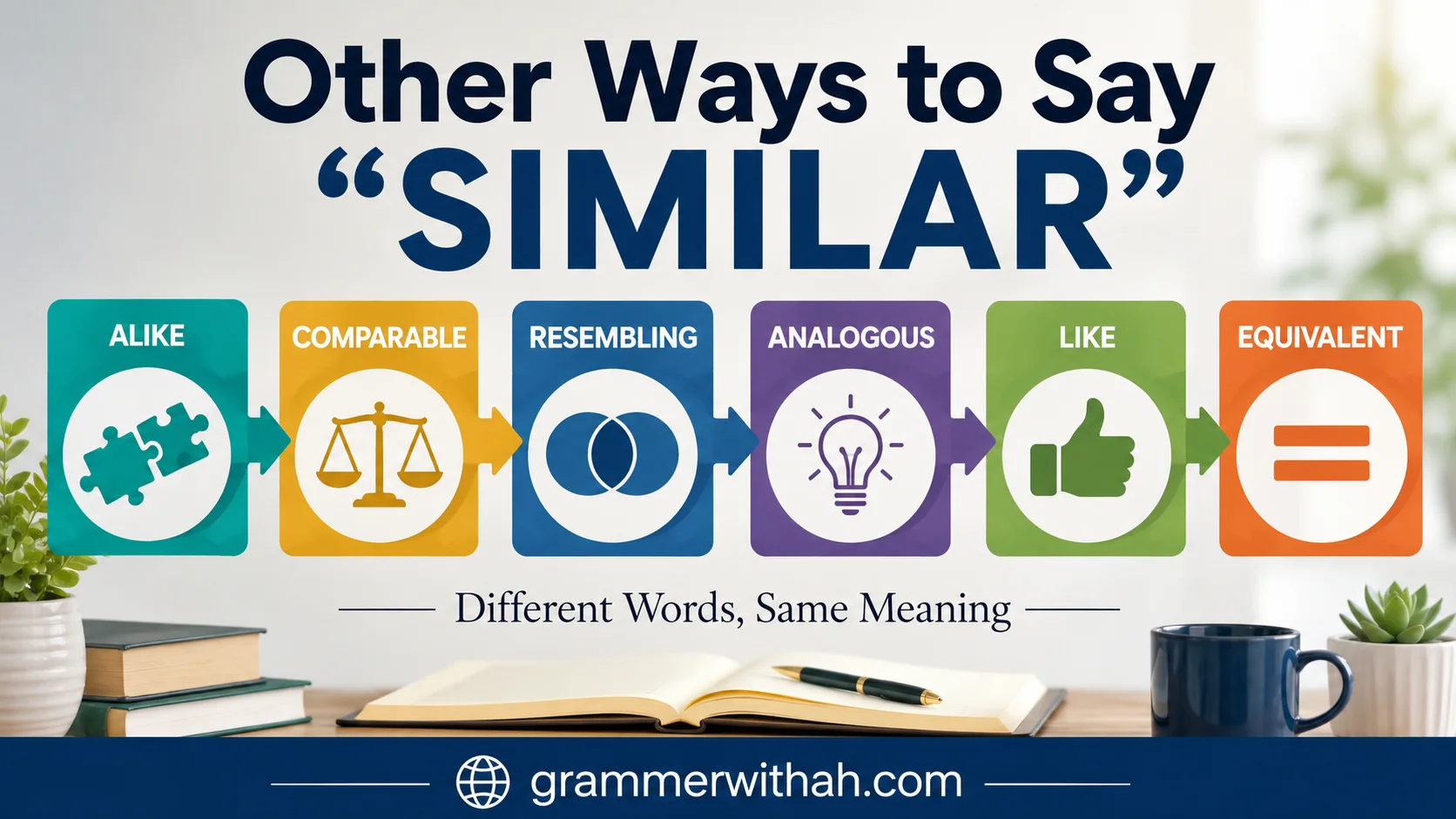
Other Ways to Say “SIMILAR” (With Examples) is a useful guide for anyone who wants to improve their English vocabulary and avoid repeating the same word. Whether you are writing an essay, email, blog, or having an everyday conversation, learning better alternatives helps your writing sound more natural, clear, and professional. Using the right synonym also makes your message easier to understand and more engaging for every reader.
Choosing the best alternative depends on the meaning, context, tone, and audience. Words like comparable, equivalent, related, matching, corresponding, analogous, and alike can express different shades of similarity. Expanding your vocabulary improves communication, enhances readability, and makes your writing more effective. These expressions are perfect for business reports, academic work, social posts, and casual conversations while helping you avoid unnecessary repetition.
What Does “Similar” Mean?
Similar means that two things share important qualities, patterns, features, or ideas, even if they are not exactly the same in every detail. It helps you show connection, comparison, and resemblance in a simple way that readers understand quickly.
Is It Professional or Polite to Say “Similar”?
Yes, similar is both professional and polite in most situations, because it is clear, neutral, and easy to understand. It works well in everyday writing, business communication, academic work, and friendly conversation when you want to compare things without sounding too strong or too formal.
Pros and Cons of Using “Similar”
Pros: The word similar is simple, familiar, and easy to read, which makes your message smooth and accessible. It is also flexible, because it can describe people, ideas, styles, results, and objects very effectively.
Cons: The word similar can feel repetitive if you use it too often, and it may sound too ordinary in more polished writing. Sometimes a stronger synonym can give your sentence more precision, style, or emotional warmth.
“Similar” Synonyms
- Alike
- Comparable
- Equivalent
- Matching
- Related
- Akin
- Analogous
- Resembling
- Parallel
- Close
- Near-Identical
- Much the Same
- Of the Same Kind
- In the Same Vein
- Corresponding
- Uniform
- Consistent
- Comparable in Nature
- Similar in Form
- Similar in Meaning
- Almost the Same
- Closely Related
- Interchangeable
- Kindred
- Reminiscent
1. Alike
Scenario Meaning: The word alike means that two things share important qualities, and they look, feel, or behave in ways that make them seem closely connected in a simple and natural way.
Examples:
- The two brothers look alike in many surprising ways.
- Their opinions are alike on this important issue.
- The dresses are alike in color and design.
- These ideas are alike in both style and purpose.
- The results are alike in pattern and meaning.
Tone: Alike sounds friendly, clear, and easy to understand, which makes it useful in both casual and simple professional writing.
Details Explanation: This word works well when you want to show resemblance without sounding too technical or complicated. It feels smooth, natural, and readable, so it often fits sentences where the comparison should remain light and direct.
Best Use: Use alike when you want to describe people, objects, ideas, or results that share noticeable qualities in a clean and familiar way.
2. Comparable
Scenario Meaning: The word comparable means that two things can be reasonably compared because they share enough qualities, value, size, or importance to make the comparison meaningful and useful.
Examples:
- Their skills are comparable in many important ways.
- The two products are comparable in price and quality.
- These results are comparable to last year’s numbers.
- Her experience is comparable to his professional background.
- The houses are comparable in size and location.
Tone: Comparable sounds professional, balanced, and thoughtful, which makes it a strong choice for business, academic, and analytical writing.
Details Explanation: This word is helpful when you want to show that two things can be fairly measured against each other. It gives your sentence a more careful and polished tone than the word similar, especially in formal writing.
Best Use: Use comparable when you want to compare value, performance, quality, experience, or results in a clear and respectful way.
3. Equivalent
Scenario Meaning: The word equivalent means that two things are equal in value, meaning, effect, or purpose, even if they appear different on the surface.
Examples:
- This amount is equivalent to the cost of one meal.
- Her explanation was equivalent to a clear apology.
- The two degrees are equivalent in academic value.
- That result is equivalent to a strong success.
- His role is equivalent to a senior manager’s position.
Tone: Equivalent sounds formal, exact, and intelligent, which makes it ideal when precision matters more than softness.
Details Explanation: This word is stronger than similar, because it suggests equality rather than simple resemblance. It is especially useful when you want to compare values, meanings, responsibilities, or outcomes with accuracy.
Best Use: Use equivalent when you want to show that two things carry the same value, function, or effect in an exact and confident way.
4. Matching
Scenario Meaning: The word matching means that two things go together well because they share the same color, style, pattern, purpose, or design in a coordinated way.
Examples:
- She wore a matching jacket and skirt.
- The curtains have matching colors and textures.
- Their answers were matching in many places.
- He bought matching shoes and belt for the suit.
- The team used matching fonts across the document.
Tone: Matching sounds practical, neat, and visually focused, which makes it useful in both everyday and design-related writing.
Details Explanation: This word often suggests harmony, coordination, and neat arrangement. It is a good choice when you want to describe things that seem deliberately paired or designed to work well together.
Best Use: Use matching when you are talking about style, appearance, pairs, sets, or coordinated details that belong together.
5. Related
Scenario Meaning: The word related means that two things are connected through meaning, origin, topic, family, or purpose, even if they are not exactly alike in appearance.
Examples:
- These two ideas are related in a direct way.
- His job is related to customer support.
- The books are related in subject matter.
- Our concerns are related to safety and comfort.
- The two events are related through timing and cause.
Tone: Related sounds calm, neutral, and professional, which makes it useful in many kinds of writing.
Details Explanation: This word is broader than similar, because it focuses more on connection than on appearance. It is especially useful when you want to show that two things belong to the same topic, category, or background.
Best Use: Use related when you want to describe ideas, subjects, people, or events that have a meaningful connection.
6. Akin
Scenario Meaning: The word akin means that two things are closely connected, somewhat alike, or naturally similar in character, feeling, or nature.
Examples:
- Her reaction was akin to relief and joy.
- His style is akin to classic storytelling.
- This feeling is akin to deep gratitude.
- Their method is akin to careful planning.
- The two experiences are akin in emotional strength.
Tone: Akin sounds thoughtful, literary, and slightly formal, which gives writing a more refined feeling.
Details Explanation: This word works well when you want to describe similarity in a deeper or more abstract way. It often sounds softer and more elegant than similar, especially in reflective or descriptive writing.
Best Use: Use akin when you want to express close resemblance in feeling, nature, style, or meaning.
7. Analogous
Scenario Meaning: The word analogous means that two things are comparable because they share a similar relationship, structure, or function, even if they belong to different areas.
Examples:
- The two systems are analogous in design.
- Her role is analogous to a team guide.
- The comparison is analogous to earlier research.
- These examples are analogous in structure.
- The situation is analogous to a previous case.
Tone: Analogous sounds formal, academic, and precise, which makes it ideal for serious writing and analysis.
Details Explanation: This word is useful when you want to compare patterns or relationships rather than simple appearance. It often appears in academic, scientific, or analytical writing because it gives a careful and intelligent tone.
Best Use: Use analogous when you want to compare two different things that work in a similar way.
8. Resembling
Scenario Meaning: The word resembling means that one thing looks, feels, or appears like another thing in some noticeable way, even if they are not fully the same.
Examples:
- The painting is resembling a winter scene.
- Her voice is resembling her mother’s voice.
- The design is resembling a modern pattern.
- The two shapes are resembling each other closely.
- The story is resembling an old folk tale.
Tone: Resembling sounds descriptive, visual, and gentle, which makes it useful for careful comparisons.
Details Explanation: This word focuses on visible or noticeable likeness, and it often helps readers picture the comparison more clearly. It is a good option when you want your sentence to sound vivid and precise.
Best Use: Use resembling when you want to describe appearance, style, sound, or general likeness.
9. Parallel
Scenario Meaning: The word parallel means that two things move, develop, or exist in a similar direction, pattern, or relationship without fully becoming the same thing.
Examples:
- Their careers are parallel in many ways.
- The two stories follow parallel themes.
- His views are parallel to hers on this issue.
- The lines are parallel in the diagram.
- Their experiences are parallel in timing and growth.
Tone: Parallel sounds structured, thoughtful, and slightly formal, which makes it useful in academic and professional writing.
Details Explanation: This word is excellent when you want to show that two things develop side by side or follow the same path. It often gives your writing a more organized and intelligent feeling.
Best Use: Use parallel when you want to compare patterns, paths, lives, ideas, or developments.
10. Close
Scenario Meaning: The word close means that two things are very alike in nature, quality, appearance, or meaning, with only small differences between them.
Examples:
- The two answers are close in meaning.
- Their colors are close to each other.
- The results are close to last month’s numbers.
- Her opinion is close to mine on this topic.
- The designs are close in shape and style.
Tone: Close sounds simple, natural, and easygoing, which makes it useful in everyday writing and speech.
Details Explanation: This word is a good choice when you want to show strong resemblance without sounding too formal. It is short, clear, and flexible, so it fits many types of sentences very easily.
Best Use: Use close when you want to express strong likeness with a plain and natural tone.
11. Near-Identical
Scenario Meaning: The word near-identical means that two things are almost the same, with only very small differences that are not easy to notice at first glance.
Examples:
- The two reports are near-identical in structure.
- Their test scores were near-identical this time.
- The shirts look near-identical in the store light.
- These documents are near-identical in wording.
- The two samples are near-identical in appearance.
Tone: Near-identical sounds exact, detailed, and highly descriptive, which makes it useful when precision matters.
Details Explanation: This word is stronger than similar, because it suggests a very high level of likeness. It works especially well when you want to stress that the difference is tiny and almost unnoticeable.
Best Use: Use near-identical when two things are almost the same and you want to highlight that fact clearly.
12. Much the Same
Scenario Meaning: The phrase much the same means that two things are very similar in quality, result, appearance, or meaning, even if they are not exactly equal.
Examples:
- Their opinions are much the same on this issue.
- The two stories feel much the same in tone.
- The results are much the same as before.
- Her answer was much the same as his response.
- The prices are much the same across stores.
Tone: Much the same sounds soft, conversational, and natural, which makes it friendly and easy to read.
Details Explanation: This phrase feels relaxed and simple, so it works well when you want to avoid sounding too technical or rigid. It is especially helpful in casual writing where warmth matters.
Best Use: Use much the same when you want to show strong similarity in a natural and easygoing way.
13. Of the Same Kind
Scenario Meaning: The phrase of the same kind means that two things belong to the same category, type, or general group because they share important characteristics.
Examples:
- These tools are of the same kind.
- The two books are of the same kind in style.
- Their ideas are of the same kind in meaning.
- The products are of the same kind in purpose.
- These emotions are of the same kind and intensity.
Tone: Of the same kind sounds clear, gentle, and descriptive, which makes it useful in both simple and careful writing.
Details Explanation: This phrase helps you group things together without needing a stronger or more technical synonym. It works well when you want to show category, type, or general likeness with kindness and clarity.
Best Use: Use of the same kind when you want to describe things that belong to the same general group or class.
Read More: 25 Other Ways to Say “PROUD” (With Examples)
14. In the Same Vein
Scenario Meaning: The phrase in the same vein means that two ideas, actions, or remarks follow the same style, direction, mood, or way of thinking.
Examples:
- She spoke in the same vein as her earlier statement.
- The article continued in the same vein as the first section.
- His reply was in the same vein as her concern.
- The two songs are written in the same vein.
- Their ideas run in the same vein throughout the meeting.
Tone: In the same vein sounds smooth, thoughtful, and a little literary, which gives writing a more refined feel.
Details Explanation: This phrase is especially useful when you are talking about tone, style, or direction rather than exact sameness. It helps your writing feel connected and elegant without sounding forced.
Best Use: Use in the same vein when you want to describe ideas, comments, or creative work that follow a similar style or mood.
15. Corresponding
Scenario Meaning: The word corresponding means that one thing matches or relates directly to another thing in position, function, meaning, or amount.
Examples:
- Please check the corresponding section in the report.
- The chart shows the corresponding figures clearly.
- His answer is corresponding to the question asked.
- Each label has a corresponding image.
- The notes include the corresponding page numbers.
Tone: Corresponding sounds formal, organized, and precise, which makes it very useful in structured writing.
Details Explanation: This word is practical when you want to show direct pairing or alignment. It often appears in instructions, data work, academic writing, and documents where order matters.
Best Use: Use corresponding when one item matches another item by position, number, role, or meaning.
16. Uniform
Scenario Meaning: The word uniform means that things stay consistent, even, or alike in style, appearance, quality, or behavior across a group or set.
Examples:
- The team followed a uniform design style.
- The pages have a uniform layout.
- Their approach remained uniform throughout the project.
- The results were uniform across all groups.
- The materials created a uniform appearance.
Tone: Uniform sounds controlled, balanced, and professional, which makes it useful in formal and technical writing.
Details Explanation: This word works well when you want to stress consistency rather than just resemblance. It suggests steadiness, order, and a careful standard that remains the same throughout.
Best Use: Use uniform when you want to describe something that stays consistent and evenly arranged.
17. Consistent
Scenario Meaning: The word consistent means that something remains similar, steady, or reliable over time, with no major changes that would break the pattern.
Examples:
- Her results have been consistent all year.
- The brand uses a consistent message.
- His behavior is consistent with his values.
- They gave consistent support during the project.
- The design stayed consistent across every page.
Tone: Consistent sounds dependable, calm, and professional, which makes it strong for both formal and everyday writing.
Details Explanation: This word often focuses on reliability and repeated similarity. It is helpful when you want to say that something does not change much and stays aligned with a pattern or expectation.
Best Use: Use consistent when you want to describe something steady, reliable, or regularly similar over time.
18. Comparable in Nature
Scenario Meaning: The phrase comparable in nature means that two things share important qualities, characteristics, or behavior that make them meaningfully alike.
Examples:
- The two situations are comparable in nature.
- These products are comparable in nature and purpose.
- Their challenges were comparable in nature.
- The ideas are comparable in nature and direction.
- The reports are comparable in nature for analysis.
Tone: Comparable in nature sounds formal, careful, and highly descriptive, which is useful in academic and professional writing.
Details Explanation: This phrase is longer, but it gives you more precision than a simple synonym. It works well when you need to sound thoughtful and exact without losing clarity.
Best Use: Use comparable in nature when you want to compare things in a detailed, formal, and careful way.
19. Similar in Form
Scenario Meaning: The phrase similar in form means that two things have a comparable structure, shape, arrangement, or outward pattern.
Examples:
- The two buildings are similar in form.
- Their arguments are similar in form and structure.
- The poems are similar in form and rhythm.
- The graphs are similar in form across the pages.
- The icons are similar in form but different in color.
Tone: Similar in form sounds analytical, neat, and focused, which makes it helpful in descriptive and technical writing.
Details Explanation: This phrase is excellent when you want to focus on structure or appearance rather than general likeness. It creates a clearer comparison by pointing to the visible shape or arrangement of things.
Best Use: Use similar in form when you want to compare structure, shape, layout, or design.
20. Similar in Meaning
Scenario Meaning: The phrase similar in meaning means that two words, ideas, statements, or expressions carry nearly the same message or purpose.
Examples:
- These two words are similar in meaning.
- His explanation was similar in meaning to hers.
- The phrases are similar in meaning but different in form.
- The titles are similar in meaning and intention.
- Their comments were similar in meaning throughout the discussion.
Tone: Similar in meaning sounds clear, thoughtful, and easy to follow, which makes it useful for language and communication writing.
Details Explanation: This phrase is especially helpful when discussing words, phrases, and expressions. It tells the reader that the message is closely aligned, even if the exact wording changes.
Best Use: Use similar in meaning when comparing words, statements, or ideas that communicate almost the same message.
21. Almost the Same
Scenario Meaning: The phrase almost the same means that two things are extremely alike, but there is still a very small difference between them.
Examples:
- Their answers are almost the same.
- The two colors look almost the same.
- His view is almost the same as mine.
- The designs are almost the same except for one detail.
- The results are almost the same across both groups.
Tone: Almost the same sounds simple, honest, and conversational, which makes it very easy for readers to understand.
Details Explanation: This phrase is useful when you want to keep the comparison plain and direct. It gives a natural feeling, and it avoids sounding too formal or overly technical.
Best Use: Use almost the same when two things are very close in resemblance but not fully identical.
22. Closely Related
Scenario Meaning: The phrase closely related means that two things have a strong connection or shared background, making them more connected than ordinary related items.
Examples:
- These two topics are closely related.
- Their experiences are closely related in timing.
- The subjects are closely related in meaning.
- These problems are closely related to one another.
- The two departments are closely related in function.
Tone: Closely related sounds clear, serious, and organized, which makes it strong for formal explanation.
Details Explanation: This phrase works well when the connection is important and not casual. It helps the reader understand that the link between the two things is strong, meaningful, and worth noticing.
Best Use: Use closely related when you want to show a strong and important connection between ideas, people, or events.
23. Interchangeable
Scenario Meaning: The word interchangeable means that two things are so similar in use, meaning, or function that one can often replace the other.
Examples:
- These terms are interchangeable in casual speech.
- The parts are interchangeable in this machine.
- The two labels are not fully interchangeable.
- Their roles are interchangeable on the team.
- The buttons are interchangeable in design and use.
Tone: Interchangeable sounds practical, precise, and formal, which makes it useful for technical and professional writing.
Details Explanation: This word is especially useful when function matters more than appearance. It suggests a very close level of similarity, where one thing can take the place of another without causing problems.
Best Use: Use interchangeable when two things can be replaced by one another because they are very closely alike in use or function.
24. Kindred
Scenario Meaning: The word kindred means that two things share a similar nature, spirit, feeling, or character, often in a warm and meaningful way.
Examples:
- They felt a kindred connection right away.
- Her writing has a kindred emotional tone.
- Their beliefs are kindred in spirit.
- The two stories carry a kindred feeling.
- He found a kindred voice in her poem.
Tone: Kindred sounds warm, thoughtful, and literary, which gives your writing a gentle and expressive quality.
Details Explanation: This word often feels deeper than similar, because it suggests shared spirit or emotional connection. It works beautifully in reflective writing, creative writing, or emotional descriptions.
Best Use: Use kindred when you want to express a meaningful and emotionally close similarity.
25. Reminiscent
Scenario Meaning: The word reminiscent means that something brings to mind another thing because it has a similar feeling, look, sound, or character.
Examples:
- The song is reminiscent of old summer nights.
- Her style is reminiscent of classic fashion.
- The scene felt reminiscent of childhood memories.
- The design is reminiscent of early modern art.
- His words were reminiscent of a sincere farewell.
Tone: Reminiscent sounds elegant, reflective, and slightly poetic, which makes it useful when you want a softer and richer style.
Details Explanation: This word does not only compare things directly; it also creates a feeling of memory or association. It helps your writing become more vivid, emotional, and expressive without losing clarity.
Best Use: Use reminiscent when one thing reminds the reader of another because of a shared mood, style, or feeling.
FAQs :
1. What does “similar” mean?
Similar means two or more things are alike in some way, but not always exactly the same.
2. Is “similar” a formal word?
Yes, similar is a common and useful word in both formal and casual English.
3. What are some common alternatives for “similar”?
Some common options are alike, comparable, related, matching, equivalent, and analogous.
4. How do I choose the best synonym for “similar”?
Choose the word based on your context, tone, and the exact meaning you want to express.
5. Why should I use other ways to say “similar”?
Using different words makes your writing sound more natural, clear, and engaging while avoiding repetition.
Conclusion :
Knowing other ways to say “similar” can make your English stronger and more flexible. The right word helps you communicate your idea more clearly, whether you are writing, speaking, or comparing two things. By practicing these alternatives, you can improve your vocabulary, make your sentences sound more natural, and express yourself with more confidence.