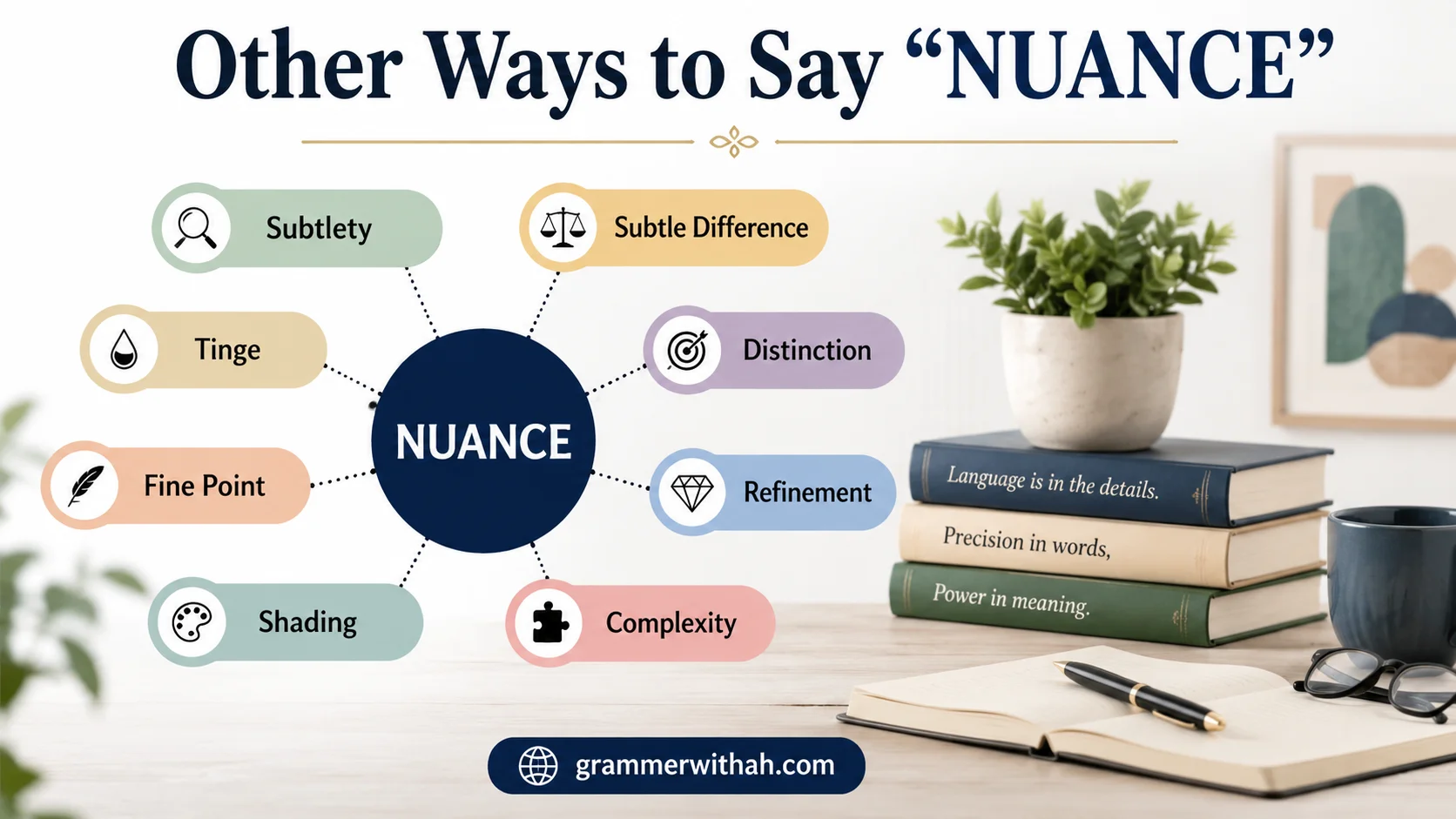
Discover Other Ways to Say “NUANCE” (With Examples) and learn how different words can describe subtle meanings, small differences, and hidden details in communication. The word nuance helps explain ideas with more depth, clarity, and accuracy. Whether you are a writer, student, or speaker, understanding related terms like subtlety, distinction, shade of meaning, and complexity can make your language more expressive and powerful.
Using the right alternatives for nuance can improve your vocabulary, writing style, and everyday conversations. These words help you describe emotions, ideas, and situations with greater precision and understanding. By exploring different expressions, you can avoid repetition and create more engaging content. Strong word choices add meaning, improve communication, and help your message connect better with readers.
What Does “Nuance” Mean?
Nuance means a small but important difference in meaning, feeling, tone, or expression. It often describes something that is not obvious at first glance, but still matters a lot. A nuance can be found in a word, a sentence, a face expression, a reaction, a relationship, or even a simple conversation.
In simple English, nuance is the fine detail that changes how something should be understood. It helps us notice that not everything is black and white. Sometimes, the real meaning is hidden in the subtle layer between the lines, and that is where nuance becomes very useful.
Is It Professional or Polite to Say “Nuance”?
Yes, nuance is both professional and polite in most situations. It is a thoughtful word that works well in writing, speaking, business communication, education, and careful discussion. It sounds smart without sounding rude, and it helps you show that you understand small differences.
That said, some people may prefer simpler words when talking in casual settings. If the conversation is very plain or everyday, a simpler alternative like detail, shade, or subtle point may feel more natural and easier to understand.
Pros and Cons of Saying “Nuance”
Pros
Nuance is a strong word because it sounds smart, careful, and thoughtful. It helps you describe meaning in a deeper way, especially when you want to show that something is not simple or direct. It is also useful in professional writing, where clear and exact language matters.
Cons
The word nuance may feel a little formal or abstract in very casual conversation. Some people may not use it often, so it can sometimes sound slightly academic or polished. In simple conversations, a more common word may feel easier and warmer.
“NUANCE” Synonyms
- Subtlety
- Shade
- Distinction
- Fine Point
- Delicacy
- Subtle Difference
- Fine Detail
- Complexity
- Layer
- Depth
- Intricacy
- Variation
- Difference
- Detail
- Implication
- Meaning
- Sensitivity
- Refinement
- Perspective
- Insight
- Observation
- Subtle Element
- Complexity of Meaning
- Fine Distinction
- Hidden Detail
1. Subtlety
Scenario Meaning: Subtlety refers to a small and careful difference that is not loud, direct, or easy to notice right away, but still changes the meaning in an important way.
Examples:
- Her subtlety in speech made the message feel gentle, thoughtful, and easy to trust.
- The subtlety of his expression showed that he understood more than he said aloud.
- We noticed the subtlety in her tone, and it changed the whole feeling of the conversation.
- The writer used subtlety to show emotion without saying everything directly.
- There was a beautiful subtlety in the design that made it feel calm and elegant.
Tone: Subtlety has a careful, soft, and refined tone that often feels intelligent and graceful.
Details Explanation: Subtlety is one of the best alternatives to nuance when you want to describe something delicate, quiet, and not immediately obvious. It works well when a small change carries a deeper meaning, especially in speech, writing, art, or behavior. This word helps explain that meaning is not always loud, and sometimes the smallest detail creates the strongest effect.
Best Use: Use subtlety when you want to point out a gentle detail, a quiet difference, or a meaning that must be noticed with care.
2. Shade
Scenario Meaning: Shade means a slight difference in meaning, feeling, or opinion that can change how something is understood in a soft and careful way.
Examples:
- There was a shade of concern in her voice that made everyone listen more closely.
- The story carried a shade of sadness, even though it was mostly hopeful.
- He noticed a shade of meaning in her reply that others missed completely.
- The comment had a small shade of humor that made the room feel lighter.
- A shade of doubt appeared in the discussion, and the mood became more serious.
Tone: Shade has a gentle, slightly informal, and expressive tone that can feel warm and natural.
Details Explanation: Shade is useful when you want to describe a tiny movement in tone, feeling, or meaning. It is not always as formal as nuance, but it can still sound thoughtful and expressive. In conversation and creative writing, shade helps you show that something is not completely one thing or another. It gives your message a soft layer of meaning that readers or listeners can feel.
Best Use: Use shade when you want to describe a small difference in emotion, tone, or meaning that adds depth to a sentence.
3. Distinction
Scenario Meaning: Distinction means a clear difference between two things, especially when that difference is important and worth noticing.
Examples:
- There is a clear distinction between being honest and being harsh.
- She made a strong distinction between care and control in her explanation.
- The lesson showed the distinction between facts and opinions very clearly.
- He noticed a distinction in their reactions that changed his understanding.
- The speaker explained the distinction with patience and respect.
Tone: Distinction has a formal, clear, and respectful tone that works well in careful communication.
Details Explanation: Distinction is a strong alternative when you want to stress that one thing is meaningfully different from another. It is especially useful in academic writing, professional discussions, and serious explanations. Unlike some softer alternatives, distinction often focuses on clarity and structure. It helps the reader understand that two ideas may look similar, but they are not the same.
Best Use: Use distinction when you want to explain a clear and important difference in a professional or thoughtful way.
4. Fine Point
Scenario Meaning: A fine point is a small detail that may seem minor, but it can affect the full meaning, decision, or understanding of something.
Examples:
- That fine point changed how I understood the whole message.
- The teacher explained every fine point with great patience and care.
- We missed a fine point in the contract, and it caused confusion later.
- There was a fine point in her reply that showed quiet confidence.
- The speaker returned to one fine point again because it mattered so much.
Tone: Fine point has a careful, clear, and practical tone that feels useful and precise.
Details Explanation: Fine point works well when you want to talk about a small detail that carries real importance. It is especially helpful in conversations about decisions, rules, writing, or explanation. This phrase feels easy to understand, so it is a good choice when you want something simple but still meaningful. It helps people pay attention to the smallest part of the message.
Best Use: Use fine point when you want to highlight a small detail that changes the meaning or result.
5. Delicacy
Scenario Meaning: Delicacy means a careful, gentle, and sensitive quality in meaning, feeling, or handling, especially when something must be treated with respect.
Examples:
- The delicacy of the topic made everyone speak more softly and kindly.
- She handled the situation with great delicacy and emotional care.
- There was a delicacy in his words that helped calm the room.
- The writer showed delicacy by choosing gentle language for a painful moment.
- Her answer had a beautiful delicacy that made it feel sincere and human.
Tone: Delicacy has a gentle, sensitive, and elegant tone that often feels calm and respectful.
Details Explanation: Delicacy is a lovely alternative when you want to describe something that needs care, softness, and emotional attention. It is especially useful in situations where feelings are involved and strong language might feel too harsh. This word adds warmth and respect to communication. It suggests that a message, subject, or reaction should be handled lightly and thoughtfully.
Best Use: Use delicacy when the situation is emotional, sensitive, or requires a very careful touch.
6. Subtle Difference
Scenario Meaning: Subtle difference means a small change or variation between things that may not be immediately visible but can affect the overall meaning or feeling.
Examples:
- The subtle difference between the two ideas completely changed the final decision.
- She noticed a subtle difference in his voice and understood his feelings.
- A subtle difference in wording can make a message sound more caring.
- The artist created a subtle difference between light and shadow in the painting.
- Understanding this subtle difference helps people communicate more clearly.
Tone: Subtle difference has a clear, thoughtful, and analytical tone.
Details Explanation: Subtle difference is a simple and easy-to-understand alternative for nuance. It explains that even small changes can have a meaningful impact. This phrase is useful because it works in both casual and professional conversations. It helps people understand that tiny details can create a completely different feeling, idea, or result.
Best Use: Use subtle difference when you want to explain a small variation that creates a meaningful change.
7. Fine Detail
Scenario Meaning: Fine detail refers to a small part or element that adds extra meaning, beauty, or understanding to something.
Examples:
- The fine detail in her explanation helped everyone understand the situation better.
- Every fine detail in the story made the experience feel more realistic.
- He focused on every fine detail before making the final choice.
- The design became special because of its beautiful fine details.
- A fine detail in his message showed how much he cared.
Tone: Fine detail has a positive, careful, and observant tone.
Details Explanation: Fine detail is a useful alternative when talking about small parts that improve understanding. It shows attention and care because it focuses on things that others might ignore. This phrase is commonly used in writing, design, communication, and analysis. It helps explain that small parts can have a big influence on the complete picture.
Best Use: Use fine detail when you want to highlight important small parts of an idea, object, or message.
8. Complexity
Scenario Meaning: Complexity means the condition of having many connected parts, ideas, or feelings that require deeper understanding.
Examples:
- The complexity of human emotions makes every situation different.
- She explained the complexity of the issue with patience and clarity.
- The movie showed the complexity of relationships in a realistic way.
- Understanding the complexity behind his decision changed my opinion.
- The discussion explored the complexity of modern communication.
Tone: Complexity has a serious, intellectual, and thoughtful tone.
Details Explanation: Complexity is connected to nuance because both words show that something has deeper layers. However, complexity focuses more on the number of connected parts, while nuance focuses more on small differences and hidden meanings. This word is helpful when explaining situations that cannot be understood in a simple way.
Best Use: Use complexity when you want to describe something with many layers, factors, or ideas.
9. Layer
Scenario Meaning: Layer means an additional level of meaning, emotion, or information that exists beneath the surface.
Examples:
- The story had a deeper layer that many readers did not notice at first.
- Her words carried a hidden layer of kindness and understanding.
- The conversation revealed another layer of the problem.
- This painting has a beautiful layer of emotion behind its appearance.
- The message included a layer of meaning that made it memorable.
Tone: Layer has a creative, warm, and descriptive tone.
Details Explanation: Layer is a powerful alternative because it shows that ideas and feelings can have different levels. It is often used when discussing stories, emotions, communication, and experiences. This word makes your expression feel deeper because it suggests that there is more to discover beyond the obvious meaning.
Best Use: Use layer when describing hidden meanings, deeper feelings, or additional details.
10. Depth
Scenario Meaning: Depth refers to the richness, importance, or deeper meaning found within an idea, feeling, or conversation.
Examples:
- The depth of her words showed great understanding and compassion.
- His explanation had more depth than a simple answer.
- The book explores the depth of human emotions.
- Their conversation reached a level of depth that created a strong connection.
- The artist added depth to the work through small meaningful details.
Tone: Depth has a meaningful, emotional, and mature tone.
Details Explanation: Depth is a strong alternative for nuance when you want to focus on the richness behind something. It shows that an idea is not shallow or simple. This word works well when discussing feelings, thoughts, art, relationships, and communication. It helps express that something contains valuable meaning beyond the surface.
Best Use: Use depth when you want to describe powerful, meaningful, or thoughtful qualities.
11. Intricacy
Scenario Meaning: Intricacy means the quality of having many small details or carefully connected parts that create something special.
Examples:
- The intricacy of the design made it unique and impressive.
- She appreciated the intricacy of the writer’s message.
- The intricacy of human behavior is difficult to understand completely.
- The project required attention to every intricacy to succeed.
- His explanation showed the intricacy of the situation clearly.
Tone: Intricacy has a formal, detailed, and professional tone.
Details Explanation: Intricacy works well when describing something that contains many connected details. It highlights careful structure and complexity. This word is useful in professional, creative, and academic situations where small parts come together to create a bigger meaning.
Best Use: Use intricacy when focusing on detailed structures, complicated ideas, or carefully connected elements.
12. Variation
Scenario Meaning: Variation means a difference or change between similar things, ideas, or situations.
Examples:
- There was a small variation in their opinions about the topic.
- The recipe allows some variation depending on personal taste.
- A slight variation in tone changed the meaning of the sentence.
- The designer created different variations of the same concept.
- This variation shows that every person has a unique perspective.
Tone: Variation has a neutral, flexible, and practical tone.
Details Explanation: Variation is a simple alternative that explains differences without sounding too formal. It is useful in everyday communication because it clearly shows that something can have different forms or versions. This word works well in discussions about ideas, styles, opinions, and choices.
Best Use: Use variation when describing changes or differences between similar things.
13. Difference
Scenario Meaning: Difference means the way one thing is separate from another in meaning, appearance, quality, or feeling.
Examples:
- The difference between the two opinions helped us understand both sides better.
- She explained the difference between being careful and being afraid.
- A small difference in words can change the entire message.
- He noticed the difference in her attitude after the conversation.
- The difference between the two ideas became clear with time.
Tone: Difference has a simple, clear, and direct tone.
Details Explanation: Difference is one of the easiest alternatives to nuance because everyone understands its meaning. It is useful when you want to explain that two things are not exactly the same. Although it is more general than nuance, it can still describe meaningful changes when used with the right context.
Best Use: Use difference when you want a simple and clear way to explain how things are not the same.
14. Detail
Scenario Meaning: Detail means a small piece of information, feature, or part that helps create a complete understanding.
Examples:
- Every detail in the story made the message more powerful.
- She remembered every detail of the important conversation.
- A small detail in his response showed his true feelings.
- The designer paid attention to every detail of the project.
- This detail helped explain the situation more clearly.
Tone: Detail has a practical, clear, and professional tone.
Details Explanation: Detail is a common and flexible alternative to nuance. It focuses on the smaller parts that create a bigger picture. This word is helpful in writing, communication, planning, and explanation because it makes people notice the important parts that may otherwise be ignored.
Best Use: Use detail when talking about small pieces of information or important parts of something.
15. Implication
Scenario Meaning: Implication means a hidden meaning, suggestion, or result that is not directly stated but can be understood.
Examples:
- The implication of his words was clear even though he did not explain everything.
- She understood the implication behind the message immediately.
- The decision had an important implication for the future.
- His comment carried an unexpected implication about the situation.
- The writer used implication to create deeper meaning in the story.
Tone: Implication has a serious, thoughtful, and analytical tone.
Details Explanation: Implication is closely connected with nuance because both involve meanings that are not always directly visible. This word is useful when something is suggested rather than clearly said. It helps explain hidden messages, possible results, and deeper ideas in communication.
Best Use: Use implication when discussing hidden meanings, suggestions, or possible effects.
16. Meaning
Scenario Meaning: Meaning refers to the idea, feeling, or message that something communicates.
Examples:
- The meaning behind her words was full of kindness and respect.
- Understanding the true meaning helped solve the misunderstanding.
- The sentence had a deeper meaning than it first appeared.
- His actions gave a new meaning to the situation.
- The artist wanted to share a special meaning through the painting.
Tone: Meaning has a simple, human, and emotional tone.
Details Explanation: Meaning is a basic but powerful alternative for nuance because it focuses on what something truly represents. It works in almost every situation, from casual conversations to serious discussions. While nuance focuses on small differences, meaning focuses on the message or idea itself.
Best Use: Use meaning when you want to explain what something truly expresses or represents.
17. Sensitivity
Scenario Meaning: Sensitivity means awareness and care toward small details, feelings, or situations that require understanding.
Examples:
- Her sensitivity helped her communicate with kindness and respect.
- The topic required great sensitivity because emotions were involved.
- He handled the conversation with sensitivity and patience.
- The writer showed sensitivity toward different experiences.
- A little sensitivity can make communication more meaningful.
Tone: Sensitivity has a warm, caring, and respectful tone.
Details Explanation: Sensitivity is a useful alternative when the nuance is connected to emotions or human experiences. It shows the ability to notice feelings and respond carefully. This word is especially valuable in personal conversations, relationships, and situations where kindness matters.
Best Use: Use sensitivity when discussing emotional awareness and thoughtful communication.
18. Refinement
Scenario Meaning: Refinement means improvement, elegance, or careful adjustment that makes something more polished and effective.
Examples:
- The refinement of her words made the message sound more professional.
- Small changes brought more refinement to the design.
- His writing showed great refinement and attention to language.
- The idea needed more refinement before being presented.
- The refinement in her approach created a better result.
Tone: Refinement has a professional, elegant, and positive tone.
Details Explanation: Refinement connects with nuance because it represents careful improvement and attention to small details. It is often used when something becomes better through thoughtful changes. This word is useful in communication, creativity, design, and personal development.
Best Use: Use refinement when describing careful improvement or polished quality.
19. Perspective
Scenario Meaning: Perspective means a particular way of viewing, understanding, or interpreting something.
Examples:
- Her perspective helped me see the situation differently.
- Everyone has a unique perspective based on their experiences.
- A new perspective can reveal details we missed before.
- His perspective added more depth to the discussion.
- Understanding another perspective creates better communication.
Tone: Perspective has a thoughtful, open-minded, and respectful tone.
Details Explanation: Perspective is related to nuance because understanding small differences often requires looking from different viewpoints. This word helps explain that people may understand the same situation in different ways. It encourages empathy and deeper thinking.
Best Use: Use perspective when talking about viewpoints, opinions, or different ways of understanding something.
20. Insight
Scenario Meaning: Insight means a deep understanding or a meaningful observation about something.
Examples:
- Her insight helped everyone understand the problem better.
- The article provided valuable insight into human behavior.
- His insight revealed a detail that others ignored.
- The conversation gave me new insight into the situation.
- A small insight can completely change how we think.
Tone: Insight has a smart, positive, and thoughtful tone.
Details Explanation: Insight is a strong alternative for nuance when you want to focus on understanding something deeply. It shows awareness, intelligence, and careful observation. This word works well in professional discussions, learning, and personal conversations where deeper understanding is important.
Best Use: Use insight when describing a valuable understanding or meaningful discovery.
21. Observation
Scenario Meaning: Observation means something noticed carefully through attention, experience, or thoughtful thinking.
Examples:
- Her observation helped the team understand the hidden issue.
- A simple observation changed the way he viewed the situation.
- His observation about human behavior was very interesting.
- The researcher shared an important observation about the results.
- A careful observation can reveal details that others miss.
Tone: Observation has a careful, intelligent, and neutral tone.
Details Explanation: Observation is a helpful alternative to nuance because it focuses on noticing things that are not always obvious. It shows attention and awareness. This word works well when someone discovers a small detail, pattern, or change through careful thinking. It is commonly used in discussions, research, learning, and personal experiences.
Best Use: Use observation when describing something noticed through careful attention.
22. Subtle Element
Scenario Meaning: Subtle element means a small part of something that adds extra meaning, emotion, or importance without being immediately noticeable.
Examples:
- The subtle element of kindness made her message special.
- The design included a subtle element that made it unique.
- A subtle element in his response showed his true feelings.
- The story contained many subtle elements that created depth.
- This subtle element changed the overall impression completely.
Tone: Subtle element has a creative, gentle, and descriptive tone.
Details Explanation: Subtle element is a clear phrase that explains the smaller parts behind a bigger idea. It is especially useful when talking about writing, design, emotions, or communication. This phrase helps describe hidden qualities that quietly influence how something is experienced.
Best Use: Use subtle element when you want to highlight a small but meaningful part of something.
23. Complexity of Meaning
Scenario Meaning: Complexity of meaning refers to the deeper layers and different interpretations that exist within an idea or message.
Examples:
- The complexity of meaning made the poem interesting to read.
- The conversation showed the complexity of meaning behind simple words.
- Understanding the complexity of meaning requires careful attention.
- The artwork had a beautiful complexity of meaning.
- The writer explored the complexity of meaning through emotions and symbols.
Tone: Complexity of meaning has a deep, academic, and thoughtful tone.
Details Explanation: Complexity of meaning is a longer alternative that explains the deeper side of nuance. It focuses on how one message can contain many ideas, emotions, or interpretations. This phrase is useful when discussing literature, communication, philosophy, and serious topics.
Best Use: Use complexity of meaning when explaining that something has multiple layers of interpretation.
24. Fine Distinction
Scenario Meaning: Fine distinction means a very small but important difference between ideas, situations, or meanings.
Examples:
- The speaker explained the fine distinction between two similar concepts.
- A fine distinction in language can change the entire message.
- She understood the fine distinction between honesty and criticism.
- The discussion focused on a fine distinction that many people ignored.
- Recognizing a fine distinction helps improve communication.
Tone: Fine distinction has a professional, precise, and intelligent tone.
Details Explanation: Fine distinction is one of the closest alternatives to nuance because it directly focuses on small differences that matter. It is useful in professional writing, education, and careful conversations. This phrase shows that details and differences can influence understanding in powerful ways.
Best Use: Use fine distinction when you need to explain a small but meaningful difference.
25. Hidden Detail
Scenario Meaning: Hidden detail means a small piece of information or meaning that is not immediately visible but can be discovered with attention.
Examples:
- The hidden detail in the story gave it a deeper message.
- She found a hidden detail that changed her understanding.
- The painting contained a hidden detail that made it special.
- A hidden detail in his words revealed his true feelings.
- The movie included many hidden details for viewers to discover.
Tone: Hidden detail has a curious, creative, and interesting tone.
Details Explanation: Hidden detail is a simple and engaging alternative for nuance. It helps explain that some meanings are not obvious at first and require attention to discover. This phrase works well in storytelling, communication, and everyday situations where small details create stronger understanding.
Best Use: Use hidden detail when describing something meaningful that is not immediately noticeable.
FAQs :
1. What is another word for nuance?
Another word for nuance is subtlety, distinction, difference, shade, or fine detail. These words describe small changes or hidden meanings in ideas, feelings, or expressions.
2. Why is understanding nuance important?
Understanding nuance helps you recognize small differences, deeper meanings, and specific details. It improves communication skills and allows you to express thoughts more accurately.
3. Can nuance be used in everyday conversation?
Yes, nuance is commonly used when discussing feelings, opinions, language, art, and situations where small details matter. It helps explain ideas that are not simple or obvious.
4. What are the best alternatives to use instead of nuance in writing?
The best alternatives include subtlety, complexity, distinction, interpretation, and shade of meaning. The right choice depends on the context and tone of your sentence.
5. How does using synonyms for nuance improve writing?
Using different words for nuance makes your writing more interesting, clear, and expressive. It helps avoid repetition and allows you to explain ideas with more precision.
Conclusion :
Understanding Other Ways to Say “NUANCE” (With Examples) can help you improve your vocabulary and communicate ideas with more clarity and depth. Words like subtlety, distinction, and fine detail allow you to describe hidden meanings and small differences more effectively. Choosing the right alternative makes your writing more engaging, natural, and powerful.