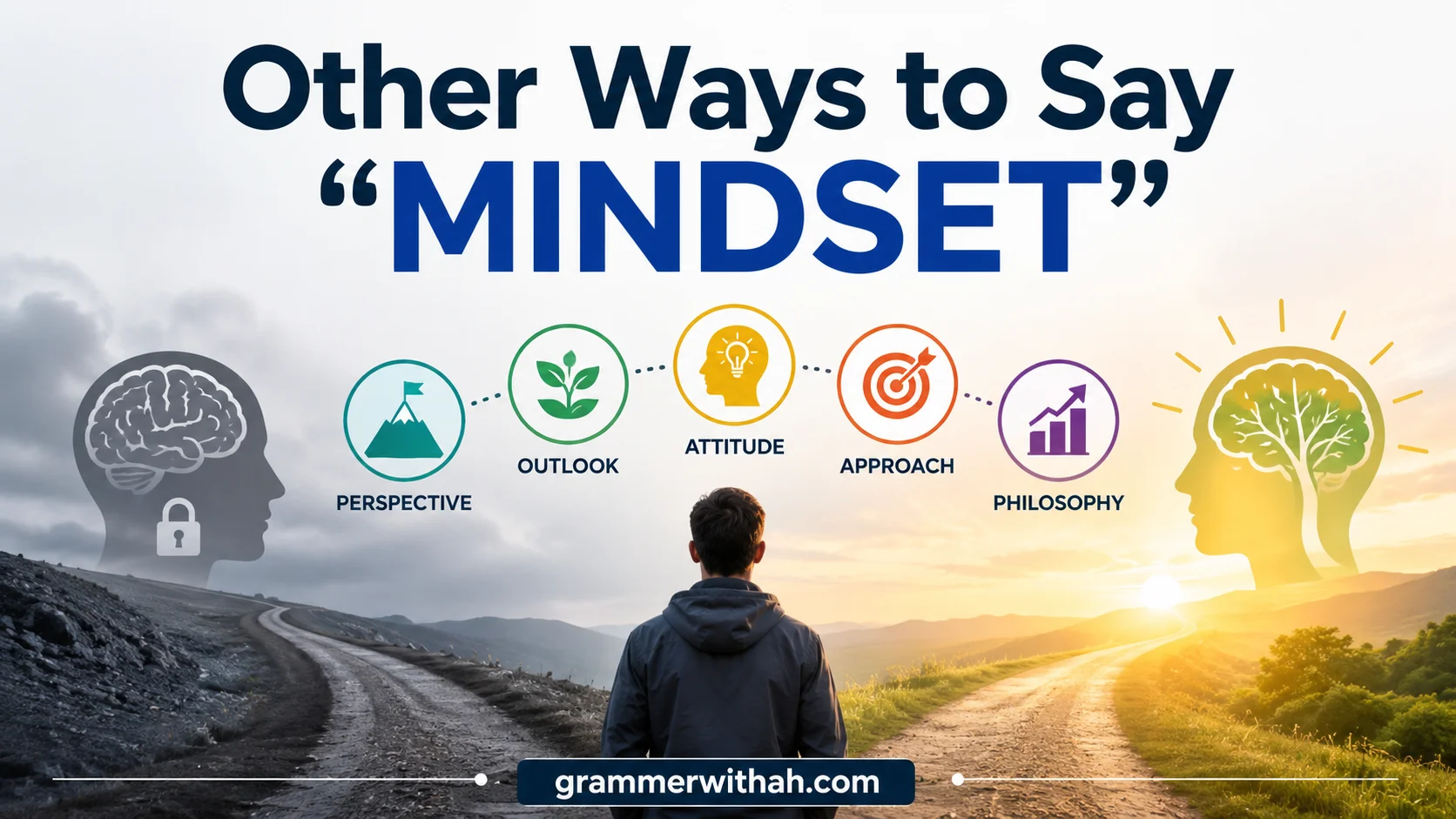
Many people use the word mindset to describe how a person thinks, but there are many other useful words too. In this guide on Other Ways to Say “MINDSET” (With Examples), you will learn simple alternatives like attitude, outlook, approach, perspective, and belief. These words help you explain how someone sees life, handles problems, and makes choices. They also make your writing sound richer, clearer, and more natural.
A mindset can shape everything from a student’s effort to a business owner’s decisions. For example, one person may stay calm and keep trying after failure, while another may give up quickly. That difference often comes from their mental state and way of thinking. In the next section, we will look at practical synonyms for mindset with clear meanings and real-life examples, so you can choose the best word in daily English, writing, and speaking.
What Does “Mindset” Mean?
Mindset means the way a person thinks, views life, responds to situations, and understands challenges. It is the mental attitude, belief pattern, and inner approach someone uses when making decisions or facing problems. A mindset can be positive, fixed, open, growth-focused, or careful, depending on the situation.
Is It Professional or Polite to Say “Mindset”?
Yes, mindset is both professional and polite in most situations. It is commonly used in workplaces, schools, coaching, self-improvement, and everyday conversation. It sounds clear, modern, and respectful. Still, sometimes a softer or more specific word may sound better, especially when you want to sound more thoughtful, gentle, or emotionally aware.
Pros and Cons of Saying “Mindset”
Pros: Mindset is simple, useful, and widely understood. It works well in professional, academic, and personal settings. It also sounds modern and positive when used carefully.
Cons: Sometimes mindset can feel a little broad or repeated too often. In some sentences, another word may sound more natural, more emotional, or more precise.
“MINDSET” Synonyms
1. Attitude
2. Perspective
3. Outlook
4. Approach
5. Belief System
6. Thinking Pattern
7. Mentality
8. Frame of Mind
9. Disposition
10. Mental Outlook
11. Way of Thinking
12. Thought Process
13. Mental Approach
14. Internal Outlook
15. Personal Lens
16. Worldview
17. Temperament
18. Mental State
19. Viewpoint
20. Psychological Outlook
21. Mental Framework
22. Inner Outlook
23. Behavioral Pattern
24. Sense of Self
25. Inner Mindset
1. Attitude
Scenario: Use this word when you want to describe how someone feels, responds, or behaves toward a situation.
Meaning: Attitude means a person’s general feeling, opinion, or emotional approach toward life, work, people, or challenges. It often shows through behavior, tone, and reactions.
Examples:
- Her attitude toward learning is always positive and open.
- He changed his attitude after receiving honest feedback.
- A respectful attitude helps build stronger relationships.
- Their attitude during the meeting impressed the whole team.
- A calm attitude can make difficult situations easier to manage.
Tone: Simple, clear, and natural.
Details Explanation: Attitude is one of the closest alternatives to mindset, but it focuses more on how a person shows their thinking outwardly. It is useful when behavior matters as much as thought.
Best Use: Use attitude in personal, workplace, and relationship conversations.
2. Perspective
Scenario: Use this word when you want to talk about how someone sees or interprets a situation.
Meaning: Perspective means a person’s way of looking at life, events, problems, or decisions. It includes personal experience, understanding, and mental view.
Examples:
- Her perspective on success is very mature and balanced.
- I respect your perspective, even when I do not agree completely.
- A new perspective can help solve old problems.
- His perspective changed after he started traveling more.
- Different perspectives often lead to better teamwork.
Tone: Thoughtful, respectful, and intelligent.
Details Explanation: Perspective sounds more reflective than mindset. It is excellent when you want to show that someone has a certain way of understanding the world or a specific issue.
Best Use: Use perspective in academic, professional, and reflective writing.
3. Outlook
Scenario: Use this word when talking about someone’s general view of the future or life.
Meaning: Outlook means the way a person expects, imagines, or looks toward what may happen next. It often shows optimism, hope, caution, or confidence.
Examples:
- She has a hopeful outlook on the future.
- His outlook improved after he found a better job.
- A positive outlook can make hard times feel lighter.
- Their outlook on change was surprisingly calm.
- A practical outlook helps people make wiser choices.
Tone: Positive, gentle, and clear.
Details Explanation: Outlook is especially useful when discussing future plans, expectations, or emotional direction. It feels a little softer than mindset in many sentences.
Best Use: Use outlook in personal growth, advice, and motivational writing.
4. Approach
Scenario: Use this word when describing how someone deals with a task, problem, or situation.
Meaning: Approach means the method, style, or way a person chooses to handle something. It focuses on action, planning, and behavior.
Examples:
- Her approach to teaching is kind and patient.
- We need a smarter approach to solve this issue.
- His careful approach reduced the chances of mistakes.
- A flexible approach often works better than a rigid one.
- Their approach to teamwork made the project easier.
Tone: Practical, professional, and direct.
Details Explanation: Approach is great when the focus is not only on thinking, but also on how that thinking turns into action. It works well in business, school, and planning contexts.
Best Use: Use approach in work, strategy, and problem-solving situations.
5. Belief System
Scenario: Use this phrase when talking about someone’s deep values, ideas, or inner principles.
Meaning: Belief system means the collection of ideas, values, and convictions that shape how a person thinks and lives. It is often more serious and deeply personal.
Examples:
- Her belief system is built on honesty and kindness.
- A strong belief system can guide difficult decisions.
- His belief system changed after years of experience.
- Different belief systems can still lead to mutual respect.
- Their belief system strongly influenced their choices.
Tone: Serious, respectful, and deep.
Details Explanation: Belief system sounds more formal and meaningful than mindset. It is best when you want to talk about values, identity, and moral thinking.
Best Use: Use belief system in serious discussions, essays, and thoughtful writing.
6. Thinking Pattern
Scenario: Use this phrase when describing the repeated way someone thinks about things.
Meaning: Thinking pattern means the regular mental habit or style a person uses when understanding, judging, or reacting to situations. It often reveals how a person processes information.
Examples:
- His thinking pattern became more open over time.
- A negative thinking pattern can affect confidence.
- She noticed a healthier thinking pattern after therapy.
- Our thinking pattern shapes many daily decisions.
- A strong thinking pattern helps with problem-solving.
Tone: Analytical, careful, and clear.
Details Explanation: Thinking pattern is useful when you want to sound more detailed and less casual. It often appears in psychology, self-improvement, and behavior discussions.
Best Use: Use thinking pattern in psychology, reflection, and learning contexts.
7. Mentality
Scenario: Use this word when discussing a person’s inner way of thinking, especially in groups or cultures.
Meaning: Mentality means the mental habits, assumptions, or attitude that shape how a person or group thinks and behaves. It often points to a shared style of thinking.
Examples:
- His mentality is focused on growth and discipline.
- The team developed a winning mentality after years of effort.
- A strong mentality helps people stay calm under pressure.
- Her mentality changed after she started reading more.
- A fixed mentality can limit personal progress.
Tone: Strong, serious, and modern.
Details Explanation: Mentality is often used in sports, leadership, business, and self-development. It gives a stronger and sometimes more competitive feeling than mindset.
Best Use: Use mentality when describing resilience, discipline, or team culture.
8. Frame of Mind
Scenario: Use this phrase when describing someone’s current mental state or emotional readiness.
Meaning: Frame of mind means the condition of a person’s thoughts, feelings, and emotional state at a certain moment. It is often temporary and situation-based.
Examples:
- She was not in the right frame of mind for that conversation.
- A peaceful frame of mind improves decision-making.
- His frame of mind changed after the long walk.
- I need a calm frame of mind before the interview.
- Their frame of mind was affected by the stressful news.
Tone: Gentle, emotional, and human.
Details Explanation: Frame of mind feels softer and more personal than mindset. It works especially well when speaking about moods, readiness, or emotional clarity.
Best Use: Use frame of mind in caring, reflective, and emotional contexts.
9. Disposition
Scenario: Use this word when describing someone’s natural character or usual way of reacting.
Meaning: Disposition means a person’s natural tendency, temperament, or general emotional style. It often describes the kind of person they usually are.
Examples:
- She has a calm and friendly disposition.
- His disposition makes people feel comfortable quickly.
- A cheerful disposition can brighten any room.
- The child’s gentle disposition stood out immediately.
- Her disposition helped her handle stress well.
Tone: Formal, soft, and descriptive.
Details Explanation: Disposition sounds a little more polished and traditional than mindset. It is useful when describing personality in a thoughtful or formal way.
Best Use: Use disposition in writing, character descriptions, and formal settings.
10. Mental Outlook
Scenario: Use this phrase when talking about someone’s overall way of thinking about life or the future.
Meaning: Mental outlook means the broad emotional and intellectual way a person sees life, challenges, and possibilities. It often reflects hope, fear, or confidence.
Examples:
- A healthy mental outlook supports better daily choices.
- His mental outlook became more positive over time.
- Stress can damage a person’s mental outlook.
- Her mental outlook helped her stay hopeful.
- A balanced mental outlook is important during change.
Tone: Balanced, serious, and supportive.
Details Explanation: Mental outlook is a little more formal than mindset and sounds useful in health, wellness, and personal development conversations.
Best Use: Use mental outlook when discussing well-being and life direction.
11. Way of Thinking
Scenario: Use this phrase when you want to keep your wording simple and easy to understand.
Meaning: Way of thinking means the manner in which a person usually thinks, judges, and understands things. It is direct, plain, and very readable.
Examples:
- Her way of thinking is practical and kind.
- That way of thinking helped him solve the problem.
- A new way of thinking can open new doors.
- His way of thinking is different from mine.
- Their way of thinking improved after training.
Tone: Simple, friendly, and clear.
Details Explanation: Way of thinking is one of the easiest alternatives to mindset. It works well when you want natural language without sounding too technical.
Best Use: Use way of thinking in everyday writing and conversation.
12. Thought Process
Scenario: Use this phrase when explaining how a person thinks step by step.
Meaning: Thought process means the series of thoughts a person uses to understand, decide, or solve something. It focuses on mental steps and reasoning.
Examples:
- Her thought process was careful and logical.
- I liked your thought process during the discussion.
- A clear thought process helps avoid confusion.
- His thought process became stronger with practice.
- Their thought process led to a smart solution.
Tone: Logical, professional, and clear.
Details Explanation: Thought process is very useful when discussing decisions, analysis, and problem-solving. It shows the path of thinking, not just the result.
Best Use: Use thought process in business, education, and explanation-based writing.
13. Mental Approach
Scenario: Use this phrase when focusing on how someone handles a challenge mentally.
Meaning: Mental approach means the internal way a person prepares, thinks, and reacts to a problem or task. It often shows strategy and control.
Examples:
- His mental approach helped him stay focused.
- A steady mental approach can reduce pressure.
- Her mental approach to exams was very disciplined.
- We need a better mental approach to change.
- Their mental approach made the project smoother.
Tone: Practical, calm, and professional.
Details Explanation: Mental approach is useful when you want to sound thoughtful without being too emotional. It often works well in sports, work, and self-improvement.
Best Use: Use mental approach in performance, discipline, and planning discussions.
14. Internal Outlook
Scenario: Use this phrase when emphasizing the personal, inward side of someone’s thinking.
Meaning: Internal outlook means the private, inward view a person has about life, self-worth, people, or situations. It reflects inner interpretation and emotional depth.
Examples:
- Her internal outlook became more peaceful with time.
- A strong internal outlook can support emotional healing.
- His internal outlook shaped his choices quietly.
- The experience changed her internal outlook deeply.
- A healthy internal outlook encourages confidence.
Tone: Deep, reflective, and gentle.
Details Explanation: Internal outlook sounds thoughtful and emotional. It is useful when writing about personal growth, healing, and inner awareness.
Best Use: Use internal outlook in reflective or emotional writing.
15. Personal Lens
Scenario: Use this phrase when talking about how someone uniquely sees a situation.
Meaning: Personal lens means the individual view, background, or filter through which a person understands the world. It often includes experience and emotion.
Examples:
- Through her personal lens, the situation felt very different.
- His personal lens shaped how he saw success.
- A new personal lens can change old beliefs.
- Their personal lens made the issue more emotional.
- My personal lens helped me understand the lesson better.
Tone: Modern, thoughtful, and creative.
Details Explanation: Personal lens is a vivid alternative to mindset. It works well when you want to sound expressive, reflective, and emotionally aware.
Best Use: Use personal lens in reflective essays, storytelling, and discussion.
16. Worldview
Scenario: Use this word when discussing a person’s broad view of life, society, and human behavior.
Meaning: Worldview means the overall set of beliefs and ideas that shape how a person understands the world. It is broad, deep, and often tied to values.
Examples:
- His worldview changed after years of travel.
- A broad worldview helps people respect differences.
- Her worldview is built on empathy and fairness.
- The book challenged my worldview in a good way.
- Their worldview influenced every major decision.
Tone: Intellectual, serious, and meaningful.
Details Explanation: Worldview is stronger and wider than mindset. It is excellent for essays, philosophy, education, and cultural discussions.
Best Use: Use worldview in academic, cultural, and reflective writing.
17. Temperament
Scenario: Use this word when describing someone’s usual emotional style or behavior.
Meaning: Temperament means a person’s natural emotional pattern, especially how calmly, quickly, or strongly they react. It is often part of personality.
Examples:
- Her temperament is calm even in stress.
- His temperament makes him a good listener.
- A patient temperament helps in customer service.
- The dog’s gentle temperament made it easy to train.
- Their temperament suited the peaceful environment well.
Tone: Formal, soft, and descriptive.
Details Explanation: Temperament is a strong word for describing emotional nature. It is useful when talking about people, animals, or character traits.
Best Use: Use temperament in personality descriptions and formal writing.
18. Mental State
Scenario: Use this phrase when describing someone’s current emotional or psychological condition.
Meaning: Mental state means the condition of a person’s mind, emotions, and inner balance at a certain time. It may change quickly depending on stress or peace.
Examples:
- Her mental state improved after good rest.
- His mental state was not stable during the crisis.
- A healthy mental state supports better focus.
- Their mental state was affected by long pressure.
- Taking a break helped restore my mental state.
Tone: Serious, careful, and clear.
Details Explanation: Mental state is more clinical and specific than mindset. It is useful in health, wellness, and emotional support discussions.
Best Use: Use mental state in health-related or serious personal writing.
19. Viewpoint
Scenario: Use this word when sharing or comparing a person’s opinion or angle.
Meaning: Viewpoint means the position or angle from which someone understands an issue, event, or idea. It often includes opinion and interpretation.
Examples:
- I understand your viewpoint clearly now.
- Her viewpoint added value to the discussion.
- We listened to every viewpoint with respect.
- His viewpoint was based on real experience.
- Different viewpoints can improve a decision.
Tone: Respectful, neutral, and clear.
Details Explanation: Viewpoint is especially useful when discussing opinions in a balanced way. It sounds polite and thoughtful in both casual and formal settings.
Best Use: Use viewpoint in debates, discussions, and professional communication.
20. Psychological Outlook
Scenario: Use this phrase when focusing on the emotional and mental side of a person’s outlook.
Meaning: Psychological outlook means the emotional and mental condition through which a person interprets life, stress, and personal experiences. It often connects to health and behavior.
Examples:
- Her psychological outlook became healthier with support.
- Stress can damage a person’s psychological outlook.
- A strong psychological outlook helps during loss.
- His psychological outlook influenced his behavior.
- Therapy improved her psychological outlook slowly.
Tone: Clinical, serious, and careful.
Details Explanation: Psychological outlook sounds more specialized than mindset. It is useful in mental health, counseling, and behavioral discussions.
Best Use: Use psychological outlook in academic, medical, or counseling-related writing.
21. Mental Framework
Scenario: Use this phrase when discussing the structure of someone’s thoughts or beliefs.
Meaning: Mental framework means the internal structure or system a person uses to organize thoughts, beliefs, and judgments. It shapes understanding and decision-making.
Examples:
- Her mental framework helped her stay organized.
- A better mental framework can reduce confusion.
- His mental framework changed through experience.
- They built a stronger mental framework over time.
- A clear mental framework supports good planning.
Tone: Structured, smart, and professional.
Details Explanation: Mental framework is especially useful when you want to sound analytical. It suggests that thinking has structure, order, and logic.
Best Use: Use mental framework in education, strategy, and self-development writing.
22. Inner Outlook
Scenario: Use this phrase when discussing someone’s private, personal way of seeing life.
Meaning: Inner outlook means the hidden or personal way a person views their own life, feelings, and experiences. It is more intimate than general mindset language.
Examples:
- Her inner outlook grew stronger after healing.
- A peaceful inner outlook can support confidence.
- His inner outlook changed through self-reflection.
- They admired her calm inner outlook.
- A positive inner outlook helps during hardship.
Tone: Warm, reflective, and gentle.
Details Explanation: Inner outlook feels more emotional and personal than mindset. It works well when discussing self-awareness, healing, and inner peace.
Best Use: Use inner outlook in personal writing and emotional reflection.
23. Behavioral Pattern
Scenario: Use this phrase when focusing on repeated actions that show thought habits.
Meaning: Behavioral pattern means the repeated way a person acts, reacts, or responds over time. It often reflects deeper thinking, emotion, or habit.
Examples:
- Her behavioral pattern showed growing confidence.
- A negative behavioral pattern can be changed.
- His behavioral pattern was studied carefully.
- New routines can improve a person’s behavioral pattern.
- Their behavioral pattern reflected strong discipline.
Tone: Analytical, formal, and specific.
Details Explanation: Behavioral pattern is more detailed than mindset because it shows how thinking appears in action. It is useful in psychology and observation.
Best Use: Use behavioral pattern in research, analysis, and formal explanation.
24. Sense of Self
Scenario: Use this phrase when you want to talk about identity, confidence, and inner understanding.
Meaning: Sense of self means the way a person understands who they are, what they value, and how they see their place in the world. It often connects to identity and confidence.
Examples:
- Her sense of self became stronger with age.
- A clear sense of self supports better boundaries.
- His sense of self improved after honest reflection.
- Travel helped shape their sense of self.
- A healthy sense of self encourages calm confidence.
Tone: Warm, deep, and human.
Details Explanation: Sense of self is more personal and identity-based than mindset. It works beautifully when discussing confidence, self-awareness, and emotional growth.
Best Use: Use sense of self in personal development and reflective writing.
25. Inner Mindset
Scenario: Use this phrase when emphasizing the private, internal side of someone’s thinking.
Meaning: Inner mindset means the private mental approach a person carries inside, including beliefs, attitudes, and quiet thoughts that guide behavior. It highlights inner life.
Examples:
- Her inner mindset helped her remain hopeful.
- A calm inner mindset can improve daily life.
- His inner mindset changed after self-care.
- They worked on building a stronger inner mindset.
- A positive inner mindset supports emotional balance.
Tone: Soft, reflective, and supportive.
Details Explanation: Inner mindset keeps the original meaning of mindset while adding a more personal and introspective feeling. It works well in caring and thoughtful writing.
Best Use: Use inner mindset in self-help, wellness, and emotional growth content.
FAQs :
1. What is another word for mindset?
Some common alternatives for mindset include attitude, outlook, perspective, approach, belief, and way of thinking. The best word depends on the situation and the meaning you want to express.
2. Why should we use different words instead of mindset?
Using different words for mindset helps improve your vocabulary, writing style, and communication. It allows you to explain someone’s thoughts, feelings, and behavior more clearly.
3. Is mindset the same as attitude?
Mindset and attitude are closely related, but they are not exactly the same. A mindset refers to a person’s overall way of thinking, while attitude often describes feelings or reactions toward something.
4. What are examples of a positive mindset?
Examples of a positive mindset include staying hopeful during challenges, learning from mistakes, believing in growth, and looking for solutions instead of focusing only on problems.
5. How can I improve my mindset?
You can improve your mindset by developing positive habits, learning from experiences, accepting challenges, and building a healthier perspective toward life and success.
Conclusion :
A mindset plays an important role in how we think, act, and respond to different situations. Learning other ways to say mindset, such as attitude, outlook, belief, and perspective, helps you communicate your ideas with more variety and clarity. Using the right words can make your English more effective and meaningful in everyday conversations, writing, and professional communication.