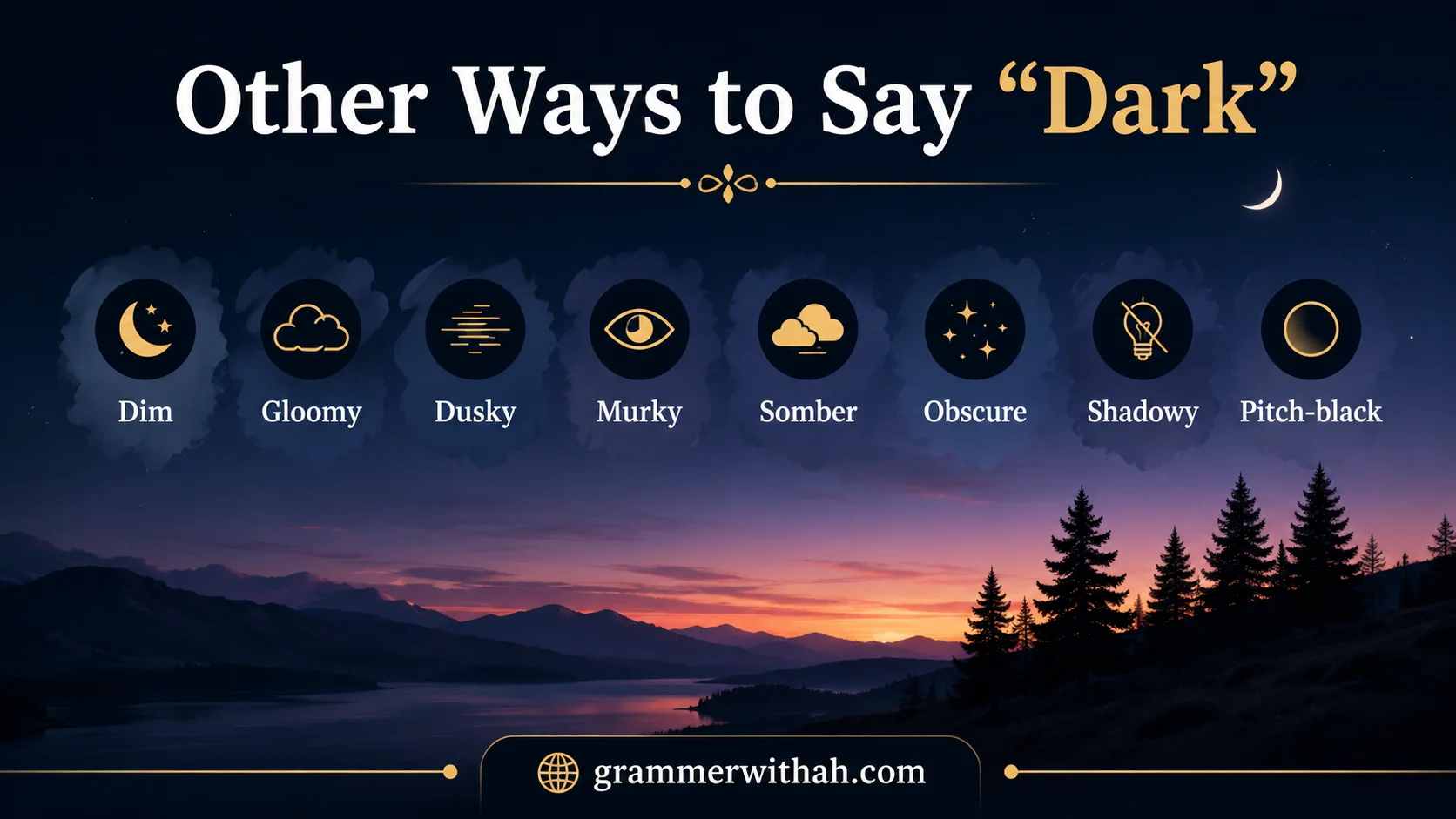
Other Ways to Say “Dark” (With Examples) is a helpful guide for anyone who wants to improve their English vocabulary and use more natural synonyms. Instead of repeating the word dark, you can choose from many alternative words and expressions that better match the meaning and tone of your sentence. Learning these options will make your writing and speaking more engaging, accurate, and easier to understand in different situations.
The word dark can describe lack of light, a gloomy mood, something hidden, mysterious, or even difficult to understand. In this article, you will explore other ways to say dark, along with simple examples, helpful explanations, and practical tips for choosing the best synonym. These alternatives will help you communicate more clearly and confidently in everyday conversations and writing.
What Does “Dark” Mean?
The word “Dark” describes something with little or no light, making it difficult to see clearly. It can also describe colors, moods, emotions, themes, or situations that feel serious, mysterious, gloomy, or intense depending on the context. Because it has many meanings, choosing the right synonym helps your message become clearer and more expressive.
Is It Professional/Polite to Say “Dark”?
Yes, “Dark” is generally professional and polite when used in the correct context. It works well in everyday conversations, business writing, creative content, and academic discussions. However, if you want to sound more descriptive or precise, selecting an alternative that better matches your intended meaning often creates a stronger impression.
Pros and Cons of Saying “Dark”
Pros
- Simple and easy for everyone to understand.
- Fits many different situations and writing styles.
- Works well for describing colors, places, emotions, and themes.
- Commonly accepted in both formal and informal communication.
Cons
- Can become repetitive when used frequently.
- May not always express the exact mood or level of darkness.
- Sometimes sounds too general without additional description.
- Stronger alternatives can make writing more vivid and engaging.
“Dark” Synonyms
- Dim
- Shadowy
- Gloomy
- Murky
- Dusky
- Black
- Pitch-Black
- Shaded
- Obscure
- Dull
- Clouded
- Overcast
- Somber
- Mysterious
- Ominous
- Bleak
- Faded
- Twilight
- Low-Lit
- Midnight
- Inky
- Smoky
- Hidden
- Unlit
- Lightless
1. Dim
Scenario Meaning:
Dim describes something with only a small amount of light, making objects visible but not bright enough for clear or comfortable viewing in most situations.
Examples:
- The dim hallway created a peaceful atmosphere that encouraged everyone to speak quietly and move carefully.
- We enjoyed dinner in a dim restaurant where the gentle lighting made the evening feel warm and relaxing.
- The dim bedroom light helped the children fall asleep more comfortably after a long and exciting day.
- She carefully searched the dim basement because the old light bulb barely illuminated the entire room.
- The dim evening sky slowly welcomed the beautiful stars as the sun disappeared below the horizon.
Tone:
Soft, calm, descriptive, and gentle.
Details Explanation:
Dim usually refers to reduced brightness instead of complete darkness. It creates a peaceful, relaxing, or slightly mysterious feeling without suggesting total absence of light.
Best Use:
Use Dim when describing lighting, rooms, streets, restaurants, or peaceful evening settings.
2. Shadowy
Scenario Meaning:
Shadowy describes something covered by shadows or partially hidden from light, giving the place or object a mysterious and slightly uncertain appearance.
Examples:
- The shadowy forest looked beautiful as sunlight passed gently through the tall trees during the afternoon.
- A shadowy figure quietly walked across the empty street before disappearing behind an old building.
- The old castle contained several shadowy hallways that fascinated every curious visitor throughout the guided tour.
- We noticed a shadowy corner inside the room where the sunlight could not easily reach.
- The photographer captured the shadowy landscape beautifully during the peaceful evening hours.
Tone:
Mysterious, descriptive, and imaginative.
Details Explanation:
Shadowy focuses on the presence of shadows instead of complete darkness, making it especially useful for storytelling, descriptions, and creative writing.
Best Use:
Use Shadowy for forests, buildings, photographs, mysterious scenes, and fictional stories.
3. Gloomy
Scenario Meaning:
Gloomy describes something that feels dark, depressing, or lacking brightness, often creating a sad, quiet, or serious atmosphere.
Examples:
- The gloomy weather encouraged everyone to stay indoors and enjoy a peaceful afternoon together.
- The abandoned house looked gloomy because no sunlight entered through its broken windows anymore.
- His office appeared gloomy until colorful decorations completely transformed the working environment.
- The gloomy sky suggested that heavy rain would arrive later in the evening.
- The movie opened with a gloomy scene that immediately captured everyone’s attention.
Tone:
Serious, emotional, and descriptive.
Details Explanation:
Gloomy often describes both physical darkness and emotional sadness, making it useful for discussing weather, places, feelings, or dramatic situations.
Best Use:
Use Gloomy when describing weather, moods, emotional scenes, or quiet environments.
4. Murky
Scenario Meaning:
Murky describes something dark, cloudy, or difficult to see through, often because the light is blocked or the surroundings are unclear.
Examples:
- The murky water prevented us from seeing the colorful fish swimming underneath the surface.
- Thick clouds made the afternoon appear murky, even though it was still early in the day.
- The explorers carefully walked through the murky cave while carrying bright flashlights for safety.
- The photographer enjoyed capturing the murky atmosphere before the storm finally arrived.
- The old tunnel remained murky despite the small lights placed along the walls.
Tone:
Descriptive, mysterious, and slightly dramatic.
Details Explanation:
Murky usually suggests unclear visibility caused by darkness, fog, smoke, or dirty water, creating an uncertain or mysterious impression.
Best Use:
Use Murky for water, caves, tunnels, weather, and mysterious environments.
5. Dusky
Scenario Meaning:
Dusky describes the soft darkness that appears during the evening, creating a calm, peaceful, and beautiful atmosphere before night fully arrives.
Examples:
- The dusky sky displayed beautiful shades of orange, purple, and blue before complete darkness arrived.
- Birds quietly returned home as the dusky evening covered the peaceful countryside.
- We enjoyed a relaxing walk beneath the dusky sky after finishing dinner together.
- The dusky landscape looked peaceful while the first evening stars slowly became visible.
- She admired the dusky horizon from the hill before heading back home.
Tone:
Warm, peaceful, and poetic.
Details Explanation:
Dusky refers to the gentle darkness of twilight, making it a beautiful choice for descriptive and creative writing.
Best Use:
Use Dusky when describing sunsets, evenings, landscapes, and peaceful outdoor scenes.
6. Black
Scenario Meaning:
Black describes the darkest color, representing the complete absence of visible light while also symbolizing elegance, mystery, strength, or seriousness in different contexts.
Examples:
- She wore a black dress that looked elegant and perfectly matched the formal evening celebration.
- The sky became completely black after the sun disappeared behind the distant mountains.
- A black curtain covered the stage before the performers appeared with an exciting presentation.
- The artist used black paint carefully to create bold contrast throughout the beautiful portrait.
- Thick black clouds gathered above the city before the heavy rainfall finally began.
Tone:
Neutral, descriptive, and powerful.
Details Explanation:
Black is one of the most common alternatives for dark because it clearly describes color, appearance, or complete darkness while fitting both everyday and professional writing.
Best Use:
Use Black when describing colors, clothing, objects, skies, or dramatic visual scenes.
7. Pitch-Black
Scenario Meaning:
Pitch-black describes complete darkness with absolutely no visible light, making it almost impossible to see anything clearly around you.
Examples:
- The cave became pitch-black after everyone switched off their flashlights for a brief moment.
- We carefully walked across the pitch-black field while using our phones as emergency lights.
- The neighborhood looked pitch-black because a sudden power outage affected every nearby home.
- The forest remained pitch-black until the bright moon slowly appeared above the trees.
- Opening the old storage room revealed a pitch-black space that had not been used for years.
Tone:
Strong, dramatic, and vivid.
Details Explanation:
Pitch-black emphasizes total darkness, making it more expressive than simply saying dark in descriptive or creative writing.
Best Use:
Use Pitch-black for night scenes, caves, tunnels, power outages, or suspenseful storytelling.
8. Shaded
Scenario Meaning:
Shaded describes an area protected from direct sunlight, making it cooler, darker, and more comfortable during bright weather.
Examples:
- We enjoyed lunch beneath a shaded tree while listening to the peaceful sounds of nature.
- The shaded garden remained cool even during the hottest part of the summer afternoon.
- Children happily played in the shaded playground to avoid the strong afternoon sunshine.
- The bench was placed in a shaded corner where visitors could relax comfortably.
- A shaded pathway guided us through the beautiful park filled with tall green trees.
Tone:
Gentle, natural, and descriptive.
Details Explanation:
Shaded focuses on reduced sunlight rather than complete darkness, making it ideal for outdoor descriptions and everyday conversations.
Best Use:
Use Shaded when describing parks, gardens, patios, streets, or outdoor seating areas.
9. Obscure
Scenario Meaning:
Obscure describes something difficult to see, understand, or notice, often because it is hidden, unclear, or surrounded by darkness.
Examples:
- The mountain path became obscure as thick fog covered the surrounding landscape.
- An obscure sign stood quietly beside the road where very few travelers noticed it.
- The ancient painting remained obscure until experts carefully restored its original beauty.
- His explanation seemed obscure, making the audience ask several thoughtful questions afterward.
- The building looked obscure behind the heavy rain and dark evening clouds.
Tone:
Formal, thoughtful, and descriptive.
Details Explanation:
Obscure can describe physical darkness or lack of clarity, making it useful for both visual descriptions and abstract ideas.
Best Use:
Use Obscure in formal writing, academic discussions, literature, or descriptive storytelling.
10. Dull
Scenario Meaning:
Dull describes something lacking brightness, vividness, or energy, creating a darker or less colorful appearance than expected.
Examples:
- The dull sky suggested that rain might arrive before the evening ended peacefully.
- His dull flashlight barely produced enough light to guide us safely through the trail.
- The room looked dull until fresh paint completely changed its appearance.
- A dull afternoon encouraged everyone to stay indoors and enjoy quiet family activities.
- The old photograph had dull colors because many years had passed since it was printed.
Tone:
Neutral, descriptive, and calm.
Details Explanation:
Dull often describes reduced brightness or color intensity, making it suitable for discussing objects, weather, interiors, and artwork.
Best Use:
Use Dull when describing colors, lighting, weather, photographs, or room appearances.
11. Clouded
Scenario Meaning:
Clouded describes something covered, hidden, or made darker by clouds, smoke, fog, or another blocking element that reduces visibility.
Examples:
- The clouded sky slowly blocked the warm sunshine during the peaceful afternoon picnic.
- Her glasses became clouded, making it difficult to see the beautiful scenery ahead.
- The mountains appeared clouded because heavy fog surrounded their highest peaks.
- A clouded evening created a peaceful atmosphere before the gentle rain finally arrived.
- The mirror remained clouded after everyone finished taking warm showers.
Tone:
Calm, descriptive, and reflective.
Details Explanation:
Clouded emphasizes partial coverage or reduced clarity instead of complete darkness, making it useful for visual and figurative descriptions.
Best Use:
Use Clouded for weather, mirrors, skies, mountains, or situations with reduced visibility.
12. Overcast
Scenario Meaning:
Overcast describes a sky completely covered by clouds, creating darker daylight with little direct sunshine throughout the day.
Examples:
- The overcast morning encouraged us to carry umbrellas before leaving the house.
- An overcast sky made the beach feel peaceful and wonderfully quiet.
- Farmers welcomed the overcast weather because it kept temperatures comfortable during work.
- The city looked beautiful beneath an overcast afternoon filled with gentle gray clouds.
- We continued our walk despite the overcast conditions because the weather remained pleasant.
Tone:
Neutral, natural, and informative.
Details Explanation:
Overcast is mainly used for weather descriptions, referring to skies filled with clouds that reduce natural brightness.
Best Use:
Use Overcast when discussing weather forecasts, travel writing, nature descriptions, or outdoor activities.
13. Somber
Scenario Meaning:
Somber describes a dark, serious, quiet, or emotionally heavy atmosphere that reflects respect, sadness, or deep thought.
Examples:
- The memorial ceremony had a somber atmosphere that encouraged everyone to reflect quietly.
- His somber expression showed that he was thinking carefully about the important decision ahead.
- The movie opened with a somber scene that immediately captured the audience’s emotions.
- Soft music created a somber mood during the emotional farewell gathering.
- The old church felt somber because of its quiet interior and gentle lighting.
Tone:
Respectful, emotional, and formal.
Details Explanation:
Somber usually refers to serious emotions or quiet surroundings rather than physical darkness, making it perfect for emotional writing.
Best Use:
Use Somber when describing ceremonies, emotional moments, literature, speeches, or thoughtful conversations
14. Mysterious
Scenario Meaning:
Mysterious describes something that is difficult to understand, hidden from view, or surrounded by uncertainty, often creating curiosity because important details remain unknown or unclear.
Examples:
- The mysterious forest attracted adventurous travelers who wanted to discover its hidden paths and beautiful secrets.
- Everyone became interested after hearing the mysterious sound coming from the quiet old house late at night.
- She smiled with a mysterious expression that made everyone wonder what exciting news she was about to share.
- The novel introduced a mysterious character whose background slowly became clear throughout the story.
- Thick fog gave the lake a mysterious appearance during the calm early morning hours.
Tone:
Curious, imaginative, and intriguing.
Details Explanation:
Mysterious emphasizes uncertainty and hidden qualities instead of simple darkness. It is an excellent choice for storytelling, descriptive writing, and creative content.
Best Use:
Use Mysterious for stories, novels, movies, landscapes, or situations that spark curiosity.
15. Ominous
Scenario Meaning:
Ominous describes something that appears threatening or suggests that an unpleasant event may happen, creating a feeling of tension or concern.
Examples:
- The ominous clouds made everyone prepare for a powerful storm before leaving the park.
- An ominous silence filled the room after the unexpected announcement ended the conversation.
- The movie began with ominous music that immediately created suspense among the audience.
- Dark smoke gave the building an ominous appearance from a distance.
- The ominous sky encouraged local residents to secure their homes before the heavy rain arrived.
Tone:
Serious, dramatic, and suspenseful.
Details Explanation:
Ominous suggests danger, uncertainty, or warning, making it stronger than the simple word dark when describing serious situations.
Best Use:
Use Ominous for storms, suspenseful stories, dramatic scenes, or warning signs.
Read More: 20 Other Ways to Say “CALM” (With Examples)
16. Bleak
Scenario Meaning:
Bleak describes a place, situation, or atmosphere that feels cold, empty, dark, or without hope, creating a serious emotional impression.
Examples:
- The bleak winter landscape stretched across the hills beneath the gray afternoon sky.
- The abandoned building looked bleak after many years without care or maintenance.
- A bleak forecast encouraged travelers to delay their outdoor plans until the weather improved.
- The novel described a bleak future before introducing hope near the ending.
- The empty street appeared bleak during the cold evening as light rain quietly continued.
Tone:
Serious, emotional, and descriptive.
Details Explanation:
Bleak combines physical darkness with emotional emptiness, making it effective for literature, storytelling, and thoughtful writing.
Best Use:
Use Bleak when describing weather, landscapes, emotional settings, or difficult situations.
17. Faded
Scenario Meaning:
Faded describes something that has gradually lost its brightness, color, or clarity, making it appear older, softer, or less noticeable.
Examples:
- The faded painting still displayed remarkable beauty despite its age and worn appearance.
- She carefully preserved the faded family photograph because it contained many precious memories.
- The old sign had faded letters that were difficult to read from a distance.
- The curtains looked faded after years of constant sunlight through the large windows.
- We admired the faded evening light before darkness completely covered the landscape.
Tone:
Gentle, nostalgic, and descriptive.
Details Explanation:
Faded highlights a gradual loss of brightness or color, making it suitable for describing objects, photographs, memories, or natural scenes.
Best Use:
Use Faded for old photographs, artwork, clothing, signs, or evening light.
18. Twilight
Scenario Meaning:
Twilight describes the soft period between daylight and complete darkness, creating a peaceful and beautiful transition as the day ends.
Examples:
- The twilight sky displayed beautiful shades of pink, purple, and blue above the mountains.
- We enjoyed a peaceful walk together during twilight before the stars filled the sky.
- Birds quietly returned to their nests during the calm twilight hours.
- The photographer captured the breathtaking beauty of twilight beside the peaceful lake.
- Gentle breezes made the twilight evening even more relaxing for everyone outdoors.
Tone:
Peaceful, poetic, and elegant.
Details Explanation:
Twilight refers to the natural light after sunset or before sunrise, making it a beautiful alternative when describing calm evening settings.
Best Use:
Use Twilight for nature writing, travel articles, poetry, or peaceful outdoor descriptions.
19. Low-Lit
Scenario Meaning:
Low-lit describes a place with intentionally reduced lighting, creating a cozy, quiet, or elegant atmosphere without complete darkness.
Examples:
- The low-lit restaurant created a romantic setting for the special anniversary dinner.
- We relaxed inside a low-lit café while enjoying warm drinks during the rainy afternoon.
- The low-lit lounge offered a peaceful environment for friendly conversations.
- Soft lamps kept the bedroom low-lit, making it perfect for reading before bedtime.
- The low-lit hallway looked stylish because of its carefully designed lighting.
Tone:
Warm, modern, and comfortable.
Details Explanation:
Low-lit focuses on intentional lighting design, making it ideal for describing restaurants, cafés, hotels, or elegant interiors.
Best Use:
Use Low-lit for restaurants, hotels, lounges, bedrooms, or relaxing indoor spaces.
20. Midnight
Scenario Meaning:
Midnight describes the deepest part of the night, often representing complete darkness, quiet surroundings, and peaceful silence.
Examples:
- The midnight sky sparkled beautifully with countless bright stars above the countryside.
- We reached home safely just after midnight following a wonderful family celebration.
- The peaceful streets remained completely silent at midnight during the holiday weekend.
- A cool breeze flowed through the trees beneath the beautiful midnight sky.
- The writer found inspiration while working during the quiet hours of midnight.
Tone:
Peaceful, descriptive, and elegant.
Details Explanation:
Midnight often symbolizes deep darkness and quietness, making it suitable for descriptive writing and creative storytelling.
Best Use:
Use Midnight when describing nighttime, skies, peaceful settings, or literary scenes.
21. Inky
Scenario Meaning:
Inky describes a darkness so deep and rich that it resembles black ink, creating vivid and dramatic visual imagery.
Examples:
- The inky sky stretched endlessly above the quiet countryside after sunset.
- Thick smoke created an inky cloud that slowly disappeared into the evening air.
- The lake reflected the inky night sky with remarkable clarity and beauty.
- An inky darkness surrounded the old cabin after every light was switched off.
- The artist painted an inky background to highlight the colorful foreground perfectly.
Tone:
Creative, vivid, and expressive.
Details Explanation:
Inky is commonly used in creative and descriptive writing because it paints a strong visual image of extremely deep darkness.
Best Use:
Use Inky for creative writing, novels, poetry, artwork, or vivid nighttime descriptions.
22. Smoky
Scenario Meaning:
Smoky describes something filled with smoke, haze, or a dark mist, making the surroundings appear less clear while creating a dramatic or atmospheric effect.
Examples:
- The smoky mountain view looked breathtaking as the morning mist slowly drifted through the valley.
- A smoky atmosphere surrounded the stage and made the performance feel more exciting and memorable.
- The fireplace created a smoky scent that reminded everyone of peaceful winter evenings together.
- Thick smoky clouds covered the hills before the gentle rain finally began to fall.
- The photographer captured the smoky sunset beautifully as the fading sunlight reflected across the lake.
Tone:
Atmospheric, descriptive, and creative.
Details Explanation:
Smoky emphasizes a hazy or smoke-filled appearance rather than complete darkness. It creates vivid imagery and works especially well in descriptive and creative writing.
Best Use:
Use Smoky for landscapes, sunsets, mountains, photography, theatrical scenes, or artistic descriptions.
23. Hidden
Scenario Meaning:
Hidden describes something that is concealed, covered, or difficult to notice, making it less visible because it remains behind another object or within darkness.
Examples:
- The hidden pathway led visitors through a peaceful garden filled with colorful flowers and tall trees.
- She discovered a hidden treasure box beneath the old wooden floor during the renovation project.
- The small village remained hidden among the mountains for many generations.
- A hidden doorway surprised everyone as it quietly opened inside the ancient castle.
- The hidden stars gradually appeared after the thick clouds finally disappeared from the night sky.
Tone:
Intriguing, descriptive, and imaginative.
Details Explanation:
Hidden focuses on something being concealed instead of simply dark, making it useful when describing places, objects, ideas, or discoveries.
Best Use:
Use Hidden for stories, adventures, mysteries, travel writing, or secret locations.
24. Unlit
Scenario Meaning:
Unlit describes a place, object, or area without any active source of light, making it naturally darker than the surrounding environment.
Examples:
- The unlit hallway became difficult to walk through until someone switched on the nearby lights.
- We carefully crossed the unlit parking area while using our mobile phone flashlights for guidance.
- The unlit street looked peaceful beneath the bright moon and countless shining stars.
- An unlit room remained quiet until the curtains were opened to let sunlight enter.
- The hikers avoided the unlit trail because visibility became extremely limited after sunset.
Tone:
Clear, practical, and descriptive.
Details Explanation:
Unlit simply means without lighting, making it a precise alternative for technical, descriptive, or everyday communication.
Best Use:
Use Unlit when describing roads, hallways, buildings, parks, rooms, or outdoor pathways.
25. Lightless
Scenario Meaning:
Lightless describes a place completely lacking natural or artificial light, creating an image of absolute darkness and stillness.
Examples:
- The explorers entered a lightless cave while carrying powerful flashlights for safety and guidance.
- A lightless tunnel stretched beneath the mountain for several kilometers before reaching the exit.
- The abandoned basement remained lightless because electricity had been disconnected many years earlier.
- The lightless forest created a peaceful yet mysterious atmosphere beneath the cloudy night sky.
- The novel described a lightless world before hope finally returned to its characters.
Tone:
Powerful, dramatic, and literary.
Details Explanation:
Lightless is a stronger and more expressive alternative to dark, often appearing in literature, fantasy writing, and dramatic descriptions that require vivid imagery.
Best Use:
Use Lightless for novels, poetry, fantasy stories, dramatic scenes, or powerful descriptive writing.
FAQs :
1. What are other ways to say “dark”?
Some common synonyms for dark are dim, gloomy, shadowy, dusky, and black. The best word depends on the exact meaning you want to express.
2. Can “dark” have different meanings?
Yes, dark can mean no light, but it can also describe something mysterious, serious, hidden, or hard to understand.
3. What is a more positive word for “dark”?
Words like dim, deep, or shadowed may sound softer than dark, depending on the sentence and tone.
4. How do I choose the best synonym for “dark”?
Choose the word that matches the context. For example, use shadowy for a place, gloomy for a mood, and dim for low light.
5. Why should I learn other ways to say “dark”?
Learning more synonyms helps you sound more natural, avoid repetition, and make your writing more clear, interesting, and expressive.
Conclusion :
Knowing other ways to say “dark” gives you more freedom in writing and speaking. Whether you want to describe light, mood, mystery, or hidden meaning, the right word can make your message stronger and more precise. With the right synonyms and examples, it becomes much easier to express yourself clearly and confidently.