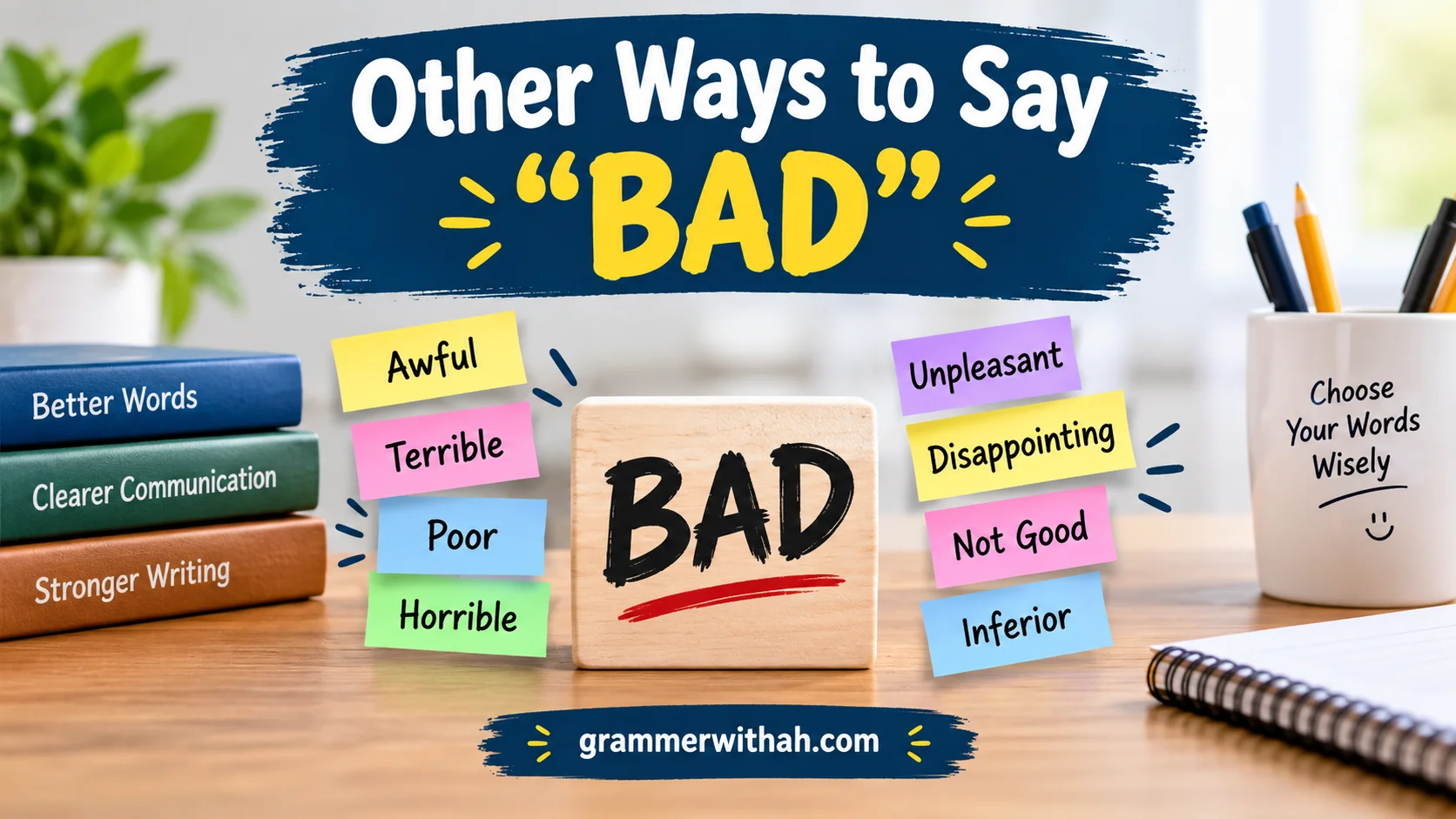
Other Ways to Say “BAD” (With Examples) helps you choose useful, clear, and effective words for writing, speech, and everyday communication. Instead of using bad repeatedly, you can choose alternatives that explain your feeling more clearly. Words such as awful, terrible, horrible, poor, and unpleasant can describe different situations. Using the right synonyms also makes your message more meaningful, especially when you are explaining a problem, sharing an experience, or writing an email.
Different words can express different levels of a negative experience. For example, defective can describe poor-quality products, while harmful suggests possible damage. Inadequate may describe something that does not meet expectations, while unacceptable shows stronger disapproval. Learning these expressions can improve your English vocabulary, word choice, and sentence structure. With regular usage and practice, you can communicate with more clarity, respect, and confidence in both personal and professional situations.
What Does “BAD” Mean?
The word “bad” generally describes something that is unpleasant, poor, harmful, disappointing, incorrect, or below an expected standard. Its meaning can change depending on the situation, because something may be bad in quality, behavior, results, condition, or emotional effect. Although bad is common and easy to understand, choosing a more specific alternative can make your communication clearer and more thoughtful.
Is It Professional or Polite to Say “BAD”?
Using “bad” is not automatically rude or unprofessional, because the word is common and acceptable in everyday and professional communication. However, simply calling something bad may sound overly direct when you are discussing another person’s work, behavior, performance, or personal effort. In professional situations, alternatives such as poor, unsatisfactory, unfavorable, disappointing, or problematic can communicate concerns more respectfully.
Pros and Cons of “BAD”
Pros:
1. Simple: The word bad is easy for almost everyone to understand without additional explanation or complicated vocabulary.
2. Direct: It communicates a clearly negative opinion without requiring a long or complicated description.
3. Flexible: The word can describe quality, behavior, experiences, situations, results, feelings, or conditions.
Cons:
1. Vague: The word bad does not always explain exactly what is wrong or why something is unsatisfactory.
2. Harsh: Calling someone’s work or behavior bad may feel unnecessarily critical or discouraging.
3. Less professional: More specific alternatives can often sound polished, constructive, and respectful in workplace communication.
Synonyms “BAD”
- Poor
- Unpleasant
- Terrible
- Awful
- Harmful
- Negative
- Unsatisfactory
- Disappointing
- Unfavorable
- Problematic
- Inferior
- Deficient
- Inadequate
- Unacceptable
- Troublesome
- Damaging
- Faulty
- Flawed
- Unfortunate
- Substandard
- Unsuitable
- Distressing
- Dreadful
- Unhealthy
- Detrimental
1. Poor
Scenario Meaning: Poor describes something that has low quality, weak performance, limited effectiveness, or a result that does not meet reasonable expectations.
Examples:
- The project received poor results because several important requirements were overlooked during the planning process.
- We experienced poor communication throughout the project, which created unnecessary confusion for everyone involved.
- The product showed poor quality despite receiving positive attention before its official release.
- His poor performance improved considerably after receiving clear guidance and helpful feedback.
- The report contained poor explanations that made several important points difficult for readers to understand.
Tone: The word poor sounds professional, neutral, and less emotionally harsh than the direct word bad.
Details Explanation: Poor works especially well when discussing quality, performance, communication, service, results, or standards without sounding unnecessarily personal or aggressive.
Best Use: Use poor when you want to describe something objectively while maintaining a professional and respectful tone.
2. Unpleasant
Scenario Meaning: Unpleasant describes something that causes discomfort, irritation, sadness, dislike, inconvenience, or an emotionally uncomfortable experience.
Examples:
- The conversation became unpleasant after several misunderstandings were brought into the discussion.
- We had an unpleasant experience because the service did not match the expectations explained beforehand.
- The weather created unpleasant conditions for everyone attending the outdoor event.
- She remembered the meeting as an unpleasant experience that she preferred not to repeat.
- The strong smell created an unpleasant atmosphere throughout the otherwise comfortable room.
Tone: The word unpleasant sounds polite, gentle, and considerate when describing uncomfortable experiences.
Details Explanation: Unpleasant focuses more on how something feels rather than directly judging its quality, making it a softer alternative to bad.
Best Use: Use unpleasant when describing experiences, situations, conversations, environments, or feelings that create discomfort.
3. Terrible
Scenario Meaning: Terrible describes something extremely unpleasant, seriously disappointing, very poor, or emotionally difficult beyond ordinary levels of dissatisfaction.
Examples:
- The storm caused terrible damage to several buildings across the area during the night.
- I felt terrible after realizing that my careless decision had affected everyone else.
- The restaurant received terrible reviews because customers repeatedly complained about the service.
- We experienced terrible delays that made the entire journey much longer than expected.
- The team faced a terrible setback just before reaching an important deadline.
Tone: Terrible sounds strong and emotional, making it more intense than ordinary alternatives such as poor or unpleasant.
Details Explanation: This word emphasizes a high level of negativity and should therefore be used when the situation genuinely feels serious, extreme, or deeply disappointing.
Best Use: Use terrible when you need to express strong disappointment, seriousness, or emotional reaction.
4. Awful
Scenario Meaning: Awful describes something extremely unpleasant, disappointing, uncomfortable, or poor in a way that creates a strong negative reaction.
Examples:
- The movie received an awful response from viewers who expected something much more engaging.
- I had an awful headache that made concentrating on my work extremely difficult.
- The service was awful, although the staff eventually apologized for the problems.
- We experienced an awful delay that caused several important plans to change.
- He felt awful about forgetting an important promise that meant a great deal to someone.
Tone: Awful is emotional and informal, although it remains common and understandable in many everyday conversations.
Details Explanation: The word expresses stronger negativity than bad, especially when describing personal experiences, feelings, service, events, or uncomfortable circumstances.
Best Use: Use awful in casual conversations when you want to communicate strong dislike or disappointment clearly.
5. Harmful
Scenario Meaning: Harmful describes something that causes, creates, or is likely to create physical, emotional, social, financial, or other forms of damage.
Examples:
- Constant negative criticism can be harmful to someone’s confidence and willingness to improve.
- The organization recognized that the outdated policy could have harmful effects on employees.
- Spreading unverified information can be harmful because people may make decisions based on false assumptions.
- The company removed the product after discovering potentially harmful materials within its construction.
- His comments were unintentionally harmful, even though he never intended to hurt anyone.
Tone: Harmful sounds serious, objective, and appropriate when discussing possible damage or negative consequences.
Details Explanation: Unlike the broad word bad, harmful clearly communicates that something creates or may create real negative effects.
Best Use: Use harmful when discussing actions, habits, choices, substances, behaviors, or situations that can cause damage.
6. Negative
Scenario Meaning: Negative describes something unfavorable, discouraging, undesirable, critical, or associated with an unwanted result or attitude.
Examples:
- The decision could have a negative impact on employees who depend on flexible working arrangements.
- She tried to avoid making negative comments about someone’s work during the discussion.
- The experience created a negative impression that took considerable effort to change.
- His negative attitude made it difficult for the team to maintain motivation.
- The company received negative feedback but used those comments to improve its services.
Tone: Negative sounds neutral, professional, and less emotionally aggressive than many stronger alternatives.
Details Explanation: This word is particularly useful because it can describe effects, attitudes, feedback, opinions, outcomes, and circumstances without sounding overly dramatic.
Best Use: Use negative in professional, academic, and everyday communication when you want a balanced expression.
7. Unsatisfactory
Scenario Meaning: Unsatisfactory describes something that fails to reach an expected, required, acceptable, or reasonable level of quality or performance.
Examples:
- The final report was considered unsatisfactory because several required sections were incomplete.
- The service provided was unsatisfactory, especially considering the amount customers were expected to pay.
- His initial performance was unsatisfactory, although improvement became noticeable after additional training.
- The committee described the proposed solution as unsatisfactory for the current situation.
- We believe the current arrangement remains unsatisfactory and requires further discussion before approval.
Tone: Unsatisfactory sounds formal, professional, objective, and considerably more diplomatic than directly saying something is bad.
Details Explanation: This alternative works particularly well when something fails to meet a recognized standard, requirement, expectation, or agreed level of quality.
Best Use: Use unsatisfactory for workplace feedback, academic assessments, services, performance reviews, and formal complaints.
8. Disappointing
Scenario Meaning: Disappointing describes something that fails to meet expectations and leaves someone feeling let down, dissatisfied, or emotionally discouraged.
Examples:
- The final result was disappointing because everyone had expected stronger progress by that stage.
- It was disappointing to see such an important opportunity disappear unexpectedly.
- The customer described the experience as disappointing but appreciated the company’s response.
- His performance was disappointing, although the team still believed he could improve.
- The outcome felt disappointing because so much preparation had gone into the event.
Tone: Disappointing sounds empathetic and emotionally aware because it focuses on unmet expectations rather than harsh judgment.
Details Explanation: This word is useful when something feels less successful or satisfying than hoped, especially when emotions are involved.
Best Use: Use disappointing when discussing results, experiences, performances, events, decisions, or situations that did not meet expectations.
9. Unfavorable
Scenario Meaning: Unfavorable describes something that creates disadvantages, negative conditions, poor prospects, or circumstances that are not beneficial.
Examples:
- The team continued working despite unfavorable conditions during the final stage of preparation.
- The company received unfavorable feedback after introducing several unexpected changes.
- The weather created unfavorable conditions for the outdoor competition.
- The decision could produce unfavorable results if the current concerns remain unresolved.
- The proposal received an unfavorable response from several members of the committee.
Tone: Unfavorable sounds formal, polished, neutral, and particularly suitable for professional or academic communication.
Details Explanation: This word communicates negativity without sounding emotional, making it useful when discussing conditions, opinions, outcomes, responses, or circumstances.
Best Use: Use unfavorable in formal reports, business communication, evaluations, and analytical writing.
10. Problematic
Scenario Meaning: Problematic describes something that creates difficulties, raises concerns, contains weaknesses, or may lead to complications.
Examples:
- The current system is problematic because employees regularly experience unnecessary technical difficulties.
- His approach became problematic when several important details were ignored.
- The agreement contains problematic sections that should be reviewed before anyone signs it.
- This communication method may become problematic when deadlines become increasingly demanding.
- The plan seems problematic because it does not address the concerns raised by customers.
Tone: Problematic sounds professional, constructive, and less judgmental because it focuses on difficulties rather than personal blame.
Details Explanation: This alternative is valuable when something is not simply bad but contains specific problems, risks, weaknesses, or complications that deserve attention.
Best Use: Use problematic for plans, policies, systems, decisions, behaviors, situations, and processes that need improvement.
11. Inferior
Scenario Meaning: Inferior describes something that is lower in quality, ability, value, effectiveness, or standard compared with another relevant option.
Examples:
- The replacement material was considered inferior to the original product used previously.
- Customers complained that the newer version offered inferior performance despite costing more.
- The second option appeared inferior when both solutions were carefully compared.
- The manufacturer stopped using the inferior material after repeated quality concerns.
- His earlier results were inferior to the improvements achieved during the following year.
Tone: Inferior sounds formal and comparative, although it can feel critical when directed toward a person’s abilities.
Details Explanation: The word usually implies a comparison, meaning one thing performs or measures below another according to a particular standard.
Best Use: Use inferior when making careful comparisons involving quality, performance, value, materials, or effectiveness.
12. Deficient
Scenario Meaning: Deficient describes something that lacks an important quality, amount, feature, ability, or standard necessary for satisfactory performance.
Examples:
- The report was deficient because several important sources were missing from the research.
- The current system is deficient in areas that require faster communication and better organization.
- His application was considered deficient because essential information had not been provided.
- The product was deficient in durability compared with similar options available.
- The training program remains deficient in practical activities that develop real workplace skills.
Tone: Deficient sounds formal, analytical, and objective, making it useful for professional evaluations.
Details Explanation: This word emphasizes that something is missing or lacking, rather than simply being unpleasant or disappointing.
Best Use: Use deficient in formal assessments, reports, evaluations, academic writing, and technical discussions.
13. Inadequate
Scenario Meaning: Inadequate describes something that is insufficient, unsuitable, or not good enough to satisfy a particular need, requirement, or expectation.
Examples:
- The current equipment is inadequate for handling the increasing number of daily requests.
- His preparation was inadequate for such an important presentation and complex discussion.
- The explanation was inadequate because it failed to answer several important questions.
- The available resources remain inadequate for completing the project within the expected timeline.
- The existing support system appears inadequate for people facing repeated technical problems.
Tone: Inadequate sounds professional, measured, and constructive because it identifies insufficiency rather than simply criticizing something.
Details Explanation: The word clearly communicates that something does not provide enough quality, support, resources, preparation, or effectiveness for a specific purpose.
Best Use: Use inadequate when explaining that something does not sufficiently meet a particular need or standard.
Read This: 25 Other Ways to Say “AMAZING” (With Examples)
14. Unacceptable
Scenario Meaning: Unacceptable describes something that fails to meet an established standard and cannot reasonably be approved, tolerated, or considered appropriate.
Examples:
- The level of service was unacceptable because customers repeatedly experienced the same unresolved problems.
- Such behavior is unacceptable because everyone deserves to be treated with basic respect.
- The final submission contained unacceptable errors that needed correction before approval.
- The current working conditions are unacceptable and require immediate attention from management.
- The delay became unacceptable after several previously promised deadlines had already passed.
Tone: Unacceptable sounds firm, serious, and authoritative, making it stronger than softer alternatives.
Details Explanation: This word communicates that something crosses a clear boundary or standard, rather than merely being disappointing or imperfect.
Best Use: Use unacceptable when discussing serious mistakes, harmful behavior, poor standards, violations, or conditions requiring correction.
15. Troublesome
Scenario Meaning: Troublesome describes something that causes repeated difficulty, inconvenience, worry, disruption, or complications.
Examples:
- The outdated software has become troublesome because employees regularly experience unexpected interruptions.
- Finding accurate information proved troublesome during the early stages of the research.
- The repeated scheduling changes became troublesome for everyone involved in the project.
- This particular issue may become troublesome if nobody addresses it soon.
- The repair process was troublesome, although the final solution worked successfully.
Tone: Troublesome sounds relatively mild, conversational, and less harsh than words such as terrible or awful.
Details Explanation: It describes something that creates ongoing inconvenience or difficulty without necessarily suggesting severe damage or failure.
Best Use: Use troublesome when discussing minor or moderate problems, inconveniences, complications, or recurring difficulties.
16. Damaging
Scenario Meaning: Damaging describes something that causes harm, weakens a situation, reduces value, or negatively affects people, relationships, systems, or outcomes.
Examples:
- Spreading rumors can be damaging to someone’s reputation and emotional confidence.
- The decision could be damaging to the company’s long-term relationship with customers.
- Constant arguments became damaging to the team’s ability to work together effectively.
- The mistake had damaging consequences that required several weeks to resolve.
- Negative assumptions can become damaging when they prevent people from communicating honestly.
Tone: Damaging sounds serious, objective, and concerned with consequences rather than simple personal dislike.
Details Explanation: The word emphasizes that something creates actual or potential harm, making it more precise than the broad term bad.
Best Use: Use damaging when describing actions, choices, mistakes, habits, conflicts, or decisions that produce harmful consequences.
17. Faulty
Scenario Meaning: Faulty describes something that contains a defect, does not work correctly, or fails because of a technical or structural problem.
Examples:
- The technician discovered a faulty component during the inspection of the machine.
- The company replaced the faulty equipment after receiving several customer complaints.
- The device stopped working because one of its internal parts was faulty.
- We discovered that the original information was based on a faulty assumption.
- The system produced incorrect results because of a faulty connection.
Tone: Faulty sounds objective, practical, and technical rather than emotional or personally critical.
Details Explanation: This alternative works best when something is defective, malfunctioning, incorrect, or affected by a specific weakness.
Best Use: Use faulty for products, machines, equipment, systems, reasoning, information, or assumptions.
18. Flawed
Scenario Meaning: Flawed describes something that contains weaknesses, mistakes, imperfections, or structural problems that reduce its effectiveness or reliability.
Examples:
- The original plan was flawed because it underestimated the amount of time required.
- The research contained a flawed assumption that affected several later conclusions.
- The design was creative but ultimately flawed in several important practical areas.
- The argument seems flawed because it depends on incomplete information.
- The system has a flawed structure that makes future changes unnecessarily difficult.
Tone: Flawed sounds analytical and constructive, especially when discussing ideas, systems, designs, or plans.
Details Explanation: Rather than saying something is simply bad, flawed identifies the presence of specific weaknesses or imperfections that can potentially be corrected.
Best Use: Use flawed when evaluating ideas, arguments, designs, plans, systems, reasoning, or processes.
19. Unfortunate
Scenario Meaning: Unfortunate describes something undesirable, regrettable, unlucky, or disappointing without necessarily suggesting deliberate wrongdoing or serious failure.
Examples:
- It was unfortunate that the event had to be canceled after months of preparation.
- The timing was unfortunate, although everyone understood that unexpected problems could occur.
- She described the misunderstanding as an unfortunate situation that could have been avoided.
- It was unfortunate that several important documents were misplaced before the meeting.
- The decision had an unfortunate effect on people who were not involved.
Tone: Unfortunate sounds polite, gentle, empathetic, and considerably softer than directly calling something bad.
Details Explanation: This word is especially useful when you want to acknowledge something negative while avoiding blame, hostility, or overly strong criticism.
Best Use: Use unfortunate when discussing mistakes, events, circumstances, misunderstandings, disappointments, or unlucky outcomes.
20. Substandard
Scenario Meaning: Substandard describes something that falls below the expected level of quality, performance, safety, or professional requirements.
Examples:
- The inspection revealed substandard materials throughout several sections of the construction.
- Customers complained about the substandard service they received during their recent visits.
- The company rejected the shipment because several items were considered substandard.
- The organization introduced new checks to prevent substandard products from reaching customers.
- His work was considered substandard because it failed to meet several clearly stated requirements.
Tone: Substandard sounds formal, direct, and professional, especially when discussing measurable quality standards.
Details Explanation: This word clearly suggests that something falls below an expected or established standard, making it stronger and more precise than bad.
Best Use: Use substandard for products, services, materials, work, performance, construction, or professional standards.
21. Unsuitable
Scenario Meaning: Unsuitable describes something that is not appropriate, effective, practical, or suitable for a particular purpose, person, condition, or situation.
Examples:
- The proposed location was unsuitable because it lacked enough space for the entire team.
- This material is unsuitable for outdoor use because it cannot withstand changing weather conditions.
- His communication style seemed unsuitable for such a sensitive and important discussion.
- The current solution is unsuitable for meeting the company’s growing operational needs.
- That approach may be unsuitable for people who require more detailed guidance and support.
Tone: Unsuitable sounds polite, professional, and objective because it focuses on appropriateness rather than personal judgment.
Details Explanation: This alternative is particularly useful when something may not be bad overall, but simply does not fit a specific need or purpose.
Best Use: Use unsuitable when discussing choices, methods, materials, locations, approaches, candidates, or solutions that do not fit.
22. Distressing
Scenario Meaning: Distressing describes something that causes strong emotional discomfort, sadness, worry, fear, upset, or psychological strain.
Examples:
- The news was distressing for everyone who had been closely following the situation.
- She found the experience distressing, although supportive friends helped her recover emotionally.
- The repeated conflict created a distressing atmosphere within the workplace.
- Hearing those details was distressing because nobody expected the situation to become serious.
- The sudden change created a distressing experience for several people involved.
Tone: Distressing sounds empathetic, emotionally aware, and sensitive when describing difficult experiences.
Details Explanation: Unlike bad, this word specifically focuses on the emotional pain, worry, or discomfort something creates for people.
Best Use: Use distressing for events, experiences, news, circumstances, conversations, or situations that cause emotional upset.
23. Dreadful
Scenario Meaning: Dreadful describes something extremely unpleasant, poor, frightening, disappointing, or difficult enough to create a strong negative reaction.
Examples:
- The weather became dreadful, making travel extremely difficult for everyone involved.
- The service was dreadful, although the manager later offered a sincere apology.
- He felt dreadful after realizing that his mistake had caused unnecessary trouble.
- The accident created a dreadful situation that required immediate assistance from several people.
- The final result was dreadful compared with what the team had originally expected.
Tone: Dreadful sounds strong and expressive, although it can sometimes feel slightly old-fashioned or dramatic.
Details Explanation: The word communicates a high level of negativity and can describe quality, experiences, feelings, conditions, or serious situations.
Best Use: Use dreadful when you want a strong, expressive alternative to bad in conversational writing.
24. Unhealthy
Scenario Meaning: Unhealthy describes something that is harmful to physical wellbeing, emotional balance, relationships, habits, environments, or overall quality of life.
Examples:
- Constantly ignoring personal boundaries can create an unhealthy relationship over time.
- The team recognized that the workplace culture had become unhealthy and needed improvement.
- Excessive stress can contribute to unhealthy habits that become difficult to change.
- Their communication pattern became unhealthy because disagreements were rarely discussed openly.
- The organization wanted to replace several unhealthy practices with more supportive approaches.
Tone: Unhealthy sounds thoughtful, caring, and constructive when discussing habits, relationships, environments, or wellbeing.
Details Explanation: This word is more specific than bad because it suggests something negatively affects wellbeing, balance, safety, or healthy functioning.
Best Use: Use unhealthy for habits, relationships, environments, behaviors, lifestyles, communication patterns, and practices.
25. Detrimental
Scenario Meaning: Detrimental describes something that has a harmful, damaging, or negative effect on progress, wellbeing, performance, development, or success.
Examples:
- Poor communication can be detrimental to teamwork when important information is not shared promptly.
- The decision could be detrimental to long-term growth if these concerns remain unresolved.
- Excessive distractions may be detrimental to productivity during demanding periods of work.
- The policy created detrimental effects for smaller organizations with limited resources.
- Ignoring customer feedback could prove detrimental to the company’s future reputation.
Tone: Detrimental sounds formal, serious, analytical, and highly suitable for professional or academic communication.
Details Explanation: This word clearly communicates that something creates a harmful effect or negative consequence, especially regarding progress, performance, or wellbeing.
Best Use: Use detrimental in professional reports, academic writing, business communication, and serious discussions about consequences.
FAQs
1. What are the best synonyms for “bad”?
Some useful synonyms for bad include poor, awful, terrible, horrible, unpleasant, negative, harmful, wicked, faulty, and inferior. The best choice depends on the context and the level of negativity you want to express.
2. Can I use “bad” synonyms in formal writing?
Yes. Words such as poor, negative, harmful, unfavorable, inadequate, and unsatisfactory can work well in formal writing. Choose a synonym that matches the exact meaning instead of replacing “bad” automatically.
3. What is a stronger word for “bad”?
If you want a stronger expression, use words such as terrible, awful, horrible, dreadful, disastrous, or atrocious. These words communicate a much more serious level of negativity.
4. What is a polite way to say “bad”?
Depending on the situation, you can use softer words such as unpleasant, disappointing, unsatisfactory, unfavorable, or less than ideal. These alternatives sound more respectful in professional and everyday conversations.
5. Why should I use synonyms for “bad”?
Using different synonyms makes your writing more precise and interesting. Instead of repeating “bad,” you can select a word that clearly shows whether something is poor, harmful, unpleasant, disappointing, or extremely negative.
Conclusion
Learning different ways to say “bad” can make your English more natural, precise, and engaging. Although “bad” is a common and useful word, alternatives such as poor, unpleasant, harmful, terrible, awful, negative, and unsatisfactory can express more specific meanings. Always consider the context, tone, and intensity before choosing a synonym. With regular practice, you’ll find it easier to select the right word for conversations, emails, academic writing, and everyday communication.