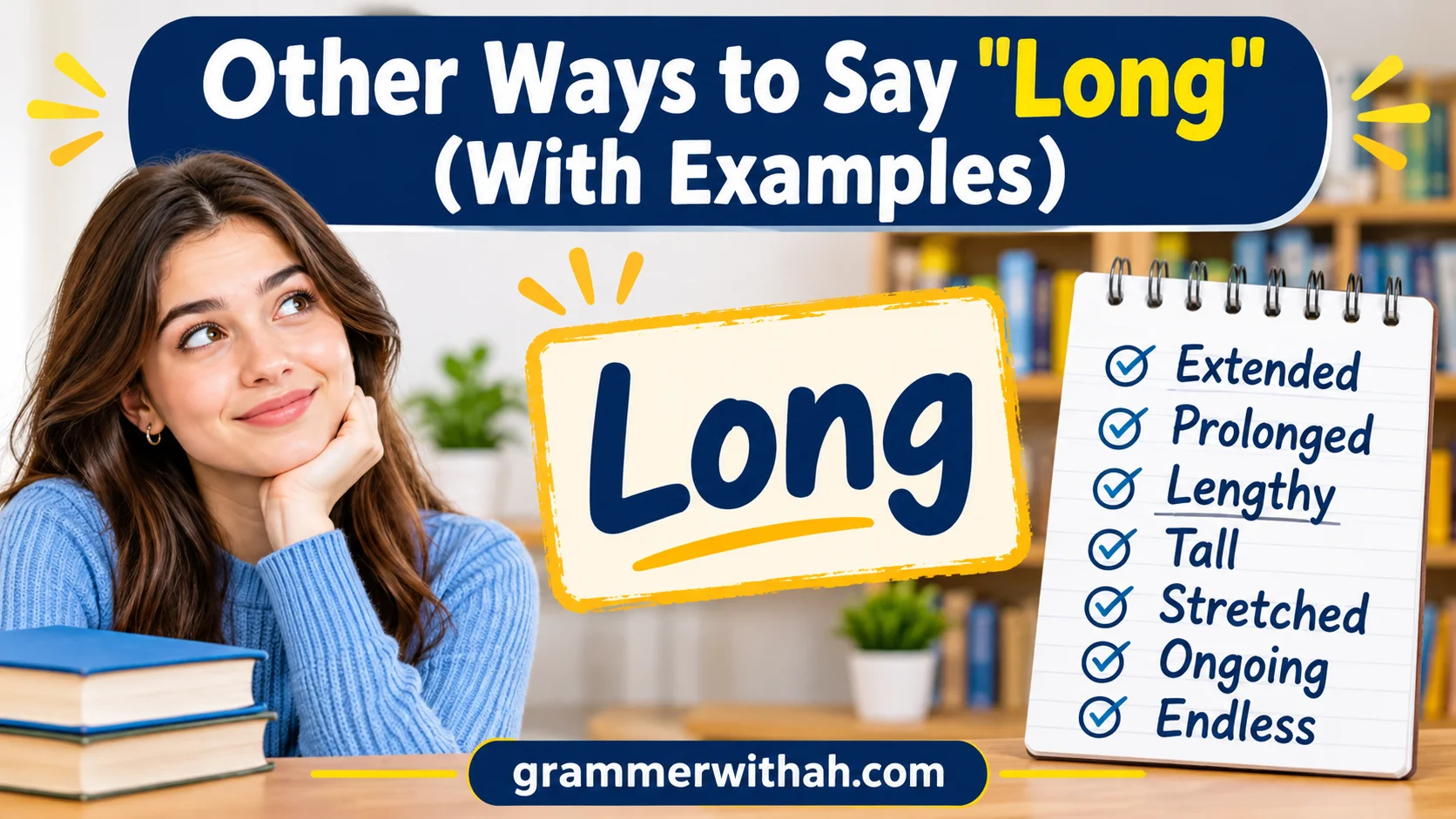
Explore Other Ways to Say “Long” to choose clearer words for time, distance, and detailed descriptions in everyday and professional communication. Choosing the right words makes your everyday communication more natural, clearer, and interesting. We often use long when talking about time, distance, or the length of something. However, repeating the same word can make your writing sound plain. Learning other ways to express your ideas gives you more phrases, synonyms, and alternatives for different situations. For example, extended, lengthy, prolonged, substantial, and extensive help you describe things more precisely.
These simple expressions also make stories, descriptions, and everyday conversations more enjoyable. Whether you talk, speak, or write, using the right expression improves your fluency, sentence structure, word choice, and clarity. It also helps you share your ideas with people and makes your language more interesting to hear. The best choice always depends on the situation and context. For instance, long time no see is a friendly greeting when reconnecting with someone after months or years apart. It works naturally in casual conversations, social interactions, and informal messages. However, it might not create the right first impression in a business email, LinkedIn message, or workplace chat. In these situations, professional ways to replace that expression can help you sound warm, respectful, and polished. A suitable formal greeting also shows respect and courtesy toward colleagues, coworkers, and business contacts. Good email etiquette, networking, and workplace communication require an appropriate tone and language.
Whether you send a reconnecting message, a follow-up message, or start a new conversation, thoughtful wording supports relationship building and stronger professional relationships. This guide covers 15 other ways to say long, including their meanings, definitions, practical examples, and appropriate usage. You’ll discover alternatives such as detailed, time-consuming, and comprehensive, which express different ideas depending on what you want to explain. Some words describe considerable time or a specific time period, while others refer to a great distance, measurement, or many details. Using natural alternatives helps improve your English vocabulary, speaking skills, and writing skills. It also strengthens verbal communication and written communication by helping you choose precise language for your audience. Whether you’re describing an event, writing an email, sending a text, or working on professional writing, these expressions help you communicate with greater clarity. You can start using them right now to improve your daily language and make your natural writing more effective.
What Does “Long” Mean?
The word long generally describes something that has greater length, duration, or distance than usual or expected. It can refer to a physical object, a period of time, a journey, or even a piece of writing. For example, a long road covers a considerable distance, while a long meeting continues for an extended period. The exact meaning depends on the context in which you use it.
Long can also describe something that requires patience or feels like it takes too much time. For instance, a long wait might feel frustrating, while a long friendship can suggest a meaningful connection that has continued for years. The word also has a verb form, as in “I long for home,” meaning to strongly wish for something. Understanding these different uses helps you select an alternative that communicates your intended meaning accurately.
Common Situations Where “Long” Is Used
People use long in many everyday situations because it describes both physical measurements and time. You might talk about a long road, a long dress, long hair, or a long journey. These expressions help explain the size, distance, or duration of something.
In text messages and personal conversations, people often use the word when discussing waiting times, holidays, relationships, and daily activities. For example, someone might say, “It’s been a long day,” to express tiredness after several hours of activity.
In professional and academic settings, long can describe reports, presentations, meetings, assignments, and explanations. However, writers sometimes choose alternatives to make their meaning more precise. Words such as lengthy, extended, and comprehensive can communicate different aspects of length without repeating the same adjective.
Is It Professional or Polite to Say “Long”?
Yes, long is both professional and polite when used appropriately. It is a neutral word that works in everyday conversations, business emails, academic writing, and formal discussions. For example, saying “We had a long meeting” is perfectly acceptable in a workplace.
However, another expression may communicate your meaning more clearly. If a meeting takes longer than expected, drawn-out might suggest that it felt unnecessarily slow. Similarly, comprehensive may be more suitable when describing a detailed report rather than simply calling it long.
The original word is not rude or inappropriate. Your choice should depend on whether you want to emphasize duration, distance, physical length, detail, or emotional meaning.
Advantages and Disadvantages of Saying “Long”
Advantages
The word long is simple, familiar, and easy to understand. Most English speakers recognize it immediately, making it useful in casual conversations and professional communication. It also works in different situations, from describing physical objects to discussing time and distance.
Another advantage is its flexibility. You can use it with many nouns, including journeys, meetings, conversations, roads, stories, and periods. This makes it a convenient choice when you want to communicate without using complicated vocabulary.
Disadvantages
Although long is useful, repeating it too often can make your writing less descriptive. It also doesn’t always explain exactly what makes something long.
For example, a lengthy report suggests considerable written content, while a comprehensive report emphasizes detailed coverage. Similarly, a drawn-out meeting may suggest unnecessary delays rather than simply a long duration.
Using more specific expressions can help you communicate meaning, tone, and context more effectively.
Synonyms for “Long”
- Lengthy
- Extended
- Prolonged
- Drawn-out
- Time-consuming
- Lasting
- Enduring
- Extensive
- In-depth
- Full-length
- Far
- Distant
- Considerable
- Marathon
- Stretched
1. Lengthy
Meaning
Lengthy describes something that takes considerable time or contains many words, details, or sections. It is especially useful when discussing written material, speeches, explanations, and activities.
Definition
Lengthy means having greater-than-usual duration or length.
Detailed Explanation
Lengthy is a slightly more descriptive alternative to long. It commonly refers to something that requires considerable time to complete or read. The word works particularly well in professional writing and academic discussions. However, it can sometimes suggest that something contains more material than necessary.
Scenario Examples
Scenario 1: Discussing a detailed email with a colleague.
Example: “Thanks for the lengthy explanation. Everything makes sense now.”
Scenario 2: Talking about a presentation.
Example: “The speaker delivered a lengthy presentation about the company’s future plans.”
Scenario 3: Describing a written assignment.
Example: “My professor assigned a lengthy research paper this semester.”
Best Use
Use lengthy when describing reports, documents, speeches, explanations, conversations, and other things that contain substantial content or take considerable time.
Tone
Tone: Neutral, professional, descriptive.
It sounds slightly more formal than long and works well in workplace and academic communication.
2. Extended
Meaning
Extended describes something that continues beyond its usual duration or covers a greater period, distance, or area.
Definition
Extended means made longer or continued for additional time.
Detailed Explanation
Extended is useful when something lasts longer than originally planned or expected. It often appears in announcements, schedules, business communication, and everyday conversations. Unlike lengthy, which can emphasize excessive duration, extended usually sounds neutral. It can also describe additional time provided for completing a task.
Scenario Examples
Scenario 1: Explaining a workplace deadline.
Example: “The manager gave us an extended deadline to finish the project.”
Scenario 2: Discussing a vacation.
Example: “We’re planning an extended stay in California this summer.”
Scenario 3: Announcing business hours.
Example: “The store will offer extended opening hours during the holiday season.”
Best Use
Choose extended for deadlines, breaks, vacations, schedules, working hours, and periods that have been lengthened.
Tone
Tone: Neutral, professional, informative.
It sounds appropriate in formal announcements and everyday communication.
3. Prolonged
Meaning
Prolonged describes something that continues for an unusually long time, often longer than expected or desirable.
Definition
Prolonged means lasting or continuing for an extended period.
Detailed Explanation
Prolonged is particularly useful when discussing situations that seem to continue without ending. It often carries a slightly negative feeling, especially when describing delays, illnesses, arguments, or difficult experiences. Unlike the neutral word long, it can suggest inconvenience or discomfort. However, its tone depends on the subject and surrounding sentence.
Scenario Examples
Scenario 1: Discussing a delayed flight.
Example: “Passengers experienced prolonged delays because of severe weather.”
Scenario 2: Talking about a difficult situation.
Example: “The prolonged disagreement affected the entire team.”
Scenario 3: Describing a medical recovery.
Example: “She needed additional support after a prolonged recovery.”
Best Use
Use prolonged when describing delays, disagreements, difficult experiences, recovery periods, and other situations that continue longer than expected.
Tone
Tone: Formal, serious, sometimes negative.
It is particularly suitable for professional reports and informative writing.
4. Drawn-Out
Meaning
Drawn-out describes something that takes longer than necessary or continues in a tiring, frustrating, or unnecessarily slow way.
Definition
Drawn-out means lasting longer than expected or needed.
Detailed Explanation
Drawn-out is a useful expression when you want to emphasize that something feels unnecessarily long. It is often used for meetings, arguments, negotiations, ceremonies, and discussions. Unlike lengthy, it usually carries a negative impression. It suggests that the experience could have been shorter or more efficient.
Scenario Examples
Scenario 1: Talking about a workplace meeting.
Example: “Today’s meeting turned into a drawn-out discussion about minor details.”
Scenario 2: Discussing a disagreement.
Example: “I don’t want another drawn-out argument over something so small.”
Scenario 3: Describing a negotiation.
Example: “The drawn-out negotiations delayed the final agreement.”
Best Use
Choose drawn-out when discussing unnecessarily lengthy meetings, arguments, negotiations, explanations, or procedures.
Tone
Tone: Casual, critical, slightly negative.
It communicates frustration more clearly than the neutral word long.
5. Time-Consuming
Meaning
Time-consuming describes an activity, task, or process that requires a significant amount of time to complete.
Definition
Time-consuming means taking considerable time or effort to finish.
Detailed Explanation
Time-consuming is more specific than long because it focuses on the time required to complete an activity. It does not necessarily suggest that something is boring or unpleasant. A complicated project can be time-consuming even when the work is interesting. This expression is particularly useful when discussing responsibilities, assignments, and workplace processes.
Scenario Examples
Scenario 1: Explaining a work responsibility.
Example: “Preparing the monthly financial report is a time-consuming task.”
Scenario 2: Talking about schoolwork.
Example: “Researching every source properly can be time-consuming.”
Scenario 3: Discussing household responsibilities.
Example: “Cleaning the entire house is more time-consuming than I expected.”
Best Use
Use time-consuming for assignments, research, paperwork, projects, household tasks, and processes that require considerable effort and time.
Tone
Tone: Neutral, practical, professional.
It works especially well when explaining why an activity requires additional time.
6. Lasting
Meaning
Lasting describes something that continues to exist, remain effective, or have an impact over time.
Definition
Lasting means continuing or remaining for a considerable period.
Detailed Explanation
Lasting is a natural alternative when discussing experiences, relationships, effects, memories, and results that continue over time. Unlike long, it focuses more on continued existence than physical length. It can also communicate emotional value or importance. For example, a lasting friendship suggests a connection that remains strong over many years.
Scenario Examples
Scenario 1: Talking about a friendship.
Example: “Their friendship has created a lasting bond.”
Scenario 2: Discussing an important lesson.
Example: “That experience left a lasting impression on me.”
Scenario 3: Describing a business decision.
Example: “We want to create lasting improvements for our customers.”
Best Use
Choose lasting for friendships, memories, relationships, effects, improvements, and positive or negative experiences that continue over time.
Tone
Tone: Warm, thoughtful, positive or neutral.
It is especially effective in personal messages and professional writing about long-term results.
7. Enduring
Meaning
Enduring describes something that continues for a long time despite difficulties, changes, or challenges.
Definition
Enduring means lasting over time or remaining strong through difficulties.
Detailed Explanation
Enduring is often associated with strength, patience, loyalty, and stability. It describes relationships, values, traditions, and qualities that remain meaningful over time. Unlike ordinary long, it can suggest emotional depth and the ability to withstand challenges. This makes it especially suitable for expressing admiration or respect.
Scenario Examples
Scenario 1: Celebrating a relationship.
Example: “Their enduring love has inspired everyone around them.”
Scenario 2: Describing a family tradition.
Example: “The festival represents an enduring cultural tradition.”
Scenario 3: Talking about friendship.
Example: “We share an enduring friendship built on trust.”
Best Use
Use enduring when describing strong relationships, traditions, values, beliefs, and connections that survive the passage of time.
Tone
Tone: Respectful, emotional, thoughtful.
It has a warmer and more meaningful feeling than the ordinary word long.
8. Extensive
Meaning
Extensive describes something that covers a large area, includes many parts, or contains a considerable amount of information.
Definition
Extensive means broad, wide-ranging, or covering a substantial amount.
Detailed Explanation
Extensive works well when describing research, knowledge, experience, collections, and projects involving many details. It does not simply mean that something takes a long time. Instead, it emphasizes scope and coverage. For example, extensive research includes a wide range of information, sources, or investigations.
Scenario Examples
Scenario 1: Discussing a research project.
Example: “The students conducted extensive research before writing their report.”
Scenario 2: Describing professional experience.
Example: “She has extensive experience in digital marketing.”
Scenario 3: Talking about home renovations.
Example: “The building needs extensive repairs before anyone can move in.”
Best Use
Choose extensive for research, experience, projects, repairs, investigations, and activities involving a broad scope.
Tone
Tone: Professional, informative, confident.
It is particularly useful in academic writing, business communication, and formal descriptions.
9. In-Depth
Meaning
In-depth describes something that explores a subject carefully and includes detailed information rather than only covering the basics.
Definition
In-depth means thorough, detailed, and covering a subject fully.
Detailed Explanation
In-depth is a good choice when describing explanations, discussions, analysis, interviews, and educational content. It can replace long when the real intention is to communicate that something contains substantial detail. However, it does not necessarily mean that the content has many words or takes a long time. Its main focus is depth of information.
Scenario Examples
Scenario 1: Requesting a detailed explanation.
Example: “Could you provide an in-depth explanation of this topic?”
Scenario 2: Discussing an interview.
Example: “The journalist conducted an in-depth interview with the author.”
Scenario 3: Describing an online lesson.
Example: “This course offers an in-depth look at English grammar.”
Best Use
Use in-depth for explanations, interviews, research, lessons, discussions, and detailed analysis.
Tone
Tone: Informative, academic, professional.
It sounds natural in educational materials and workplace communication.
10. Full-Length
Meaning
Full-length describes something presented in its complete or standard length rather than a shortened version.
Definition
Full-length means complete in length or duration, without being shortened.
Detailed Explanation
Full-length is particularly useful when discussing movies, books, recordings, performances, and other creative works. It emphasizes that the entire work is available rather than an edited or shortened version. Unlike lengthy, it does not suggest that something is excessively long. Instead, it communicates completeness.
Scenario Examples
Scenario 1: Discussing a movie.
Example: “The director is releasing a full-length version of the film.”
Scenario 2: Talking about a book.
Example: “I finally finished reading the full-length novel.”
Scenario 3: Describing a video.
Example: “You can watch the full-length interview on our website.”
Best Use
Choose full-length for movies, novels, videos, interviews, performances, and other complete creative works.
Tone
Tone: Neutral, descriptive, informative.
It is appropriate for entertainment discussions, publishing, and media descriptions.
11. Far
Meaning
Far describes a considerable physical distance between two places or points.
Definition
Far means located at a great distance from something.
Detailed Explanation
Far is one of the most natural alternatives when long describes distance rather than duration or physical dimensions. For example, a long journey may take several hours, but a far destination emphasizes how distant the place is. The word is commonly used in everyday conversation and informal writing. It is not interchangeable with long in every sentence because it focuses specifically on distance.
Scenario Examples
Scenario 1: Talking about travel plans.
Example: “The beach is too far for us to visit this afternoon.”
Scenario 2: Giving directions.
Example: “The nearest supermarket isn’t far from your hotel.”
Scenario 3: Discussing a family visit.
Example: “My grandparents live far away, so I visit them during holidays.”
Best Use
Use far when describing geographical distance, travel destinations, locations, and the space between two places.
Tone
Tone: Casual, neutral, conversational.
It sounds natural in everyday speech and simple written communication.
12. Distant
Meaning
Distant describes something located far away in space or time. It can also describe an emotional separation between people.
Definition
Distant means far away or separated by a considerable distance.
Detailed Explanation
Distant offers a more descriptive alternative when discussing places, memories, historical periods, and relationships. It can refer to physical separation, such as a distant town, or time, such as the distant past. In emotional contexts, it may suggest that someone seems less friendly or connected. The intended meaning depends on the surrounding sentence.
Scenario Examples
Scenario 1: Discussing travel.
Example: “They moved to a distant village in the mountains.”
Scenario 2: Talking about history.
Example: “These traditions began in the distant past.”
Scenario 3: Describing someone’s behavior.
Example: “He seemed distant during our conversation yesterday.”
Best Use
Choose distant for geographical locations, historical periods, memories, and emotional relationships.
Tone
Tone: Descriptive, thoughtful, sometimes emotional.
It sounds more expressive than far and works well in both formal and creative writing.
13. Considerable
Meaning
Considerable describes something that is fairly large, substantial, or significant in size, amount, extent, or degree.
Definition
Considerable means large enough to be important or noticeable.
Detailed Explanation
Considerable is useful when you want to emphasize that a period, distance, amount, or effort is significant. It does not directly mean long, but it can replace it when the intended meaning involves a substantial duration or extent. The word sounds more formal and measured than long. It is particularly useful when you want to avoid giving an exact measurement.
Scenario Examples
Scenario 1: Discussing a waiting period.
Example: “We experienced a considerable delay before receiving the documents.”
Scenario 2: Talking about travel.
Example: “Reaching the destination requires a considerable journey.”
Scenario 3: Describing professional effort.
Example: “Completing the project required considerable time and attention.”
Best Use
Use considerable when describing significant time, distance, effort, delays, amounts, and other substantial quantities.
Tone
Tone: Formal, measured, professional.
It works particularly well in reports, business communication, and informative writing.
14. Marathon
Meaning
Marathon can describe an activity or event that lasts an unusually long time or requires considerable endurance.
Definition
Marathon means an exceptionally long or demanding activity or event.
Detailed Explanation
Marathon originally refers to a long-distance running race. In everyday English, it also describes lengthy activities such as meetings, study sessions, movie sessions, and work periods. It gives the expression a more energetic and sometimes humorous feeling. Unlike the neutral word long, marathon emphasizes endurance and the demanding nature of the experience.
Scenario Examples
Scenario 1: Discussing a busy workday.
Example: “We had a marathon meeting that lasted nearly five hours.”
Scenario 2: Talking about studying.
Example: “I spent the weekend in a marathon study session before my exams.”
Scenario 3: Planning an entertainment evening.
Example: “Let’s have a movie marathon on Saturday night.”
Best Use
Choose marathon for unusually long meetings, study sessions, movie sessions, work periods, and demanding events.
Tone
Tone: Casual, energetic, humorous.
It is particularly effective in informal conversations and social media posts.
15. Stretched
Meaning
Stretched describes something extended in physical length or spread across a longer period than usual.
Definition
Stretched means extended, pulled longer, or made to cover a greater distance or period.
Detailed Explanation
Stretched is useful when describing physical objects, time periods, schedules, and resources that have been extended. It can also suggest that something is being used beyond its usual limits. Unlike lengthy, it often focuses on the process or result of extending something. The expression stretched-out can also describe something that has been extended physically or in duration.
Scenario Examples
Scenario 1: Describing a physical object.
Example: “The elastic band stretched across the width of the box.”
Scenario 2: Discussing a schedule.
Example: “The project schedule was stretched over several additional weeks.”
Scenario 3: Talking about a difficult budget.
Example: “Our limited budget was stretched to cover the extra expenses.”
Best Use
Use stretched when describing extended objects, schedules, resources, deadlines, and periods.
Tone
Tone: Neutral, descriptive, practical.
It works in everyday conversation and professional writing when something has been extended or spread out.
FAQs
1. What are some other ways to say long?
Some common alternatives to long include lengthy, extended, prolonged, extensive, substantial, time-consuming, and drawn-out. The best choice depends on whether you’re describing time, distance, or size.
2. How can I avoid repeating the word long in writing?
You can replace repeated words with suitable synonyms and descriptive expressions. For example, use lengthy for something that takes considerable time or extensive for something that covers many details.
3. What is a professional way to say long?
Professional alternatives include extended, prolonged, extensive, substantial, and comprehensive. For example, you can describe a meeting as an extended meeting or a report as a comprehensive report.
4. What is another way to say a long time?
You can say an extended period, a considerable amount of time, a lengthy period, or a prolonged duration. These expressions work in both everyday and professional communication.
5. What is the difference between lengthy, extended, and prolonged?
Lengthy describes something that takes a lot of time or contains many words. Extended means something has been made longer or continued beyond its usual duration. Prolonged describes something that continues for an unusually long time, often longer than expected.
Conclusion
Choosing the right alternatives to long can make your writing and everyday conversations more natural and interesting. Words such as lengthy, extended, prolonged, substantial, and extensive help you express different meanings without repeating the same word. However, every alternative has its own meaning and usage. Some describe time, while others refer to distance, size, or detailed information. Think about your audience and the situation before choosing an expression. Whether you’re writing a professional email, sharing a story, describing an event, or sending a casual message, the right vocabulary helps you communicate clearly. Keep practicing these alternatives, and you’ll gradually develop stronger English vocabulary and more confident communication skills.