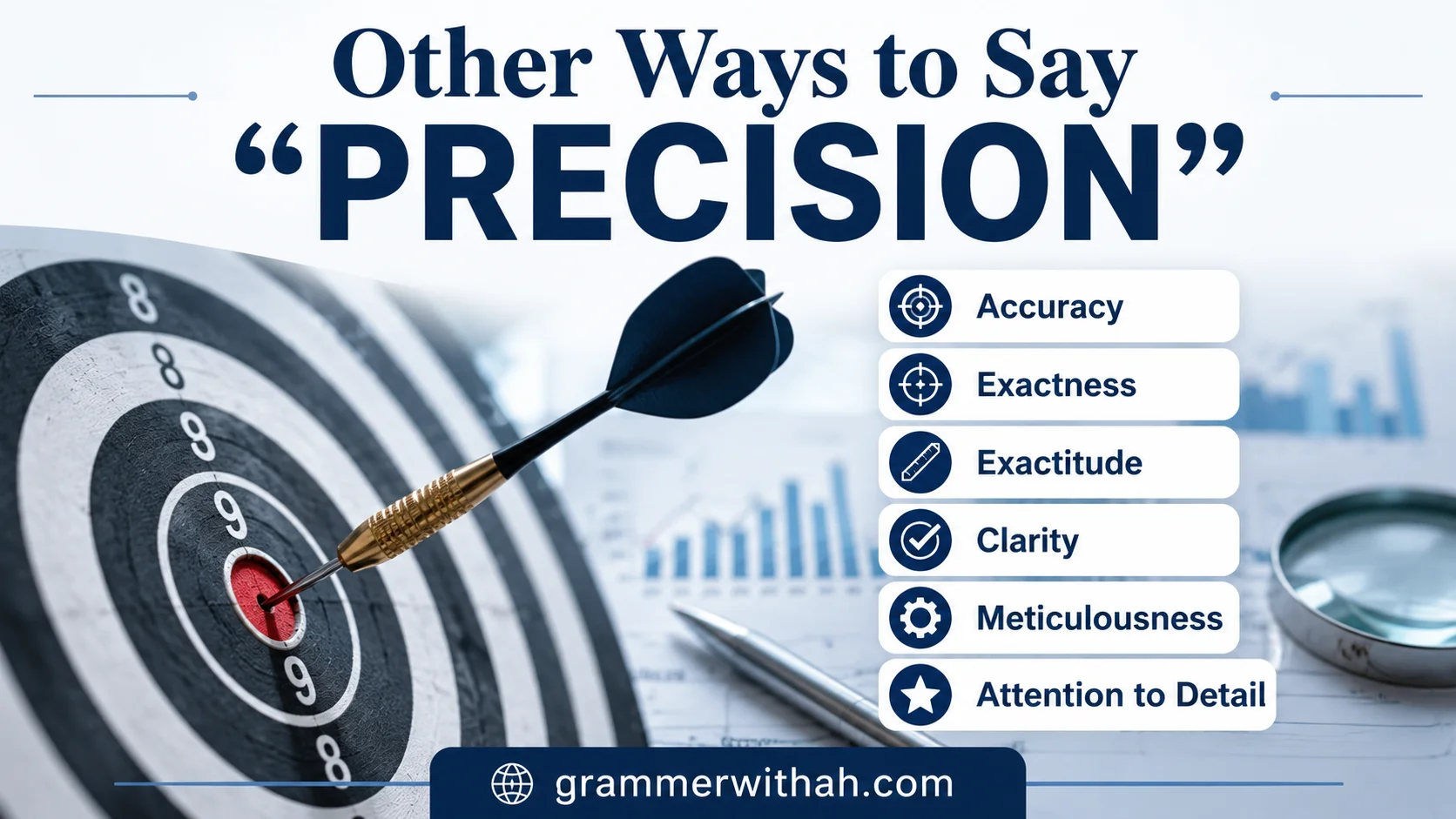
Explore Other Ways to Say ‘PRECISION’ (With Examples) to discover accurate alternatives that can bring more clarity, detail, and effectiveness to your writing. Precision means being exact, careful, and consistent in communication, measurements, and decisions. This guide introduces useful words like accuracy, exactness, correctness, and reliability with simple meanings and examples. These alternatives will help you improve your vocabulary, create stronger professional writing, and express your ideas with more confidence and clarity.
Finding the right word can make your message more powerful and understandable. Different alternatives to precision can describe careful actions, accurate results, or detailed work in different situations. Whether you are writing for work, study, or everyday communication, choosing the best synonym helps your readers understand your meaning better. These related words will make your sentences more natural, detailed, and effective.
What Does “Precision” Mean?
Precision means being exact, careful, and accurate in the way something is done, measured, written, or explained. It often describes a person, process, or result that avoids mistakes and pays close attention to detail.
In simple English, precision is the quality of doing something the right way, with very little room for error.
Is It Professional or Polite to Say “Precision”?
Yes, precision is usually both professional and polite. It works very well in academic writing, business communication, technical work, and any situation where accuracy matters.
Still, in casual or emotional conversations, precision can sometimes sound a little formal or distant. That is why choosing a warmer alternative can help your message feel more human, more gentle, and more natural.
Pros and Cons of Saying “Precision”
Pros
- It sounds clear, smart, and professional.
- It shows that you value accuracy and care.
- It works well in technical, academic, and workplace settings.
Cons
- It can sound a little cold or mechanical in personal conversations.
- It may feel too formal when a softer word would be better.
- Some readers may connect it more with machines, data, or science than with human warmth.
“PRECISION” Synonyms
- Accuracy
- Exactness
- Exactitude
- Correctness
- Meticulousness
- Thoroughness
- Carefulness
- Rigor
- Attention to Detail
- Fine-Tuned Accuracy
- Sharp Accuracy
- Close Measurement
- Tight Control
- High Consistency
- Detailed Accuracy
- Spot-On Precision
- Faultless Accuracy
- Delicacy
- Specificity
- Stringency
- Fineness
- Exact Measurement
- Careful Detailing
- Accurate Handling
- Crisp Accuracy
1. Accuracy
Scenario Meaning: Accuracy means doing something correctly, with very few mistakes, and with results that match the truth as closely as possible. It is one of the most common and useful alternatives to precision.
Examples:
- We checked the accuracy of the report before sending it to the client.
- Her accuracy in typing numbers saved the team a lot of time.
- The machine gives excellent accuracy during measurements.
- I appreciate the accuracy of your notes and observations.
- Good accuracy helps every project feel more reliable.
Tone: Accuracy sounds professional, clear, and dependable.
Details Explanation: This word works well when you want to show that something is correct and trustworthy. It is simple, familiar, and strong, which makes it useful in both formal and everyday writing.
Best Use: Use accuracy when you want to talk about correct facts, measurements, results, or careful work.
2. Exactness
Scenario Meaning: Exactness means being very precise, very specific, and very close to the true or intended result. It suggests that every part has been handled with close attention and little error.
Examples:
- The exactness of the drawing impressed everyone in the room.
- She spoke with such exactness that nothing was unclear.
- I liked the exactness of the instructions you shared.
- The carpenter worked with great exactness on every joint.
- We need exactness if we want the final result to look perfect.
Tone: Exactness sounds careful, formal, and highly detailed.
Details Explanation: This word is useful when you want to highlight the exact form, amount, or detail of something. It often feels a little more formal than accuracy, but it still sounds natural in thoughtful writing.
Best Use: Use exactness when precision must be especially clear, strict, and detailed.
3. Exactitude
Scenario Meaning: Exactitude means a very high level of exactness, care, and correctness. It often appears in formal writing when you want to describe very careful and disciplined work.
Examples:
- The editor checked every line with impressive exactitude.
- Her exactitude made the final version much stronger.
- The scientist described the process with careful exactitude.
- We admire the exactitude of your measurements.
- The project succeeded because of his exactitude.
Tone: Exactitude sounds formal, refined, and serious.
Details Explanation: This word is more advanced and often feels literary or academic. It works best when you want a polished word that shows very careful attention to every small detail.
Best Use: Use exactitude in formal writing, academic work, or elegant professional communication.
4. Correctness
Scenario Meaning: Correctness means being right, proper, or free from errors. It focuses more on whether something is true or acceptable than on tiny measurement details.
Examples:
- We checked the correctness of the answer before submitting it.
- Her correctness in grammar is one reason the article reads well.
- I value the correctness of your process and method.
- The teacher praised the correctness of the solution.
- Good correctness keeps mistakes from spreading.
Tone: Correctness sounds formal, fair, and dependable.
Details Explanation: This word is useful when you want to stress that something is right and suitable. It is especially helpful in writing, teaching, editing, and quality checking.
Best Use: Use correctness when your focus is on truth, proper form, or error-free work.
5. Meticulousness
Scenario Meaning: Meticulousness means paying very close attention to every detail, especially in a careful and disciplined way. It suggests that someone works slowly, thoughtfully, and with real care.
Examples:
- Her meticulousness made the final design look polished.
- I admire his meticulousness when reviewing important documents.
- The team’s meticulousness helped prevent small mistakes.
- Your meticulousness shows real respect for quality.
- Great results often come from meticulousness and patience.
Tone: Meticulousness sounds thoughtful, disciplined, and highly respectful.
Details Explanation: This word is ideal when you want to praise a person for being extremely careful. It often feels warm and admiring, because it highlights effort, patience, and real attention.
Best Use: Use meticulousness when you want to recognize careful work done with patience and pride.
6. Thoroughness
Scenario Meaning: Thoroughness means doing something completely, carefully, and without leaving important parts out. It suggests full attention from beginning to end.
Examples:
- The thoroughness of your research made the paper stronger.
- I appreciate the thoroughness of this review.
- Her thoroughness helped the team spot hidden problems.
- The inspector praised the thoroughness of the checklist.
- Good thoroughness often leads to better long-term results.
Tone: Thoroughness sounds reliable, serious, and complete.
Details Explanation: This word is helpful when you want to show that something was not rushed or half-finished. It gives the idea of full effort, careful checking, and complete attention.
Best Use: Use thoroughness when you want to emphasize complete and careful work.
7. Carefulness
Scenario Meaning: Carefulness means acting with attention, caution, and thought so that mistakes are less likely to happen. It often feels more human and gentle than stricter technical words.
Examples:
- Her carefulness protected the project from errors.
- I noticed the carefulness in your explanation.
- The doctor’s carefulness gave the patient confidence.
- We value carefulness when working with sensitive details.
- Your carefulness makes the whole process smoother.
Tone: Carefulness sounds kind, calm, and considerate.
Details Explanation: This word works well when you want to describe someone who thinks before acting. It feels warm and personal, which makes it useful in supportive or appreciative communication.
Best Use: Use carefulness when you want a softer word that still shows responsibility and attention.
8. Rigor
Scenario Meaning: Rigor means strict attention to standards, details, and correctness. It often suggests discipline, seriousness, and a very high level of care.
Examples:
- The study was praised for its rigor.
- We need more rigor in the testing process.
- Her rigor made the argument very convincing.
- The team followed each step with strong rigor.
- Good rigor helps prevent weak results.
Tone: Rigor sounds strong, formal, and disciplined.
Details Explanation: This word is often used in education, science, business, and research. It shows that something was done with strict standards and no loose thinking.
Best Use: Use rigor when you want to describe careful work that follows high standards.
9. Attention to Detail
Scenario Meaning: Attention to detail means noticing small things and handling them carefully. It is one of the most natural and friendly alternatives to precision in everyday English.
Examples:
- Your attention to detail made the final draft much better.
- She is known for her strong attention to detail.
- Good attention to detail saves time later.
- The manager appreciated his attention to detail in the budget.
- This job requires attention to detail and patience.
Tone: Attention to detail sounds professional, clear, and easy to understand.
Details Explanation: This phrase is useful because it sounds natural in work, school, and casual praise. It focuses on careful noticing, thoughtful checking, and a respectful approach to quality.
Best Use: Use attention to detail when you want a warm, common, and professional phrase.
10. Fine-Tuned Accuracy
Scenario Meaning: Fine-tuned accuracy means accuracy that has been carefully adjusted, improved, and polished until it is almost exact. It suggests thoughtful refinement and extra care.
Examples:
- The system now offers fine-tuned accuracy in its readings.
- Her fine-tuned accuracy improved the final outcome.
- We need fine-tuned accuracy for this type of work.
- The team achieved fine-tuned accuracy after several reviews.
- His fine-tuned accuracy made the process feel effortless.
Tone: Fine-tuned accuracy sounds modern, polished, and technical.
Details Explanation: This phrase works well when something has been carefully improved rather than simply done once. It gives the sense of refinement, testing, and smart adjustment.
Best Use: Use fine-tuned accuracy when you want to show careful improvement and polished results.
11. Sharp Accuracy
Scenario Meaning: Sharp accuracy means very clear, quick, and exact correctness. It suggests a result that is not blurry, uncertain, or weak.
Examples:
- His sharp accuracy stood out during the presentation.
- The app delivers sharp accuracy in its predictions.
- We were impressed by her sharp accuracy under pressure.
- That tool gives sharp accuracy when used properly.
- Strong sharp accuracy is valuable in fast work.
Tone: Sharp accuracy sounds energetic, direct, and modern.
Details Explanation: This phrase feels lively and strong, especially when you want to describe quick and exact results. It works best in situations where speed and clarity matter together.
Best Use: Use sharp accuracy when you want a confident, active phrase with a modern feel.
12. Close Measurement
Scenario Meaning: Close measurement means measuring very carefully, with little difference between the intended and actual result. It is especially useful in technical, scientific, or practical settings.
Examples:
- The project required close measurement at every stage.
- Her close measurement kept the numbers reliable.
- We achieved better results through close measurement.
- The builder used close measurement for all the cuts.
- Good close measurement protects the final quality.
Tone: Close measurement sounds practical, technical, and careful.
Details Explanation: This phrase focuses on the act of measuring with a very small margin of error. It is especially useful when the exact numbers or sizes matter a lot.
Best Use: Use close measurement when you want to emphasize careful measuring and exact results.
13. Tight Control
Scenario Meaning: Tight control means keeping something carefully managed so that nothing moves too far away from the intended result. It often suggests discipline, limits, and strong oversight.
Examples:
- The factory keeps tight control over product quality.
- She used tight control to keep the budget balanced.
- Good tight control helps prevent major mistakes.
- The experiment needed tight control from start to finish.
- His tight control over the process improved consistency.
Tone: Tight control sounds firm, organized, and practical.
Details Explanation: This phrase is useful when the idea is not just being exact, but also keeping something carefully managed. It often appears in business, manufacturing, and project work.
Best Use: Use tight control when strict management and accuracy both matter.
Read This: 25 Other Ways to Say “PROTEST” (With Examples)
14. High Consistency
Scenario Meaning: High consistency means getting the same careful result again and again without large changes or mistakes. It suggests steadiness, reliability, and predictable quality.
Examples:
- The team showed high consistency in every delivery.
- Her high consistency made the process trustworthy.
- We need high consistency for this system to work well.
- The writer’s high consistency is easy to see.
- Good high consistency builds confidence over time.
Tone: High consistency sounds stable, professional, and dependable.
Details Explanation: This phrase is useful when you want to praise repeated accuracy rather than just one accurate moment. It works well for habits, workflows, performance, and quality control.
Best Use: Use high consistency when you want to describe reliable results over time.
15. Detailed Accuracy
Scenario Meaning: Detailed accuracy means accuracy that includes many small facts, points, and careful observations. It suggests that the work is not only correct, but also richly complete.
Examples:
- The report showed detailed accuracy throughout.
- Her detailed accuracy helped answer every question.
- We appreciate the detailed accuracy of your notes.
- The model gives detailed accuracy in complex cases.
- Good detailed accuracy makes work easier to trust.
Tone: Detailed accuracy sounds clear, thorough, and professional.
Details Explanation: This phrase is especially useful when accuracy comes with many small supporting points. It tells the reader that the work was checked carefully and filled with useful detail.
Best Use: Use detailed accuracy when you want to highlight both correctness and rich supporting detail.
16. Spot-On Precision
Scenario Meaning: Spot-on precision means something is exactly right, almost perfectly matched to what was needed. It feels modern, friendly, and confident.
Examples:
- Your spot-on precision made the project shine.
- The engineer worked with spot-on precision all day.
- She answered with spot-on precision and confidence.
- The design shows spot-on precision in every line.
- We love the spot-on precision of your edits.
Tone: Spot-on precision sounds friendly, sharp, and positive.
Details Explanation: This phrase is more conversational than many formal alternatives. It works well when you want to sound appreciative without sounding stiff or overly technical.
Best Use: Use spot-on precision in friendly professional praise or casual positive feedback.
17. Faultless Accuracy
Scenario Meaning: Faultless accuracy means accuracy without obvious mistakes or weaknesses. It suggests work that feels clean, reliable, and carefully finished.
Examples:
- The team delivered faultless accuracy in the final version.
- Her faultless accuracy impressed everyone.
- The data showed faultless accuracy across all sections.
- We trust his faultless accuracy in important work.
- Great faultless accuracy often comes from careful review.
Tone: Faultless accuracy sounds polished, formal, and highly respectful.
Details Explanation: This phrase is useful when you want to give strong praise for work that appears error-free. It feels elegant and serious, which makes it useful in formal appreciation.
Best Use: Use faultless accuracy when you want to praise near-perfect, carefully checked work.
18. Delicacy
Scenario Meaning: Delicacy means handling something with careful softness, especially when a situation, detail, or message needs a gentle touch. It can also suggest subtle precision.
Examples:
- She handled the issue with real delicacy.
- The artist worked with great delicacy in the background.
- I liked the delicacy of your response.
- The design was shaped with beautiful delicacy.
- This topic needs delicacy and careful language.
Tone: Delicacy sounds gentle, refined, and thoughtful.
Details Explanation: This word is especially useful when care matters as much as correctness. It gives a softer and more graceful feeling than harder technical words.
Best Use: Use delicacy when you want to describe careful handling in sensitive or artistic situations.
19. Specificity
Scenario Meaning: Specificity means being exact, clear, and focused on particular details instead of general ideas. It helps avoid confusion and makes meaning easier to understand.
Examples:
- The specificity of your instructions was helpful.
- Her specificity made the plan easy to follow.
- We need more specificity in the proposal.
- The manager asked for specificity in the timeline.
- Good specificity improves communication quickly.
Tone: Specificity sounds precise, formal, and clear.
Details Explanation: This word is great when you want to stress exact details rather than broad statements. It is common in writing, business, law, and technical communication.
Best Use: Use specificity when you want clearer details, sharper focus, and less guesswork.
20. Stringency
Scenario Meaning: Stringency means strictness, careful limits, and strong control over standards or rules. It often suggests that little room is left for mistakes or shortcuts.
Examples:
- The stringency of the rules kept the process fair.
- We value the stringency of the review system.
- Her stringency helped raise the quality level.
- The testing process requires real stringency.
- Good stringency protects important standards.
Tone: Stringency sounds strict, formal, and disciplined.
Details Explanation: This word works best when you want to describe strong standards that must be followed carefully. It is less warm than some options, but very useful in serious settings.
Best Use: Use stringency when rules, limits, and exact standards are important.
21. Fineness
Scenario Meaning: Fineness means a very small, delicate, or carefully tuned quality. It can describe subtle detail, smooth work, or careful adjustment.
Examples:
- The fineness of the pattern made it special.
- We admired the fineness of the engraving.
- Her fineness in editing improved every line.
- The tool offers great fineness in control.
- That design needs more fineness to feel complete.
Tone: Fineness sounds delicate, elegant, and refined.
Details Explanation: This word is useful when you want to point to subtle detail rather than loud or obvious precision. It often appears in art, craft, design, and careful technical work.
Best Use: Use fineness when you want to describe subtle quality and careful detail.
22. Exact Measurement
Scenario Meaning: Exact measurement means a measurement that is precise, correct, and closely matched to what is needed. It is especially useful in practical and technical writing.
Examples:
- The project depended on exact measurement.
- She checked the exact measurement twice.
- Good exact measurement helped prevent waste.
- We need exact measurement before cutting the material.
- The chart gives exact measurement for every part.
Tone: Exact measurement sounds practical, clear, and technical.
Details Explanation: This phrase is easy to understand and highly useful in everyday work. It focuses directly on numbers, size, and correct calculation, which makes it especially strong in hands-on tasks.
Best Use: Use exact measurement when numbers, size, and careful calculation matter most.
23. Careful Detailing
Scenario Meaning: Careful detailing means adding or checking small parts with attention, patience, and thought. It often refers to work that becomes stronger because of small, thoughtful improvements.
Examples:
- The painting showed beautiful careful detailing.
- Her careful detailing improved the final draft.
- We noticed the careful detailing in every section.
- The builder used careful detailing on the edges.
- Good careful detailing makes work feel complete.
Tone: Careful detailing sounds thoughtful, creative, and precise.
Details Explanation: This phrase is useful when small touches matter a lot. It is especially helpful in design, writing, art, and any work where small choices shape the final quality.
Best Use: Use careful detailing when small, thoughtful additions improve the whole result.
24. Accurate Handling
Scenario Meaning: Accurate handling means managing, using, or treating something in a correct and careful way. It suggests both precision and responsibility.
Examples:
- The system depends on accurate handling of the data.
- Her accurate handling kept the process clean.
- We need accurate handling when dealing with numbers.
- The team’s accurate handling improved the outcome.
- Good accurate handling prevents avoidable mistakes.
Tone: Accurate handling sounds practical, careful, and responsible.
Details Explanation: This phrase is helpful when precision is part of the action itself. It works well in jobs, systems, and processes where careful treatment leads to better results.
Best Use: Use accurate handling when careful and correct action is more important than speed alone.
25. Crisp Accuracy
Scenario Meaning: Crisp accuracy means accuracy that feels sharp, clean, and clearly defined. It suggests a result that is neat, direct, and free from confusion.
Examples:
- The presentation showed crisp accuracy from start to finish.
- Her crisp accuracy made the message easy to trust.
- The report was written with crisp accuracy.
- We appreciate the crisp accuracy of the revised figures.
- His crisp accuracy made a strong impression.
Tone: Crisp accuracy sounds fresh, clean, and confident.
Details Explanation: This phrase works well when you want to describe something precise in a neat and modern way. It feels polished without sounding too stiff or too technical.
Best Use: Use crisp accuracy when you want a clean, sharp, and modern-sounding alternative.
FAQs:
1. What is another word for precision?
Some common alternatives for precision include accuracy, exactness, correctness, accuracy, exactitude, and reliability. The best choice depends on the situation and the meaning you want to express.
2. Is precision the same as accuracy?
Precision and accuracy are related but slightly different. Accuracy means being close to the correct result, while precision focuses on consistency and exact detail in results or actions.
3. Why should I use synonyms for precision?
Using different words instead of repeating precision can make your writing more engaging, natural, and professional. It helps you express ideas with better clarity and depth.
4. Which word is best to use instead of precision in professional writing?
Words like accuracy, exactness, and correctness work well in professional settings because they communicate trust, quality, and attention to detail.
5. How can learning precision synonyms improve communication?
Learning alternatives for precision helps you choose more suitable words, explain ideas clearly, and create stronger messages in everyday and professional communication.
Conclusion:
Finding the right alternatives for precision can make your writing more powerful and expressive. Words like accuracy, exactness, correctness, and reliability help you describe detailed ideas with greater clarity. By understanding the meaning and usage of these terms, you can improve your vocabulary and communicate with more confidence in different situations.