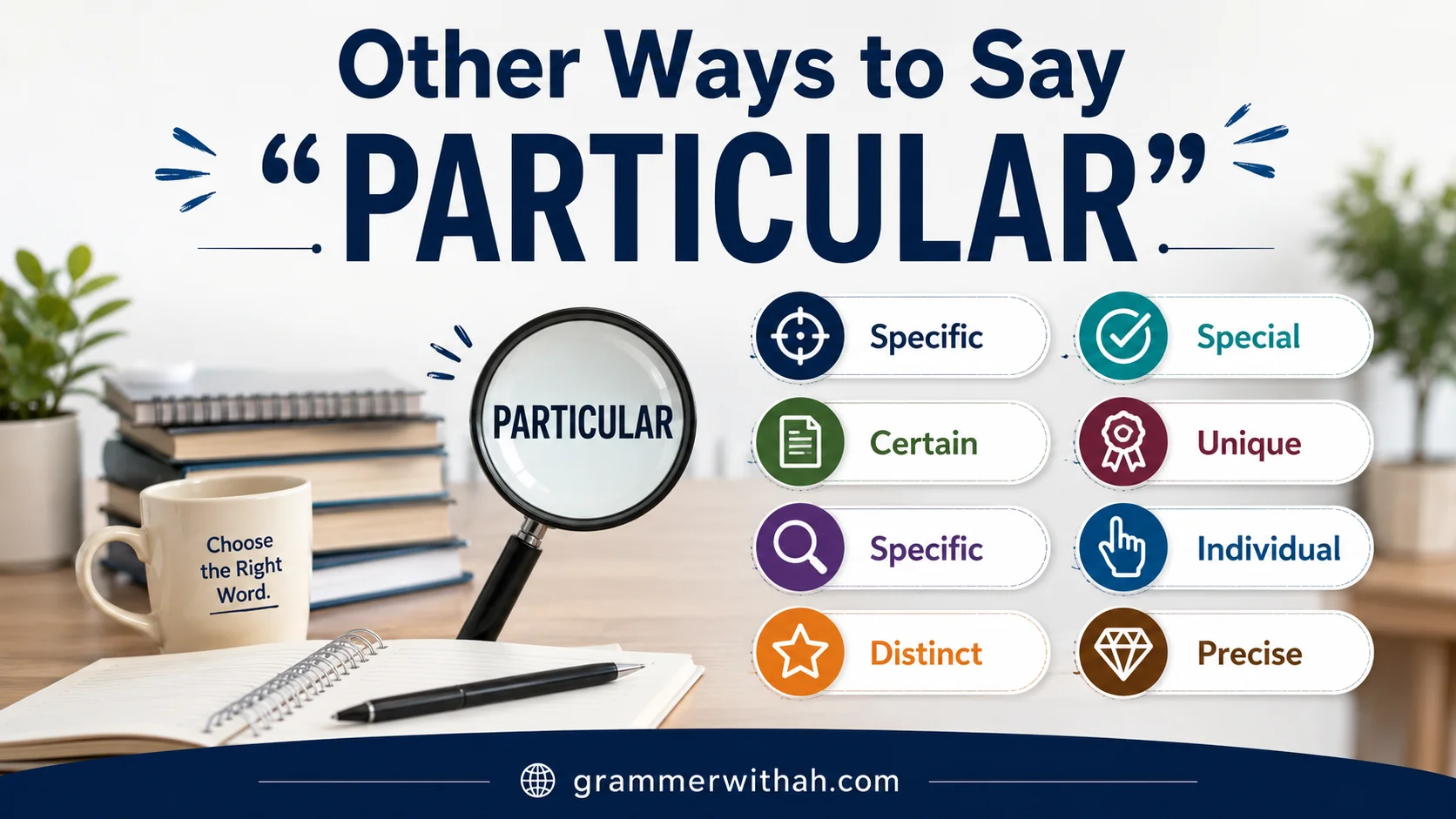
Discover Other Ways to Say “PARTICULAR” (With Examples) to find better expressions for this commonly used word and improve your writing style. The term particular refers to something specific, special, or clearly identified from others. Understanding its alternatives helps you describe details, preferences, and situations with more accuracy and confidence. Whether you mean a certain choice, a person, or a small point, using the right words can make your communication more natural and meaningful in everyday writing and professional contexts.
Exploring different synonyms for particular allows you to express ideas with greater clarity and variety. This word often connects with specific cases, individual things, and important points that need attention. By learning these alternatives, you can choose phrases that match your tone and message better. These options are useful for conversations, articles, and creative writing because they make your sentences sound more polished and engaging. The right alternative can add depth while keeping your meaning clear and easy to understand.
What Does “Particular” Mean?
Particular can mean specific, exact, chosen carefully, or not general. It can also describe someone who is selective, careful, or hard to satisfy in certain situations. The meaning changes a little depending on how you use it, but the main idea is usually about one exact thing, one exact person, or one exact detail.
Is It Professional or Polite to Say “Particular”?
Yes, particular is usually professional, polite, and clear. It works well in formal writing, school work, business communication, and everyday conversation. However, in some situations, it can sound a little strict or demanding, especially when used to describe a person’s preferences. Choosing a softer synonym can sometimes make your message feel warmer and more respectful.
Pros and Cons of Saying “Particular”
Pros: Particular is clear, direct, and easy to understand. It helps you describe exact details without confusion. It also works well in both formal and casual writing, which makes it very flexible.
Cons: In some sentences, particular can sound a little firm, distant, or picky. It may not always feel warm enough when you want to sound gentle, kind, or emotionally thoughtful.
“PARTICULAR” Synonyms
- Specific
- Exact
- Precise
- Exacting
- Particularized
- Selective
- Discerning
- Meticulous
- Careful
- Picky
- Fussy
- Detailed
- Narrow
- Strict
- Choosy
- Discriminating
- Fine-tuned
- Tailored
- Special
- Unique
- Chosen
- Chosen-out
- Selected
- Individual
- Definite
1. Specific
Scenario Meaning: Use specific when you want to point to one exact thing instead of talking generally. It is one of the clearest and most common alternatives to particular.
Examples:
- I need a specific answer about the delivery time.
- She gave me a specific reason for leaving early.
- We are looking for a specific style of furniture.
- Please share a specific example from your experience.
- He asked for a specific plan before making a decision.
Tone: Specific sounds clear, professional, and direct.
Details Explanation: This word is useful when you want to remove confusion and focus on one exact detail, one exact choice, or one exact idea. It is often used in school writing, business messages, instructions, and formal communication. Because it is so clear, it works well when accuracy matters and when general language is not enough. It also helps the reader understand exactly what you mean without guessing. That makes it a strong and reliable replacement for particular in many situations.
Best Use: Use specific when you want to be clear, precise, and easy to understand.
2. Exact
Scenario Meaning: Use exact when you want to show something is fully correct, fully matched, or fully agreed upon without any difference.
Examples:
- That is the exact time the meeting starts.
- She found the exact word she wanted.
- We need the exact address before we leave.
- This is the exact color I was looking for.
- He gave the exact number of items in the box.
Tone: Exact sounds precise, careful, and confident.
Details Explanation: This word is strong when you want to show no doubt, no estimate, and no loose meaning. It works well in instructions, measurements, planning, and situations where correctness matters a lot. You can use it when a detail must be matched perfectly, such as time, number, place, or wording. It is also helpful in formal writing because it feels neat and accurate. If you want to sound very certain and careful, exact is a very strong choice.
Best Use: Use exact when precision and correctness are the most important parts of your message.
3. Precise
Scenario Meaning: Use precise when you want to describe something with very careful detail and strong accuracy.
Examples:
- The teacher gave a precise explanation of the topic.
- We need a precise measurement for this project.
- Her words were precise and easy to follow.
- He made a precise estimate of the cost.
- They asked for a precise location on the map.
Tone: Precise sounds formal, smart, and careful.
Details Explanation: This word is excellent when you want to show that something is not vague, not rough, and not careless. It suggests a high level of attention and accuracy, which makes it useful in academic writing, technical work, and professional communication. It also helps when you want to sound thoughtful and reliable. In many cases, precise feels a little more polished than particular, especially when discussing facts, instructions, or results. It gives your writing a careful and intelligent feeling.
Best Use: Use precise when you want to highlight accuracy, detail, and careful thought.
4. Exacting
Scenario Meaning: Use exacting when you want to describe something or someone that expects a very high level of detail, effort, or quality.
Examples:
- The project had exacting standards.
- She is an exacting editor who notices every mistake.
- The job requires exacting attention to detail.
- He followed an exacting routine every morning.
- The work was difficult because of the exacting rules.
Tone: Exacting sounds serious, strict, and high-standard.
Details Explanation: This word is useful when the focus is on high expectations and strong attention to detail. It often describes people, tasks, rules, or standards that are not easy to satisfy. While it is professional, it can also sound a little severe, so it is best used carefully. It works well when you want to show that something requires real effort and careful handling. If your goal is to describe demanding quality or detail, exacting fits very well.
Best Use: Use exacting when you want to describe high standards or very careful work.
5. Particularized
Scenario Meaning: Use particularized when something is explained in a detailed, specific, and organized way.
Examples:
- The report gave a particularized description of the issue.
- She made a particularized list of every item needed.
- The lawyer offered a particularized explanation of the case.
- We received a particularized summary of the meeting.
- The teacher gave a particularized answer to the question.
Tone: Particularized sounds formal, detailed, and academic.
Details Explanation: This word is less common in everyday speech, but it is useful in formal or written contexts. It suggests that something has been broken into exact parts and explained very carefully. It can sound scholarly and detailed, which makes it suitable for reports, legal writing, and analytical discussion. Because it is more advanced, it may not fit casual conversation very well. Still, it is a strong alternative when you want to show careful and full explanation.
Best Use: Use particularized when you need a formal word for detailed and exact explanation.
6. Selective
Scenario Meaning: Use selective when someone chooses only certain things and ignores others with care.
Examples:
- She is selective about the books she reads.
- He is selective when choosing a restaurant.
- The company uses a selective hiring process.
- They made a selective choice of gifts.
- I am selective about the people I trust.
Tone: Selective sounds careful, thoughtful, and sometimes picky.
Details Explanation: This word is useful when the main idea is choice and preference. It often suggests that a person or system does not accept everything, but instead chooses only what feels right. In a positive way, it can show good judgment and high standards. In a less positive way, it can suggest someone is difficult to satisfy. Because of that, the tone depends on the situation. It is a flexible word that can sound either smart or strict.
Best Use: Use selective when choice, judgment, and careful preference are important.
7. Discerning
Scenario Meaning: Use discerning when someone is good at noticing small differences and making smart choices.
Examples:
- She is a discerning reader of quality writing.
- He has a discerning eye for design.
- The customer was discerning and noticed every detail.
- They made a discerning choice of partners.
- Her discerning taste helped her choose well.
Tone: Discerning sounds smart, refined, and respectful.
Details Explanation: This word feels elegant and intelligent, and it often describes someone with good judgment and sharp awareness. It is a wonderful choice when you want to sound polite while also showing that someone notices quality and detail. It has a warm, thoughtful feeling that works very well in formal and descriptive writing. Unlike picky, discerning sounds positive and mature. It suggests wisdom, taste, and careful evaluation.
Best Use: Use discerning when you want to praise careful judgment and good taste.
8. Meticulous
Scenario Meaning: Use meticulous when someone pays very close attention to every small detail.
Examples:
- She is a meticulous planner.
- He gave a meticulous review of the document.
- The artist showed meticulous care in every stroke.
- They followed a meticulous process from start to finish.
- His meticulous work impressed the whole team.
Tone: Meticulous sounds careful, serious, and highly detailed.
Details Explanation: This word is excellent when you want to show strong attention and patience. It describes people who do not rush and who care deeply about correctness and quality. It is often positive because it suggests dedication and pride in good work. You can use it in school, work, creative writing, or professional settings. If you want to describe someone who checks every detail with care, meticulous is a powerful choice.
Best Use: Use meticulous when you want to praise very careful and detailed work.
9. Careful
Scenario Meaning: Use careful when someone thinks before acting and avoids mistakes.
Examples:
- Please be careful with that glass.
- She made a careful choice before replying.
- He gave a careful answer to the question.
- We need a careful plan for the trip.
- They took a careful look at the problem.
Tone: Careful sounds gentle, safe, and thoughtful.
Details Explanation: This word is simple, warm, and easy to understand. It works well when you want to show caution without sounding harsh or overly formal. It can describe actions, decisions, speech, and behavior. Because it is familiar, it feels natural in both conversation and writing. It is a great alternative when you want a calm and considerate tone. It can also make your message feel more human and kind.
Best Use: Use careful when you want to show attention, caution, and kindness.
10. Picky
Scenario Meaning: Use picky when someone is difficult to please or very selective about small details.
Examples:
- He is picky about his food.
- She can be picky when choosing clothes.
- My brother is picky about music.
- They were picky about the hotel room.
- I am not usually picky about small things.
Tone: Picky sounds casual, slightly critical, and sometimes humorous.
Details Explanation: This word is common in everyday speech and often describes someone who pays too much attention to small details or who is hard to satisfy. It can be playful in a friendly conversation, but it may sound negative in formal writing. Because of that, it is best used when the tone is relaxed and informal. It can also be a good choice when you want to describe preference in an honest, simple way. However, it should be avoided when a softer or more respectful word is needed.
Best Use: Use picky in casual conversation when you want to describe strong preferences.
11. Fussy
Scenario Meaning: Use fussy when someone is hard to satisfy because they care a lot about tiny details.
Examples:
- The baby was fussy all afternoon.
- She is fussy about how the table is set.
- He became fussy over the smallest mistake.
- They were fussy about the menu choices.
- My aunt is fussy when buying home décor.
Tone: Fussy sounds casual, slightly negative, and sometimes playful.
Details Explanation: This word often describes someone who complains about small things or wants everything arranged in a very exact way. It can also describe babies or children who are uneasy and difficult to calm. In conversation, it may sound light and funny, but in writing it can feel a bit judgmental. It is best used when you want to describe small, repeated complaints or narrow preferences. If you want a more respectful tone, another synonym may work better.
Best Use: Use fussy when describing small annoyances, strong preferences, or hard-to-please behavior.
12. Detailed
Scenario Meaning: Use detailed when something includes many useful facts, clear parts, or careful explanation.
Examples:
- She gave a detailed answer to the question.
- The report was detailed and easy to follow.
- He wrote a detailed summary of the event.
- They made a detailed plan for the project.
- Her detailed notes helped the whole class.
Tone: Detailed sounds clear, organized, and helpful.
Details Explanation: This word is great when you want to show that something is complete and rich in information. It feels practical and useful, especially in writing that needs explanation, instruction, or reporting. It can make your work sound more thoughtful and trustworthy because it shows effort and care. Unlike some stronger words, detailed is gentle and neutral, which makes it very flexible. It is one of the most useful alternatives when you want to explain something fully.
Best Use: Use detailed when you want to show full explanation and careful information.
13. Narrow
Scenario Meaning: Use narrow when choices or focus are limited to only a few things.
Examples:
- His narrow focus helped him solve the problem.
- She has a narrow list of favorite foods.
- We followed a narrow path through the forest.
- They made a narrow choice between two options.
- The topic became too narrow for the discussion.
Tone: Narrow sounds limited, focused, and sometimes restrictive.
Details Explanation: This word can describe something very specific or something too limited, depending on the context. It is useful when the range is small and attention is tightly focused. In positive situations, it can mean clear focus. In negative situations, it can mean a lack of openness or flexibility. Because of that, the tone can change quickly. It is best used carefully so the reader understands your intention.
Best Use: Use narrow when you want to describe a small range, limited choice, or tight focus.
14. Strict
Scenario Meaning: Use strict when rules, choices, or standards are firm and not easy to bend.
Examples:
- The school has strict rules about uniforms.
- She followed a strict study schedule.
- He is strict with deadlines.
- They kept strict control over the budget.
- The company has a strict hiring process.
Tone: Strict sounds firm, serious, and disciplined.
Details Explanation: This word is useful when you want to show strong standards or clear boundaries. It can describe people, rules, or systems that do not allow much freedom. In professional writing, it can suggest order and control. In casual conversation, it may feel a bit harsh, depending on the situation. It works best when you want to show that something must be followed closely and seriously.
Best Use: Use strict when you want to show strong rules, firm standards, or clear discipline.
15. Choosy
Scenario Meaning: Use choosy when someone is careful about selecting only what they like best.
Examples:
- She is choosy about her friends.
- He is choosy when buying shoes.
- They are choosy about where they eat.
- My cousin is very choosy with gifts.
- I am a little choosy about travel plans.
Tone: Choosy sounds casual, natural, and sometimes slightly critical.
Details Explanation: This word often describes someone who does not settle quickly and wants to make a good choice. In a friendly tone, it can simply mean careful and thoughtful. In a negative tone, it may imply that someone is hard to satisfy. It is a common, simple word that works well in conversation. Use it when you want to describe preference in an everyday, human way.
Best Use: Use choosy when you want a casual word for selective preference.
16. Discriminating
Scenario Meaning: Use discriminating when someone can notice quality differences and choose wisely.
Examples:
- The store serves discriminating customers.
- She has a discriminating taste in books.
- He made a discriminating choice of materials.
- The audience was discriminating and attentive.
- They hired a discriminating reviewer for the job.
Tone: Discriminating sounds formal, refined, and intelligent.
Details Explanation: This word is more formal and often suggests sharp judgment and refined taste. It is a strong choice when you want to describe someone who notices quality and difference very well. In modern usage, it should be handled carefully because it may sound old-fashioned in some settings. Still, it remains a useful word in polished writing. It gives a thoughtful, educated feeling to the sentence.
Best Use: Use discriminating when you want to emphasize refined judgment and careful taste.
17. Fine-tuned
Scenario Meaning: Use fine-tuned when something has been adjusted carefully and exactly.
Examples:
- The team made a fine-tuned plan for launch day.
- She gave a fine-tuned answer to the problem.
- The machine needed a fine-tuned setting.
- They used a fine-tuned strategy for success.
- His speech was fine-tuned for the audience.
Tone: Fine-tuned sounds modern, careful, and smart.
Details Explanation: This phrase suggests careful adjustment and detailed improvement. It is especially useful when something has been improved little by little until it feels right. It works well in business, technology, planning, and creative work. It feels thoughtful and polished, which makes it a nice replacement in the right context. It also suggests skill and careful attention without sounding harsh.
Best Use: Use fine-tuned when something has been carefully adjusted for the best result.
18. Tailored
Scenario Meaning: Use tailored when something is made to fit one person, one need, or one situation.
Examples:
- They created a tailored plan for the client.
- She gave a tailored answer to the question.
- The course was tailored to beginners.
- He wore a tailored suit to the event.
- We need a tailored solution for this problem.
Tone: Tailored sounds personal, professional, and carefully designed.
Details Explanation: This word is very useful when you want to show that something is not generic. It suggests care, planning, and personal attention, which makes it feel warm and thoughtful. In business and service writing, it is often a strong and attractive choice. It tells the reader that the message, product, or plan fits a specific need. That makes it one of the best alternatives when you want to sound considerate and modern.
Best Use: Use tailored when you want to show personal fit and careful adjustment.
19. Special
Scenario Meaning: Use special when something stands out, feels unique, or is not ordinary.
Examples:
- This is a special day for our family.
- She has a special way of making people smile.
- They prepared a special meal for the guest.
- He gave me a special gift.
- We made a special effort to help her.
Tone: Special sounds warm, kind, and positive.
Details Explanation: This word is simple, friendly, and emotionally rich. It works very well when you want to make something feel important or unique. Unlike more technical words, special adds warmth and care to the sentence. It is a good choice for personal messages, friendly writing, and emotional expression. If you want your wording to feel heartfelt, special is a lovely option.
Best Use: Use special when you want to show uniqueness, importance, or emotional value.
20. Unique
Scenario Meaning: Use unique when something is one of a kind and different from others.
Examples:
- She has a unique style of writing.
- That shop sells unique handmade gifts.
- He brought a unique idea to the meeting.
- The city has a unique culture.
- Their friendship is truly unique.
Tone: Unique sounds positive, distinctive, and confident.
Details Explanation: This word shows that something stands apart from the rest in a noticeable way. It is useful when you want to highlight originality, special value, or uncommon quality. In many cases, it feels uplifting and respectful. It can work beautifully in personal writing, product descriptions, and creative content. Because it is simple and positive, it often leaves a strong impression on the reader.
Best Use: Use unique when you want to show that something is one of a kind.
21. Chosen
Scenario Meaning: Use chosen when one thing has been selected from many options.
Examples:
- She was the chosen speaker for the event.
- This was the chosen path for our team.
- He is the chosen person for the task.
- They followed the chosen method carefully.
- That book became my chosen favorite.
Tone: Chosen sounds clear, simple, and thoughtful.
Details Explanation: This word is useful when the focus is on selection and decision. It feels personal and definite, which makes it good for writing that needs clarity. It can also carry a sense of value because the selected thing was not random. In emotional writing, chosen may feel warm and meaningful. It is a simple alternative that works well when you want to stress decision and preference.
Best Use: Use chosen when selection matters and you want a simple, clear word.
22. Chosen-out
Scenario Meaning: Use chosen-out in a descriptive way when a person or item has been picked from a larger group.
Examples:
- The chosen-out team was announced today.
- She received the chosen-out invitation.
- The chosen-out idea worked best.
- He was the chosen-out student for the role.
- This is the chosen-out route for the project.
Tone: Chosen-out sounds descriptive, selective, and simple.
Details Explanation: This phrase is not as common as the others, but it can still be used when you want to stress selection from many possibilities. It is more explanatory than elegant, so it works best in casual or creative writing. Because it is less standard, it should be used carefully in formal communication. It can still help you describe a picked or preferred option. In most formal cases, chosen or selected will sound smoother.
Best Use: Use chosen-out only when you want an informal way to show something has been selected.
23. Selected
Scenario Meaning: Use selected when something has been carefully picked for a reason.
Examples:
- The selected items are on the top shelf.
- She read the selected chapters for class.
- We reviewed the selected candidates today.
- He bought the selected materials online.
- The selected words made the message stronger.
Tone: Selected sounds formal, clean, and organized.
Details Explanation: This word is excellent for lists, groups, and careful choices. It often feels more structured than particular, which makes it useful in writing that needs order and clarity. It works well in business, education, research, and content writing. The word also gives a sense of purpose, because the items were chosen for a reason. It is a very reliable replacement when you need a polished and professional tone.
Best Use: Use selected when something has been carefully chosen from a group.
24. Individual
Scenario Meaning: Use individual when you want to focus on one separate thing, one person, or one exact case.
Examples:
- Each individual student needs support.
- We studied the individual results carefully.
- The individual case was handled with care.
- She gave each individual guest a welcome note.
- His individual opinion mattered in the discussion.
Tone: Individual sounds respectful, clear, and thoughtful.
Details Explanation: This word is very useful when you want to separate one thing from the larger group. It feels respectful because it recognizes one person, one case, or one item as important on its own. In many contexts, it sounds professional and balanced. It can also make your writing feel more human because it highlights the person or item directly. It is a strong choice when group language feels too broad.
Best Use: Use individual when you want to focus on one separate person, thing, or case.
25. Definite
Scenario Meaning: Use definite when something is clearly fixed, certain, or without confusion.
Examples:
- We need a definite answer today.
- She made a definite choice about the dress.
- He gave a definite time for the call.
- The team has a definite plan now.
- There was a definite improvement in the result.
Tone: Definite sounds clear, certain, and confident.
Details Explanation: This word is useful when you want to remove doubt and show certainty. It works well in communication where clarity matters, such as plans, decisions, and answers. It can make a sentence feel stronger because it leaves less room for uncertainty. The tone is straightforward, which helps in both formal and everyday writing. It is a practical and dependable alternative to particular in the right context.
Best Use: Use definite when you want to show certainty and clear decision-making.
Faqs :
1. What does the word particular mean?
Particular means something specific, certain, or different from others. It is used when talking about a specific person, thing, choice, or detail.
2. What are the best alternatives for particular?
Some common alternatives for particular include specific, special, certain, individual, and distinct. The best choice depends on the meaning and situation.
3. When should I use synonyms for particular?
You can use alternatives for particular when you want your writing to sound more natural, clear, and varied. Different words can help express your exact meaning better.
4. Is particular a positive word?
Yes, particular can be positive, neutral, or simply descriptive. It depends on the context, such as a particular preference, particular detail, or particular person.
5. Can particular and specific be used the same way?
In many situations, particular and specific have similar meanings. However, specific often focuses on exact details, while particular can also show importance or uniqueness.
Conclusion :
Finding the right alternatives for particular can make your communication more effective, clear, and expressive. Whether you are describing a specific detail, a personal choice, or an important situation, using the right words helps your writing feel more natural and engaging.