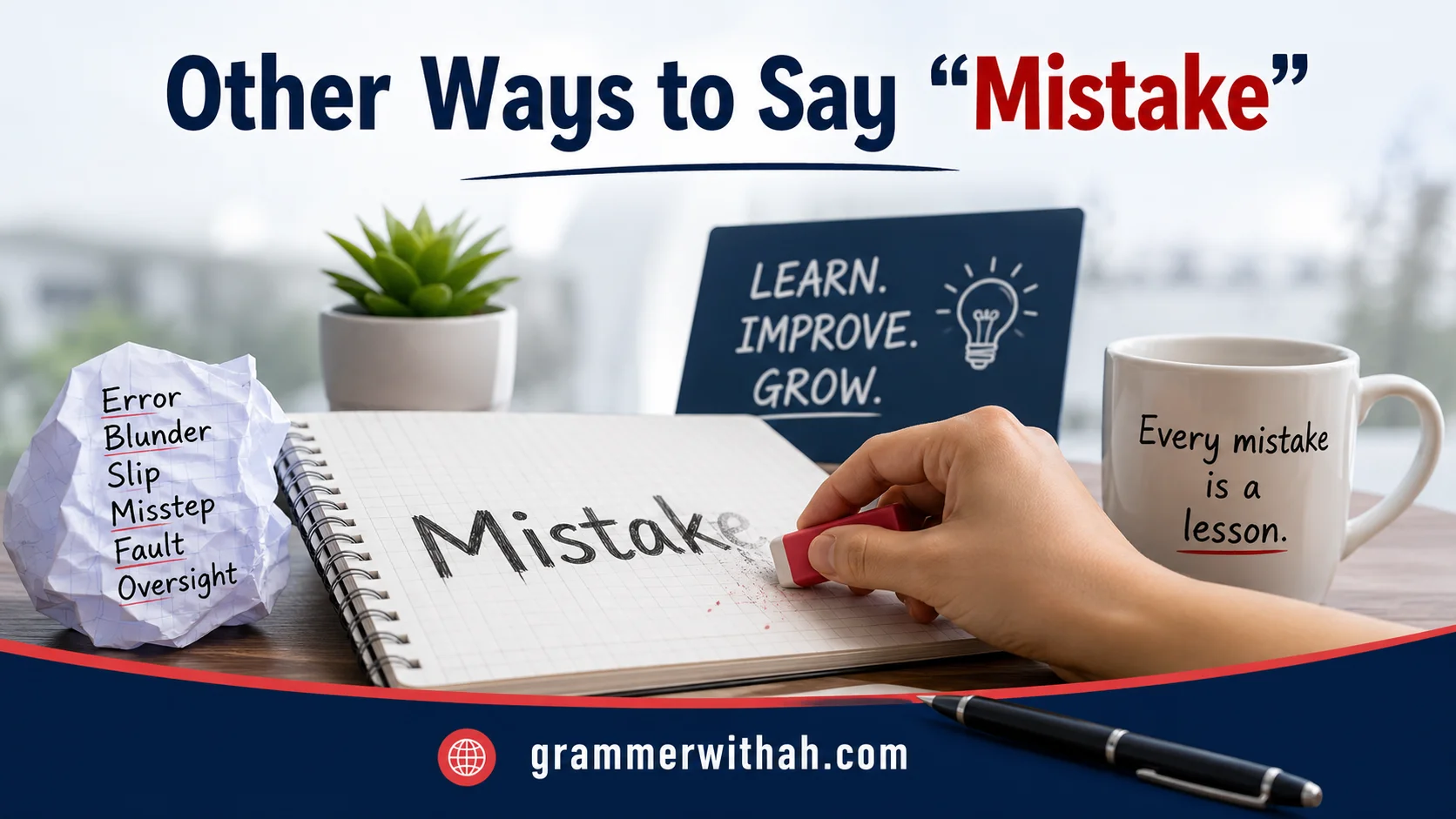
The phrase Other Ways to Say “Mistake” is useful when you want to improve your writing and choose more accurate words. A mistake can be a small error, a serious blunder, or a simple oversight, depending on the situation. Learning different alternatives helps you communicate more clearly, sound more professional, and express your ideas with greater confidence in everyday conversations and formal writing.
Using the right synonym for mistake makes your message more natural and precise. Whether you need to describe a spelling error, misjudgment, inaccuracy, or explain how to correct a mistake in a document or system, selecting the best word improves clarity. This guide shares practical alternatives with easy examples, helping you write and speak with confidence in every situation.
What Does “Mistake” Mean?
A mistake is something that is wrong, unplanned, or not correct, and it usually happens when someone overlooks details, misunderstands something, rushes, or makes a poor choice in the moment. It is a very common word, but it can sometimes sound a little direct, so choosing a softer or more precise alternative can make your communication feel warmer and more thoughtful.
Is It professional or polite to say mistake?
Yes, mistake is generally professional and polite in many everyday, school, and workplace situations. Still, words like oversight, error, or misstep can sound more careful and gentle when you want to speak with extra tact, especially in sensitive conversations.
Pros and Cons of Saying mistake
Pros: The word mistake is simple, familiar, and easy for almost everyone to understand quickly. It also sounds honest, clear, and direct, which is useful when you want to take responsibility without using complicated language.
Cons: In some situations, mistake can sound a little blunt, and that bluntness may feel too sharp when someone is already upset or embarrassed. In those moments, a softer word can make your message feel more supportive, calm, and considerate.
“Mistake” Synonyms
- Error
- Blunder
- Slip-up
- Oversight
- Misstep
- Fault
- Inaccuracy
- Lapse
- Omission
- Slip
- Gaffe
- Faux Pas
- Miscalculation
- Misunderstanding
- Typo
- Deviation
- Shortcoming
- Defect
- Flaw
- Weakness
- Problem
- Inconsistency
- Mishap
- Poor Judgment
- Unintentional Act
1. Error
Scenario Meaning: An error is a wrong result, action, or statement that happens because something was not done correctly, carefully, or accurately enough.
Examples:
- There was a small error in the report, but it was corrected quickly and calmly.
- The teacher noticed an error in my answer and explained the right step kindly.
- A typing error changed the meaning of the sentence in a surprising way.
- The team found an error before sending the final document to the client.
- One small error can affect the whole result when the details are important.
Tone: Error sounds formal, clear, and professional, especially in writing, schoolwork, and technical communication.
Details Explanation: This word works well when you want to sound precise, calm, and focused on facts rather than emotions. It is often used in office work, education, and technology because it gives a polished and neutral feeling.
Best Use: Use error when you want a respectful word that feels accurate, serious, and easy to understand in professional settings.
2. Blunder
Scenario Meaning: A blunder is a serious or obvious mistake that usually happens because of carelessness, poor timing, or a bad decision.
Examples:
- His public blunder made the meeting awkward for everyone in the room.
- She admitted the blunder honestly, which helped rebuild trust very quickly.
- The company made a costly blunder by ignoring customer feedback for months.
- I made a social blunder when I spoke before thinking carefully.
- That blunder became a lesson that changed how the team worked later.
Tone: Blunder sounds strong, serious, and sometimes a little dramatic, so it should be used carefully.
Details Explanation: This word is useful when the mistake is quite noticeable and has a bigger impact than a small slip. It can sound more intense than mistake, so it is best when you want to show that the problem was significant.
Best Use: Use blunder when you want to describe a major mistake that deserves attention, reflection, and a thoughtful response.
3. Slip-up
Scenario Meaning: A slip-up is a small or accidental mistake that happens because someone briefly loses focus, forgets something, or acts too quickly.
Examples:
- It was just a small slip-up, and nobody stayed upset for long.
- I had a slip-up during the presentation, but I recovered smoothly.
- Her slip-up was minor, and the rest of the work was excellent.
- The customer understood the slip-up once the issue was explained clearly.
- A simple slip-up should not cancel out someone’s good effort.
Tone: Slip-up sounds soft, friendly, and less harsh than many stronger mistake words.
Details Explanation: This word helps reduce blame and keeps the conversation light and human. It is useful when you want to show that the issue was small, accidental, and not worth making too heavy.
Best Use: Use slip-up when you want a gentle word for a minor mistake that can be fixed without much tension.
4. Oversight
Scenario Meaning: An oversight is a mistake caused by not noticing something important, often because it was missed or forgotten by accident.
Examples:
- The missing signature was an oversight, not a deliberate problem.
- We corrected the oversight before the final version was shared.
- That oversight happened because the team was working very quickly.
- Her honest apology showed that the oversight was unintentional.
- A small oversight can happen when many details need attention at once.
Tone: Oversight sounds polite, professional, and careful, which makes it excellent for respectful communication.
Details Explanation: This word often feels softer than mistake because it suggests something was missed rather than done carelessly. It is especially useful in business, formal emails, and thoughtful problem-solving conversations.
Best Use: Use oversight when you want to explain that something was missed without sounding harsh or overly critical.
5. Misstep
Scenario Meaning: A misstep is a wrong action, poor choice, or small failure in judgment that moves things in an unhelpful direction.
Examples:
- The manager called it a misstep and promised to handle it better next time.
- Her misstep was small, but it still taught everyone a useful lesson.
- A rushed misstep can create more stress than people expect.
- He turned the misstep into a chance to improve his approach.
- That misstep reminded the team to slow down and think carefully.
Tone: Misstep sounds measured, thoughtful, and slightly more reflective than the word mistake.
Details Explanation: This word is useful when you want to show that a choice was not ideal, but it was not necessarily disastrous. It often sounds diplomatic and emotionally balanced, which makes it helpful in mature conversations.
Best Use: Use misstep when you want a calm word for a wrong choice that still leaves room for learning and growth.
6. Fault
Scenario Meaning: A fault is a problem, weakness, or error that causes something to go wrong or work poorly.
Examples:
- The fault in the system caused delays for the whole department.
- It was nobody’s fault, and the problem was fixed with patience.
- The report showed a fault in the process, not in the people.
- She admitted her fault honestly, which made the conversation more open.
- A small fault can become bigger when it is ignored too long.
Tone: Fault sounds serious, clear, and sometimes more personal or blame-related than other options.
Details Explanation: This word can point to a problem in a person, process, or object, depending on the context. Because it may sound more direct, it should be used carefully when kindness and tact matter.
Best Use: Use fault when you need a straightforward word for a problem, weakness, or responsibility-related issue.
7. Inaccuracy
Scenario Meaning: An inaccuracy is something that is not correct, exact, or fully true in details, facts, or measurements.
Examples:
- There was an inaccuracy in the data, so the chart had to be updated.
- The writer fixed the inaccuracy before the article was published.
- A small inaccuracy can confuse readers who expect clear information.
- The team reviewed the document carefully to remove every inaccuracy.
- That inaccuracy changed the meaning more than anyone expected.
Tone: Inaccuracy sounds formal, careful, and especially useful in academic or technical settings.
Details Explanation: This word focuses on facts, numbers, and details that are not exact enough. It is a good choice when you want to sound precise and objective rather than emotional or personal.
Best Use: Use inaccuracy when the problem is about incorrect information, wrong details, or imperfect precision.
8. Lapse
Scenario Meaning: A lapse is a temporary failure in attention, judgment, memory, or discipline that leads to a small or moderate mistake.
Examples:
- His lapse in attention caused him to miss an important deadline.
- The lapse was brief, and he quickly returned to good work.
- A simple lapse in memory can happen to anyone under pressure.
- She apologized for the lapse and handled the situation with grace.
- That lapse did not erase the care she showed the rest of the day.
Tone: Lapse sounds gentle, mature, and often less judgmental than stronger mistake words.
Details Explanation: This word often suggests a short break in good judgment rather than a deep failure. It works well when you want to keep the tone calm, respectful, and understanding.
Best Use: Use lapse when the problem was temporary and you want to describe it in a balanced, thoughtful way.
9. Omission
Scenario Meaning: An omission is something that was left out, missed, or not included when it should have been there.
Examples:
- The missing page was an omission that we fixed immediately.
- Her omission of one name caused a little confusion in the list.
- The editor spotted the omission before the final draft was approved.
- A small omission can become important when the document is formal.
- That omission was accidental, and the correction came quickly.
Tone: Omission sounds formal, neutral, and especially useful in written communication.
Details Explanation: This word focuses on something that was left out rather than something done wrongly. It is very helpful when you want to discuss a missing detail with calm precision and minimal emotion.
Best Use: Use omission when the issue is about something being left out of a list, message, file, or report.
10. Slip
Scenario Meaning: A slip is a small, usually accidental mistake that happens quickly and often without serious damage.
Examples:
- It was just a small slip, and the message was corrected right away.
- Her slip in wording was harmless and easy to understand.
- A minor slip should not distract from the quality of the work.
- He laughed at his slip and moved on without embarrassment.
- Even careful people make a slip when they are tired.
Tone: Slip sounds light, friendly, and generally less formal than many other alternatives.
Details Explanation: This is a simple word that softens the feeling of blame and keeps things relaxed. It works well in everyday conversation when you want to acknowledge a small mistake without making it feel heavy.
Best Use: Use slip when you want a very casual, gentle word for a tiny mistake or brief lapse.
11. Gaffe
Scenario Meaning: A gaffe is an embarrassing or socially awkward mistake, especially one that is spoken or done in public.
Examples:
- His public gaffe made the interview more uncomfortable than expected.
- She laughed it off after a small gaffe during the speech.
- The politician’s gaffe quickly became the focus of the discussion.
- A social gaffe can feel bigger than it really is.
- The team recovered well after one awkward gaffe in the meeting.
Tone: Gaffe sounds social, slightly serious, and sometimes a little humorous depending on context.
Details Explanation: This word is often used for public or social mistakes that create embarrassment rather than damage. It works well when you want to describe a slip in manners, speech, or timing.
Best Use: Use gaffe when the mistake was public, awkward, or socially uncomfortable.
12. Faux pas
Scenario Meaning: A faux pas is a social mistake that breaks expected manners, etiquette, or polite behavior.
Examples:
- It was a small faux pas, but everyone recovered politely and quickly.
- She made a faux pas by interrupting at the wrong moment.
- The dinner faux pas was embarrassing, but nobody stayed angry.
- A simple faux pas can happen when someone is unfamiliar with the customs.
- He apologized after the faux pas and handled it respectfully.
Tone: Faux pas sounds polished, slightly formal, and often a little elegant or refined.
Details Explanation: This phrase is borrowed from French, and it is usually used for social manners rather than general errors. It can sound more stylish than mistake, which makes it useful in thoughtful or classy writing.
Best Use: Use faux pas when the issue is about etiquette, social manners, or polite behavior.
13. Miscalculation
Scenario Meaning: A miscalculation is an incorrect estimate, wrong judgment, or inaccurate decision based on numbers, timing, or planning.
Examples:
- The project delay came from a miscalculation in the schedule.
- Her miscalculation of the budget caused stress for the whole team.
- A small miscalculation can affect future plans in a big way.
- They corrected the miscalculation before it damaged the final outcome.
- That miscalculation showed why careful planning matters so much.
Tone: Miscalculation sounds serious, analytical, and often more technical than emotional.
Details Explanation: This word is especially useful when numbers, planning, or strategic choices are involved. It suggests that someone made the wrong estimate, which is different from a random accident or simple typo.
Best Use: Use miscalculation when the mistake came from planning, estimating, or judging numbers or outcomes.
Read This: 25 Other Ways to Say “INFLUENCE” (With Examples)
14. Misunderstanding
Scenario Meaning: A misunderstanding is a mistake caused by not correctly understanding a message, idea, intention, or situation.
Examples:
- The argument started because of a simple misunderstanding.
- Once the misunderstanding was cleared up, everyone felt much better.
- A small misunderstanding can create bigger problems if nobody explains it.
- She apologized for the misunderstanding and spoke more clearly afterward.
- Good communication can prevent many misunderstandings before they begin.
Tone: Misunderstanding sounds gentle, human, and often more relationship-focused than blame-focused.
Details Explanation: This word is helpful when the mistake came from unclear communication rather than carelessness. It encourages patience, listening, and empathy, which makes it very useful in personal and professional conversations.
Best Use: Use misunderstanding when the problem happened because someone interpreted words or actions in the wrong way.
15. Typo
Scenario Meaning: A typo is a small writing error, usually caused by typing the wrong letter, word, or character by accident.
Examples:
- There was a small typo in the email, but the meaning stayed clear.
- I fixed the typo before sending the message to the group.
- A single typo can make a sentence look less polished.
- She noticed the typo quickly and corrected it with care.
- The report was fine, except for one tiny typo on the last page.
Tone: Typo sounds casual, modern, and very common in digital communication.
Details Explanation: This word is best for text-related errors, especially in messages, articles, emails, and printed material. It feels light and practical, which makes it a friendly way to mention a small writing problem.
Best Use: Use typo when the mistake is clearly related to spelling, typing, or written text.
16. Deviation
Scenario Meaning: A deviation is a change, difference, or departure from what was expected, planned, standard, or normal.
Examples:
- The numbers showed a small deviation from the usual pattern.
- That deviation from the plan caused concern during the review.
- The team adjusted after noticing the deviation early.
- A slight deviation is not always a serious problem.
- The manager asked for an explanation of the deviation in the process.
Tone: Deviation sounds formal, technical, and often analytical in nature.
Details Explanation: This word is useful when something does not follow the expected path or standard. It is common in reports, research, systems, and quality control situations where exactness matters.
Best Use: Use deviation when something moves away from a rule, pattern, or expected result.
17. Shortcoming
Scenario Meaning: A shortcoming is a weakness, limitation, or imperfect part of something or someone.
Examples:
- One shortcoming of the plan was the lack of enough time.
- He spoke honestly about his shortcoming and wanted to improve.
- The product had one clear shortcoming, but it still worked well.
- Every person has a shortcoming, and that is part of being human.
- The report described the system’s shortcoming in a balanced way.
Tone: Shortcoming sounds thoughtful, respectful, and often more balanced than harsh criticism.
Details Explanation: This word focuses on a weakness rather than a single wrong act. It is useful when you want to talk about limits, imperfect qualities, or areas that need improvement without sounding overly severe.
Best Use: Use shortcoming when the issue is a weakness, limitation, or imperfect feature rather than one single action.
18. Defect
Scenario Meaning: A defect is a flaw, fault, or imperfection that makes something less correct, less useful, or less reliable.
Examples:
- The machine had a defect that needed immediate repair.
- They replaced the item because of a small defect in the part.
- A hidden defect can be hard to notice at first.
- The inspection team found a defect before the product went out.
- That defect made the final result less strong than expected.
Tone: Defect sounds serious, technical, and often product-related or quality-related.
Details Explanation: This word is usually used for objects, systems, or materials rather than personal behavior. It feels precise and practical, which makes it a strong choice in manufacturing, repair, and inspection contexts.
Best Use: Use defect when the mistake is actually a flaw in an object, system, or process.
19. Flaw
Scenario Meaning: A flaw is a weakness, imperfection, or fault that reduces the quality, strength, or correctness of something.
Examples:
- The design had a small flaw, but it was easy to improve.
- She noticed a flaw in the argument almost immediately.
- A tiny flaw can sometimes affect the final impression.
- The team worked hard to remove every flaw before launch.
- That flaw did not ruin the project, but it deserved attention.
Tone: Flaw sounds clear, balanced, and often more refined than the word mistake.
Details Explanation: This word can describe both objects and ideas, and it often suggests something is imperfect rather than completely wrong. It is a useful word when you want to sound careful and thoughtful without sounding harsh.
Best Use: Use flaw when you want to point out an imperfection in work, logic, design, or character.
20. Weakness
Scenario Meaning: A weakness is a less strong part, limitation, or vulnerable point in a person, plan, system, or idea.
Examples:
- One weakness in the plan was the lack of backup support.
- He spoke honestly about his weakness and asked for help.
- The report identified a major weakness in the current process.
- A weakness in communication can create confusion very quickly.
- The team fixed the weakness before it caused larger problems.
Tone: Weakness sounds honest, reflective, and often slightly personal or developmental.
Details Explanation: This word is best when the issue is not a one-time action, but a softer area that needs support or improvement. It often encourages growth, learning, and self-awareness in a respectful way.
Best Use: Use weakness when you want to describe a vulnerable point, limitation, or area needing improvement.
21. Problem
Scenario Meaning: A problem is something that causes difficulty, concern, or disruption and needs attention or a solution.
Examples:
- The problem was small, but it still needed a careful response.
- We solved the problem before it affected the rest of the work.
- A communication problem can create stress very quickly.
- She stayed calm and handled the problem with patience and care.
- The problem was not serious, but it deserved a proper fix.
Tone: Problem sounds neutral, practical, and very common in both formal and everyday speech.
Details Explanation: This word is broader than mistake, because it can refer to a situation, issue, or challenge rather than a wrong action. It is useful when you want simple language that most people will understand immediately.
Best Use: Use problem when the issue needs attention, support, or a solution rather than blame.
22. Inconsistency
Scenario Meaning: An inconsistency is a difference, contradiction, or lack of steady agreement within facts, behavior, or information.
Examples:
- The editor found an inconsistency in the two paragraphs.
- There was an inconsistency between the report and the numbers.
- The team reviewed the file to remove every inconsistency.
- A small inconsistency can make readers question the whole message.
- She explained the inconsistency clearly and corrected it right away.
Tone: Inconsistency sounds formal, analytic, and very useful in careful writing or review.
Details Explanation: This word works well when things do not match or stay the same in a way that matters. It is common in editing, research, auditing, and quality checking, where consistency is very important.
Best Use: Use inconsistency when the mistake involves conflicting details or uneven quality.
23. Mishap
Scenario Meaning: A mishap is an unfortunate small accident, trouble, or error that causes inconvenience but not usually serious damage.
Examples:
- The delivery mishap delayed the package by one more day.
- It was only a minor mishap, so nobody was badly affected.
- She handled the mishap with calm patience and a kind attitude.
- A small mishap during travel can still feel tiring and stressful.
- The team laughed later about the mishap, even though it annoyed them at first.
Tone: Mishap sounds gentle, soft, and often a little more forgiving than stronger words.
Details Explanation: This word is useful when something goes wrong, but the tone should stay light and understanding. It can soften disappointment and keep the focus on recovery rather than blame.
Best Use: Use mishap when the mistake or accident was minor, inconvenient, and not deeply serious.
24. Poor judgment
Scenario Meaning: Poor judgment means making a choice or decision that is not wise, careful, or well thought out.
Examples:
- The decision showed poor judgment, but the lesson was important.
- He admitted his poor judgment and promised to think more carefully.
- A moment of poor judgment can create problems that last longer.
- The manager discussed the poor judgment in a respectful and direct way.
- That poor judgment was unfortunate, yet it also became a learning moment.
Tone: Poor judgment sounds serious, direct, and focused on decision-making rather than simple accidents.
Details Explanation: This phrase is useful when the problem came from a choice that was not wise enough. It is stronger than a light mistake word, so it should be used carefully and respectfully.
Best Use: Use poor judgment when the issue was caused by a bad decision rather than an accidental slip.
25. Unintentional act
Scenario Meaning: An unintentional act is something done by accident, without planning, and without the goal of causing harm or trouble.
Examples:
- The damage was an unintentional act, not something done on purpose.
- She explained the unintentional act carefully and apologized right away.
- A small unintentional act can still need a thoughtful response.
- The team understood that the unintentional act came from confusion.
- He took responsibility for the unintentional act with honesty and care.
Tone: Unintentional act sounds formal, careful, and very considerate in serious conversations.
Details Explanation: This phrase is especially useful when you want to clearly show that there was no bad intention behind the action. It can make communication feel fair, compassionate, and balanced in sensitive situations.
Best Use: Use unintentional act when you want a formal and gentle way to say something happened by accident.
FAQs:
1. What are some common other ways to say “mistake”?
Some common alternatives include error, blunder, oversight, misjudgment, slip-up, fault, and inaccuracy. Each word fits different situations and levels of formality.
2. Which synonym for “mistake” is the most professional?
Error, oversight, and inaccuracy are the most professional choices because they are widely used in business, academic, and technical writing.
3. Can I use “blunder” instead of “mistake”?
Yes, but blunder usually describes a serious or embarrassing mistake, while mistake is a more general term that works in most situations.
4. How do I say “correct a mistake” professionally?
Professional alternatives include correct an error, rectify an issue, make a correction, amend a record, or resolve an inaccuracy, depending on the context.
5. Why should I learn different ways to say “mistake”?
Using a variety of synonyms makes your writing more engaging, improves your vocabulary, avoids repetition, and helps you choose the most suitable word for every situation.
Conclusion:
Learning other ways to say “mistake” helps you communicate with greater clarity, confidence, and accuracy. Whether you are writing a professional email, creating academic content, or having an everyday conversation, choosing the right synonym makes your message more natural and meaningful. By understanding when to use words like error, blunder, oversight, or misjudgment, you can express yourself more effectively and improve both your speaking and writing skills.