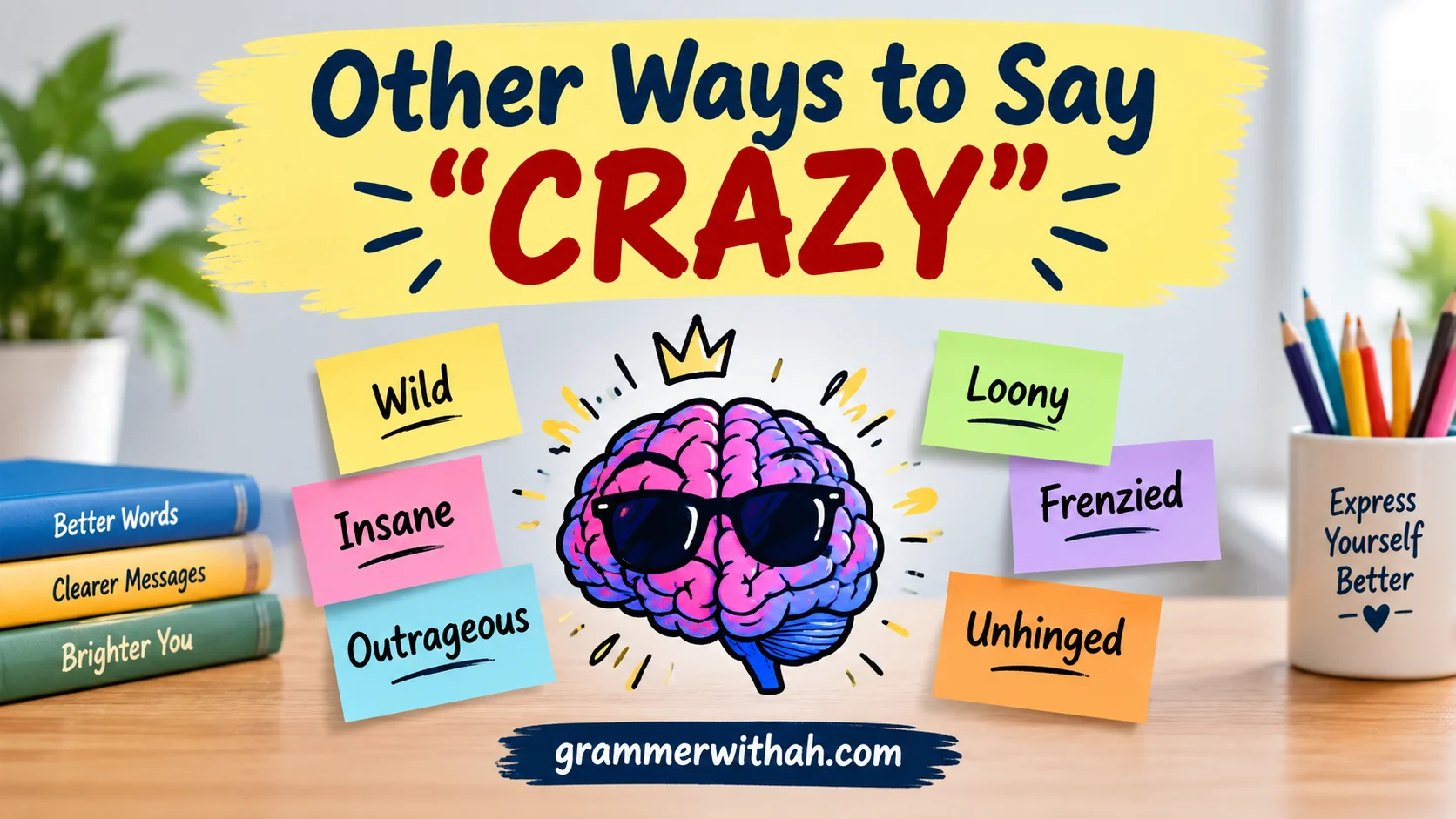
Other Ways to Say “CRAZY” (With Examples) gives you useful choices when crazy feels repetitive in writing or speech. You can describe something surprising, exciting, unusual, overwhelming, intense, or difficult with more precise words. In everyday English, different alternatives make conversations sound natural and help you communicate your intended meaning clearly. Depending on the context, something may be wild, unbelievable, chaotic, eccentric, unpredictable, extraordinary, or astonishing.
The best alternative depends on what you want to express. Thoughtful words can show warmth, care, and respect, especially when discussing mental health, feelings, or behavior. For casual, playful, and fun conversations, colorful choices can make your language more interesting and expressive. This guide offers ways to improve word choice, learn useful synonyms, and add colorful language to your communication. By choosing words carefully, you can describe someone, explain situations, and make your speech and writing more meaningful without sounding insensitive.
What Does “Crazy” Mean?
Crazy commonly means extremely unusual, surprising, unreasonable, exciting, confusing, uncontrolled, or difficult to understand depending on the context. The word can describe an event, idea, situation, experience, behavior, or reaction, although its meaning changes considerably based on how it appears in a sentence.
For example, saying “That was a crazy weekend” usually means the weekend was unusually exciting, busy, surprising, or memorable. However, calling a person “crazy” can sound judgmental or hurtful, especially when the word is connected with someone’s emotional or mental health.
Is It Professional or Polite to Say “Crazy”?
The word “crazy” is generally acceptable in casual conversations, but it may sound too informal, insensitive, or vague in professional communication. When speaking respectfully, it is usually better to choose a more specific word that explains whether something was unusual, intense, unpredictable, unreasonable, overwhelming, or remarkable.
For example, “The schedule was hectic” sounds more professional than “The schedule was crazy.” Similarly, “That was an unexpected decision” communicates more clearly than simply calling a decision “crazy.”
Pros and Cons of “Crazy”
Pros: The word crazy is short, familiar, expressive, and easy to understand in casual conversations. It can quickly communicate strong surprise, excitement, confusion, or disbelief without requiring many additional words.
Cons: The word crazy can be vague, overly casual, judgmental, or potentially insensitive when describing people or situations connected with mental health. It may also fail to communicate exactly what you mean because wild, chaotic, ridiculous, surprising, and intense all describe different feelings.
Synonyms “Crazy”
- Wild
- Unbelievable
- Intense
- Chaotic
- Eccentric
- Unpredictable
- Extraordinary
- Astonishing
- Bizarre
- Absurd
- Ridiculous
- Outrageous
- Extreme
- Unconventional
- Strange
- Peculiar
- Offbeat
- Frantic
- Hectic
- Impulsive
- Reckless
- Irrational
- Surprising
- Mind-Blowing
- Remarkable
1. Wild
Scenario Meaning: Wild describes something unusually exciting, uncontrolled, surprising, energetic, or difficult to predict, especially when ordinary expectations are completely exceeded.
Examples:
- The concert became wild when everyone started dancing together during the final song.
- We had a wild weekend filled with unexpected adventures and memorable conversations.
- That was a wild story that I honestly never expected to hear from you.
- The weather became wild before the storm finally moved away from town.
- She had a wild idea that eventually turned into something surprisingly successful.
Tone: Casual, energetic, playful, and expressive.
Details Explanation: Wild works especially well when something feels exciting, uncontrolled, adventurous, or unexpectedly intense without necessarily sounding negative.
Best Use: Use wild for casual conversations involving adventures, events, experiences, stories, parties, ideas, or unexpected situations.
2. Unbelievable
Scenario Meaning: Unbelievable describes something so surprising, extraordinary, or unexpected that accepting it immediately feels difficult.
Examples:
- The final result was unbelievable, especially after everything our team experienced.
- She told us an unbelievable story about meeting her favorite author.
- The amount of support we received was genuinely unbelievable.
- That performance was unbelievable from beginning to end.
- It was unbelievable how quickly everything changed that afternoon.
Tone: Amazed, positive, emotional, and conversational.
Details Explanation: Unbelievable emphasizes surprise or disbelief and works particularly well when something exceeds ordinary expectations.
Best Use: Use unbelievable when describing surprising achievements, stories, events, results, experiences, or unexpected developments.
3. Intense
Scenario Meaning: Intense describes something extremely strong, powerful, concentrated, emotional, demanding, or difficult to experience casually.
Examples:
- The training session was intense, but everyone remained motivated throughout.
- We had an intense conversation about the future of our project.
- The competition became intense during the final few minutes.
- She experienced an intense moment of excitement after hearing the announcement.
- The workload has been intense, although everyone is handling it carefully.
Tone: Serious, mature, descriptive, and emotionally aware.
Details Explanation: Intense is useful when you want to communicate strong feelings, pressure, activity, concentration, or emotional energy more precisely.
Best Use: Use intense for conversations involving emotions, work, competition, experiences, pressure, training, or demanding situations.
4. Chaotic
Scenario Meaning: Chaotic describes something confused, disorganized, unpredictable, or lacking clear order because many things happen simultaneously.
Examples:
- The office became chaotic when several important meetings changed unexpectedly.
- Our travel plans became chaotic after the first flight was delayed.
- The morning felt completely chaotic because everyone needed something immediately.
- The event was chaotic, but somehow everyone still managed to enjoy themselves.
- Moving into the new apartment was an extremely chaotic experience.
Tone: Honest, descriptive, casual, and slightly negative.
Details Explanation: Chaotic focuses on disorder and confusion rather than simply describing something as unusual or exciting.
Best Use: Use chaotic for busy schedules, disorganized situations, confusing events, crowded environments, or complicated experiences.
5. Eccentric
Scenario Meaning: Eccentric describes someone or something noticeably unconventional, unusual, distinctive, or different from ordinary expectations.
Examples:
- Her eccentric style makes her instantly recognizable wherever she goes.
- He has an eccentric approach to solving difficult creative problems.
- The artist was known for creating eccentric designs that challenged traditional ideas.
- Their eccentric traditions make every family gathering memorable.
- She developed an eccentric but surprisingly effective working routine.
Tone: Respectful, distinctive, curious, and sometimes playful.
Details Explanation: Eccentric can describe unusual people, styles, habits, ideas, or approaches without automatically presenting them as negative.
Best Use: Use eccentric when describing individuality, unusual personalities, creative styles, distinctive habits, or unconventional ideas.
6. Unpredictable
Scenario Meaning: Unpredictable describes something that cannot easily be anticipated because its future behavior, result, or direction remains uncertain.
Examples:
- The weather has been extremely unpredictable throughout this entire week.
- His schedule is often unpredictable because unexpected meetings appear frequently.
- The game became unpredictable after both teams changed their strategies.
- Their journey was unpredictable, but every unexpected moment became memorable.
- The market can remain unpredictable when major announcements suddenly appear.
Tone: Neutral, thoughtful, and professional.
Details Explanation: Unpredictable is more precise than crazy when the main idea involves uncertainty or difficulty anticipating what happens next.
Best Use: Use unpredictable for people, weather, schedules, markets, situations, outcomes, plans, or changing circumstances.
7. Extraordinary
Scenario Meaning: Extraordinary describes something remarkably unusual, impressive, exceptional, or far beyond what normally happens.
Examples:
- She demonstrated extraordinary patience while helping everyone understand the new process.
- The team achieved an extraordinary result despite facing several difficult challenges.
- His dedication to the community has been truly extraordinary.
- We witnessed an extraordinary performance that everyone remembered afterward.
- The project became an extraordinary example of creative teamwork.
Tone: Positive, respectful, warm, and sophisticated.
Details Explanation: Extraordinary is an excellent positive alternative when crazy means something unusually impressive or remarkable.
Best Use: Use extraordinary in professional writing, compliments, speeches, formal conversations, and meaningful personal messages.
8. Astonishing
Scenario Meaning: Astonishing describes something extremely surprising or impressive because it greatly exceeds normal expectations.
Examples:
- The improvement in her skills was astonishing after only a few months.
- The final amount of support was genuinely astonishing to everyone involved.
- His ability to remain calm during difficult moments was astonishing.
- The view from the mountain was absolutely astonishing.
- The results were astonishing, especially considering how little time remained.
Tone: Impressed, enthusiastic, positive, and expressive.
Details Explanation: Astonishing highlights strong surprise while maintaining a respectful and positive tone.
Best Use: Use astonishing when something is impressively surprising, remarkable, unexpected, or difficult to believe.
9. Bizarre
Scenario Meaning: Bizarre describes something extremely unusual, strange, unexpected, or difficult to understand through ordinary experiences.
Examples:
- We witnessed a bizarre situation that nobody could explain afterward.
- The movie presented a bizarre story filled with unexpected developments.
- That was a bizarre coincidence that made everyone stop and think.
- He shared a bizarre idea that surprisingly worked very well.
- The conversation took a bizarre turn before eventually becoming normal again.
Tone: Curious, humorous, unusual, and sometimes slightly negative.
Details Explanation: Bizarre emphasizes unusual qualities and often suggests that something feels strange or difficult to explain.
Best Use: Use bizarre for strange stories, coincidences, events, ideas, experiences, or situations that feel outside ordinary expectations.
10. Absurd
Scenario Meaning: Absurd describes something unreasonable, illogical, ridiculous, or so extreme that it seems difficult to take seriously.
Examples:
- The suggestion sounded absurd, but everyone listened before making a decision.
- It would be absurd to ignore such an obvious opportunity.
- The price seemed completely absurd compared with similar products.
- His explanation became increasingly absurd as the conversation continued.
- The situation felt absurd because nothing seemed to make logical sense.
Tone: Critical, humorous, direct, and sometimes sarcastic.
Details Explanation: Absurd is stronger than unusual because it suggests that something lacks reasonable logic or makes little sense.
Best Use: Use absurd when criticizing unreasonable ideas, situations, decisions, explanations, prices, or claims.
11. Ridiculous
Scenario Meaning: Ridiculous describes something unreasonable, foolish, exaggerated, or difficult to accept because it seems unnecessarily silly.
Examples:
- The amount they wanted to charge seemed completely ridiculous.
- It would be ridiculous to blame one person for the entire problem.
- His excuse sounded ridiculous after everyone heard the complete story.
- The rules became ridiculous when they started creating unnecessary problems.
- We laughed because the situation had become almost ridiculous.
Tone: Casual, critical, humorous, and direct.
Details Explanation: Ridiculous communicates strong disagreement or disbelief and usually carries more judgment than the word crazy.
Best Use: Use ridiculous for unreasonable claims, rules, prices, excuses, ideas, behavior, or situations.
12. Outrageous
Scenario Meaning: Outrageous describes something shockingly excessive, unreasonable, unacceptable, or surprisingly extreme compared with normal standards.
Examples:
- The restaurant charged an outrageous amount for such a simple meal.
- Her outrageous outfit immediately became the center of attention.
- The decision was outrageous and left many people feeling disappointed.
- He made an outrageous claim that nobody could easily believe.
- The final request sounded completely outrageous to everyone involved.
Tone: Strong, emotional, expressive, and sometimes humorous.
Details Explanation: Outrageous works when something feels shockingly extreme, unfair, excessive, or unusually bold.
Best Use: Use outrageous for prices, behavior, claims, decisions, fashion, demands, or situations that strongly exceed expectations.
13. Extreme
Scenario Meaning: Extreme describes something reaching an unusually high, severe, intense, or far-reaching level beyond what is normally considered ordinary.
Examples:
- The team faced extreme pressure during the final stage of the competition.
- The weather reached extreme levels during the afternoon.
- She took an extreme approach to solving the complicated problem.
- His reaction seemed extreme considering what had actually happened.
- The project required extreme attention to detail from everyone involved.
Tone: Serious, direct, neutral, and professional.
Details Explanation: Extreme focuses on degree or severity and provides a clearer meaning when something is unusually intense.
Best Use: Use extreme for weather, reactions, conditions, decisions, opinions, pressure, situations, or behavior.
Read This: 25 Other Ways to Say “Strong” (With Examples)
14. Unconventional
Scenario Meaning: Unconventional describes something that does not follow traditional, common, or expected methods, patterns, styles, or ideas.
Examples:
- She developed an unconventional method that helped the team solve the problem.
- His unconventional style makes his work immediately recognizable.
- They chose an unconventional approach to organizing the event.
- The company encourages employees to suggest unconventional ideas.
- Her unconventional perspective helped everyone consider another possibility.
Tone: Positive, respectful, thoughtful, and professional.
Details Explanation: Unconventional is especially helpful when crazy means different, creative, original, or outside traditional expectations.
Best Use: Use unconventional for ideas, methods, lifestyles, strategies, designs, approaches, and creative decisions.
15. Strange
Scenario Meaning: Strange describes something unfamiliar, unusual, unexpected, or noticeably different from what people normally experience.
Examples:
- There was a strange feeling in the room after everyone became silent.
- She noticed a strange sound coming from outside the window.
- That was a strange coincidence that happened twice within one week.
- His strange idea eventually became an interesting discussion topic.
- The situation felt strange because nobody knew what would happen next.
Tone: Simple, neutral, conversational, and flexible.
Details Explanation: Strange is one of the easiest alternatives because it communicates unusualness without sounding excessively dramatic.
Best Use: Use strange in everyday conversations when something feels unusual, unfamiliar, confusing, or unexpected.
16. Peculiar
Scenario Meaning: Peculiar describes something noticeably unusual, distinctive, or different from what people generally consider normal.
Examples:
- There was a peculiar smell coming from the old storage room.
- She has a peculiar habit of organizing everything by color.
- The story included a peculiar detail that nobody expected.
- He noticed a peculiar pattern appearing across several documents.
- The building has a peculiar design that makes it memorable.
Tone: Polite, thoughtful, slightly formal, and curious.
Details Explanation: Peculiar offers a softer and more refined way to describe something unusual without immediately judging it.
Best Use: Use peculiar for habits, details, designs, patterns, behaviors, objects, or observations that seem unusual.
17. Offbeat
Scenario Meaning: Offbeat describes something unusual, unconventional, quirky, or different from ordinary styles, ideas, behaviors, or expectations.
Examples:
- She has an offbeat sense of humor that makes everyone laugh unexpectedly.
- The movie uses an offbeat style that feels fresh and creative.
- His offbeat ideas often lead to interesting conversations.
- They chose an offbeat theme for their small celebration.
- The artist is famous for creating offbeat designs.
Tone: Casual, playful, creative, and friendly.
Details Explanation: Offbeat usually carries a lighter and more positive feeling when describing unusual creativity or personality.
Best Use: Use offbeat for humor, art, fashion, ideas, personalities, entertainment, and creative styles.
18. Frantic
Scenario Meaning: Frantic describes someone or something extremely rushed, panicked, hurried, or emotionally overwhelmed by pressure.
Examples:
- Everyone became frantic when the important documents suddenly disappeared.
- The final hour before the event was completely frantic.
- She made a frantic attempt to finish everything before the deadline.
- The office became frantic after the unexpected announcement.
- We had a frantic morning trying to catch the early train.
Tone: Urgent, emotional, serious, and descriptive.
Details Explanation: Frantic is more specific than crazy because it focuses on panic, urgency, rushing, or emotional pressure.
Best Use: Use frantic for rushed situations, emergencies, stressful moments, busy periods, or panicked actions.
19. Hectic
Scenario Meaning: Hectic describes a period or situation that is extremely busy, rushed, demanding, or filled with many activities happening together.
Examples:
- This week has been hectic, but we are finally getting everything organized.
- The morning became hectic after several meetings changed unexpectedly.
- Moving to a new home can be a surprisingly hectic experience.
- Her schedule remains hectic because she manages several responsibilities.
- The restaurant was especially hectic during the evening rush.
Tone: Casual, practical, neutral, and conversational.
Details Explanation: Hectic is ideal when crazy means very busy, rushed, crowded, or difficult to manage.
Best Use: Use hectic for schedules, workplaces, travel, events, mornings, routines, and busy periods.
20. Impulsive
Scenario Meaning: Impulsive describes actions or decisions made suddenly without enough thought about possible consequences or future results.
Examples:
- Buying the expensive item was an impulsive decision that she later reconsidered.
- His impulsive reaction made the conversation more difficult than necessary.
- She sometimes makes impulsive choices when she feels particularly excited.
- The decision was impulsive, although it eventually produced positive results.
- An impulsive response can sometimes create problems that careful thinking could prevent.
Tone: Neutral, thoughtful, and slightly cautionary.
Details Explanation: Impulsive provides a precise alternative when crazy describes behavior that happens suddenly without careful consideration.
Best Use: Use impulsive for decisions, reactions, purchases, choices, actions, or behavior that happens without sufficient planning.
21. Reckless
Scenario Meaning: Reckless describes behavior involving unnecessary risk because someone acts without giving enough attention to possible consequences.
Examples:
- Driving so quickly through the crowded street was extremely reckless.
- His reckless decision could have created serious problems for everyone.
- She realized that making such a reckless choice was not worth the risk.
- The company avoided taking a reckless approach to its long-term planning.
- His reckless behavior concerned everyone who cared about him.
Tone: Serious, concerned, direct, and cautionary.
Details Explanation: Reckless should be used when the important meaning involves dangerous, careless, or unnecessarily risky behavior.
Best Use: Use reckless for risky decisions, dangerous actions, careless behavior, or choices that may seriously affect others.
22. Irrational
Scenario Meaning: Irrational describes thoughts, decisions, reactions, or actions that do not follow reasonable logic or sound judgment.
Examples:
- His fear became irrational after several people explained the situation calmly.
- Making that decision without considering the evidence seemed irrational.
- Her reaction felt irrational, although everyone understood that she was upset.
- The argument became irrational when neither person listened carefully anymore.
- It would be irrational to ignore the information available to us.
Tone: Analytical, direct, serious, and professional.
Details Explanation: Irrational is a precise alternative when crazy refers to reasoning, decisions, reactions, or beliefs that appear unreasonable.
Best Use: Use irrational for arguments, decisions, fears, reasoning, reactions, beliefs, or conclusions that lack logical support.
23. Surprising
Scenario Meaning: Surprising describes something unexpected because it differs from what someone reasonably anticipated or believed would happen.
Examples:
- The final result was surprising, especially after the difficult beginning.
- Her answer was surprising, but it made everyone reconsider the situation.
- We received a surprising amount of positive feedback.
- The sudden change in plans was surprising for everyone involved.
- It was surprising to discover how quickly the project improved.
Tone: Gentle, neutral, positive, and conversational.
Details Explanation: Surprising is a safe and flexible choice when crazy simply means unexpected or different from what someone anticipated.
Best Use: Use surprising for results, news, reactions, discoveries, changes, events, experiences, or unexpected information.
24. Mind-Blowing
Scenario Meaning: Mind-blowing describes something extremely impressive, surprising, exciting, or difficult to believe because it greatly exceeds expectations.
Examples:
- The concert was mind-blowing, especially during the final performance.
- Her photography skills are absolutely mind-blowing.
- The view from the highest point was completely mind-blowing.
- We learned some mind-blowing facts during the documentary.
- The final reveal was so mind-blowing that everyone remained silent afterward.
Tone: Excited, enthusiastic, casual, and expressive.
Details Explanation: Mind-blowing is an informal phrase that strongly emphasizes amazement, excitement, surprise, or admiration.
Best Use: Use mind-blowing in casual conversations about entertainment, discoveries, achievements, experiences, technology, or impressive moments.
25. Remarkable
Scenario Meaning: Remarkable describes something unusually impressive, memorable, noteworthy, or deserving special attention because of its exceptional qualities.
Examples:
- Her progress over the past year has been truly remarkable.
- The team achieved a remarkable result despite several unexpected challenges.
- His ability to remain positive during difficult moments is remarkable.
- We experienced a remarkable evening that everyone remembered fondly.
- The project became a remarkable example of thoughtful collaboration.
Tone: Positive, respectful, warm, and professional.
Details Explanation: Remarkable is an excellent polished alternative when crazy means unusually impressive, memorable, surprising, or exceptional.
Best Use: Use remarkable for achievements, people, experiences, progress, results, qualities, events, and meaningful accomplishments.
FAQs:
1. What are some other ways to say “crazy”?
Some useful alternatives include wild, bizarre, insane, chaotic, ridiculous, irrational, unpredictable, strange, and unbelievable. The best choice depends on whether you mean unusual behavior, excitement, confusion, or something hard to believe.
2. Is “crazy” a formal word?
Crazy is common in everyday English, but it may sound informal in professional or academic writing. Depending on the context, words such as unusual, irrational, extreme, chaotic, or unpredictable can sound more precise.
3. What is a polite synonym for “crazy”?
Polite alternatives include unusual, eccentric, unpredictable, strange, and unconventional. These words can describe someone or something without sounding as harsh or judgmental as “crazy.”
4. Can “crazy” describe something positive?
Yes. In informal English, crazy can describe something exciting, impressive, surprising, or extreme. For example, “That was a crazy concert!” means the concert was extremely exciting or memorable.
5. How do I choose the right synonym for “crazy”?
Think about the exact meaning you want. Use wild for energetic situations, bizarre for something very strange, chaotic for disorder, irrational for unreasonable behavior, and unbelievable for something difficult to believe.
Conclusion:
There are many effective ways to say crazy, and each alternative creates a slightly different meaning or tone. Words such as wild, bizarre, chaotic, irrational, strange, and unpredictable can make your writing and conversations more precise. Instead of repeating “crazy,” choose a synonym that matches the situation, emotion, and level of formality. This simple change can make your English sound more natural, expressive, and interesting.