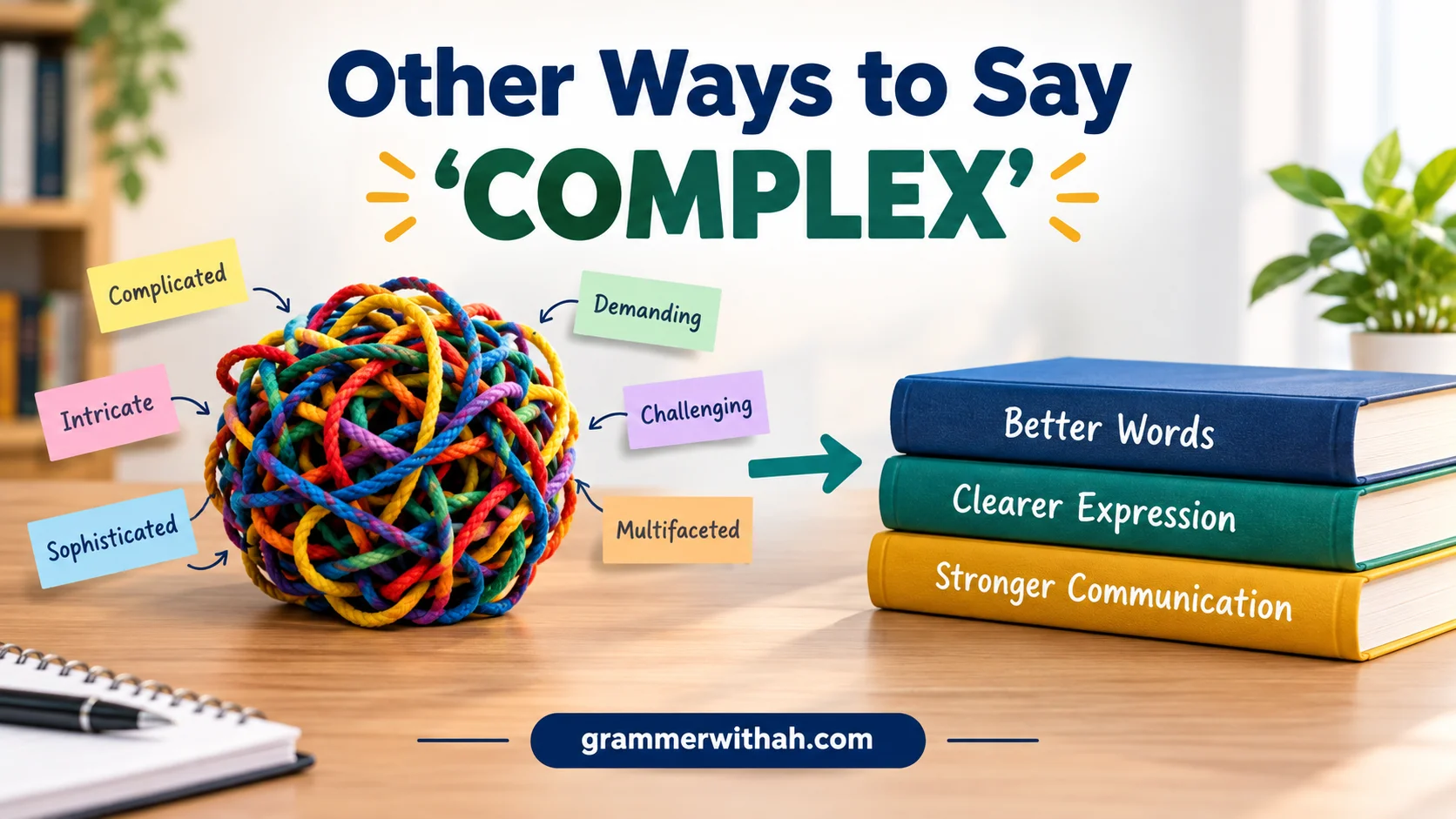
Other Ways to Say “COMPLEX” (With Examples) is a helpful guide for anyone who wants to improve their writing with clear, natural, and accurate vocabulary. Instead of repeating the word complex, you can use fresh expressions that better describe ideas, systems, problems, and detailed situations. Choosing the right words makes your message easier to understand while giving your writing a more polished and professional tone.
Whether you are describing interconnected parts, layered compositions, or challenging concepts, using the right synonym adds depth and clarity. This guide includes easy definitions, practical examples, and carefully chosen alternatives that fit everyday and professional writing. With a simple approach and an expert touch, you will discover vocabulary that helps your sentences sound more engaging, precise, and confident in any context.
What Does “COMPLEX” Mean?
Complex describes something that contains many connected parts, details, ideas, or difficulties that make it harder to understand, manage, or explain. The word can describe situations, problems, emotions, systems, relationships, ideas, or tasks that require careful thought before someone can fully understand them.
For example, a complex problem may involve several different causes, while a complex emotion may contain several feelings happening at the same time. The word does not always mean something is negative, because complexity can sometimes make an idea interesting, thoughtful, detailed, or valuable.
Is It Professional or Polite to Say “COMPLEX”?
Yes, complex is generally a professional and polite word that works well in workplaces, academic writing, conversations, and everyday communication. It can clearly explain that something contains several connected elements without automatically criticizing the person, idea, or situation being discussed.
However, the tone can sometimes sound slightly formal, especially during sensitive conversations where someone may need empathy rather than technical language. Choosing a softer alternative, such as multifaceted or involved, can make your communication feel more considerate while keeping your meaning clear.
Pros And Cons of “COMPLEX”
Pros:
Clear: The word quickly communicates that something contains multiple connected parts or difficulties.
Professional: It works naturally in business, education, technical discussions, and formal written communication.
Versatile: You can use complex to describe problems, ideas, emotions, relationships, systems, and many other subjects.
Cons:
Sometimes vague: The listener may understand that something is difficult without knowing exactly what makes it difficult.
Can sound formal: In emotional conversations, the word may feel less personal than a warmer alternative.
May feel negative: Depending on the context, someone might interpret complex as unnecessarily difficult or confusing.
Synonyms “COMPLEX”
- Complicated
- Intricate
- Multifaceted
- Elaborate
- Sophisticated
- Involved
- Detailed
- Layered
- Nuanced
- Convoluted
- Difficult
- Challenging
- Multilayered
- Interconnected
- Comprehensive
- Subtle
- Advanced
- Intriguing
- Deep
- Complicated in Nature
- Full of Details
- Hard to Understand
- Highly Structured
- Multidimensional
- Not Straightforward
1. Complicated
Scenario Meaning: Complicated means something has several connected parts or difficulties that make it harder to understand, solve, explain, or manage easily.
Examples:
- The situation became complicated because several different concerns needed attention at the same time.
- Their relationship is complicated, but both people are trying to understand each other better.
- The instructions looked complicated because they included several steps and different requirements.
- This problem seems complicated, although we can understand it better by discussing each part separately.
- Her feelings were complicated because she experienced happiness, worry, disappointment, and hope simultaneously.
Tone: The word complicated sounds natural, conversational, and slightly serious without necessarily making the situation sound completely negative.
Details Explanation: Complicated is one of the most common alternatives to complex because people use it naturally during everyday conversations. It suggests that something is difficult because many factors are involved, rather than simply saying something is impossible to understand.
Best Use: Use complicated when you want to describe a difficult situation, relationship, problem, process, or emotion using simple and familiar language.
2. Intricate
Scenario Meaning: Intricate means something contains many small, carefully connected parts that create a detailed structure requiring close attention and thoughtful understanding.
Examples:
- The artist created an intricate design that included countless small details and carefully connected patterns.
- The machine has an intricate system that requires experienced professionals to understand and maintain properly.
- Her explanation provided an intricate view of the situation without ignoring any important details.
- The building contains intricate decorations that reveal remarkable attention to craftsmanship and design.
- Understanding the agreement requires examining its intricate terms and carefully considering their meaning.
Tone: Intricate sounds thoughtful, refined, and descriptive, often suggesting that complexity comes from impressive details rather than confusion.
Details Explanation: Unlike complicated, intricate can carry a more positive feeling because it often suggests something is carefully designed, detailed, or skillfully constructed. It works especially well when describing art, systems, designs, processes, writing, or technical structures.
Best Use: Use intricate when you want to emphasize fine details and carefully connected parts, especially when the complexity is interesting or impressive.
3. Multifaceted
Scenario Meaning: Multifaceted means something has several different aspects, qualities, perspectives, or dimensions that should be considered together for understanding.
Examples:
- Mental health can be a multifaceted subject involving emotional, social, physical, and environmental influences.
- Her personality is multifaceted, showing different qualities depending on the circumstances around her.
- The organization faces a multifaceted challenge requiring cooperation between several departments and experienced professionals.
- Their friendship has a multifaceted history shaped by trust, disagreement, support, growth, and shared experiences.
- Climate change represents a multifaceted issue that affects communities, economies, environments, and future generations.
Tone: The tone of multifaceted is professional, thoughtful, respectful, and particularly useful when discussing subjects with several meaningful dimensions.
Details Explanation: Multifaceted is an excellent choice when you want to avoid making complexity sound like confusion or difficulty. Instead, it highlights the fact that something has many different sides, allowing your language to sound more balanced and considerate.
Best Use: Use multifaceted in professional, academic, emotional, or thoughtful conversations where you want to recognize multiple perspectives or dimensions.
4. Elaborate
Scenario Meaning: Elaborate means something contains many carefully developed details, features, steps, or decorative elements that make it highly detailed.
Examples:
- They created an elaborate plan that considered several possible outcomes and potential challenges.
- The wedding included an elaborate arrangement with thoughtful decorations, music, food, and entertainment.
- He gave an elaborate explanation because the subject required additional background and supporting information.
- The designer produced an elaborate pattern containing many carefully arranged details.
- The project required an elaborate preparation process before the team could begin working successfully.
Tone: Elaborate often sounds positive and impressive, although it can sometimes suggest that something contains more details than necessary.
Details Explanation: This alternative focuses strongly on development and detail, rather than simply describing something as difficult. It is especially useful when discussing plans, designs, explanations, celebrations, systems, or arrangements that contain numerous carefully considered elements.
Best Use: Use elaborate when you want to emphasize that something has been carefully developed, detailed, or extensively planned.
5. Sophisticated
Scenario Meaning: Sophisticated means something is highly developed, advanced, refined, or capable of handling many complicated features with intelligence and effectiveness.
Examples:
- The company developed a sophisticated system capable of processing large amounts of information efficiently.
- Her understanding of the subject became more sophisticated after years of study and practical experience.
- The software uses sophisticated technology to identify patterns that ordinary systems might miss.
- His argument was sophisticated, showing awareness of several different perspectives.
- Modern communication requires increasingly sophisticated tools because people exchange information in many different ways.
Tone: The word sophisticated usually sounds positive, intelligent, professional, and respectful toward the subject being described.
Details Explanation: Sophisticated does not simply mean difficult, because it often suggests that something has reached a high level of development or refinement. It can therefore make your description sound more positive and appreciative than the word complex.
Best Use: Use sophisticated when describing advanced technology, ideas, systems, skills, arguments, designs, or developed understanding.
6. Involved
Scenario Meaning: Involved means something includes many connected details, activities, people, steps, or considerations that require significant attention.
Examples:
- The hiring process was involved, requiring several interviews and careful evaluations.
- Planning the event became more involved than the team initially expected.
- The discussion was involved, with everyone sharing different concerns and suggestions.
- Preparing the report was an involved process because numerous sources needed careful review.
- Their family situation is involved, with several responsibilities affecting everyone differently.
Tone: Involved sounds neutral, professional, and less harsh than some alternatives that strongly emphasize difficulty or confusion.
Details Explanation: When you describe something as involved, you are emphasizing the amount of participation, detail, or effort required. This makes it especially useful when complexity comes from a process involving many people, steps, or responsibilities.
Best Use: Use involved when describing processes, projects, discussions, responsibilities, or situations requiring substantial attention.
7. Detailed
Scenario Meaning: Detailed means something includes many specific pieces of information, descriptions, explanations, or features that provide a fuller understanding.
Examples:
- She prepared a detailed report explaining the project’s progress and remaining challenges.
- The teacher provided detailed instructions so every student could understand the assignment clearly.
- His explanation was detailed, covering both the main issue and several smaller concerns.
- We received a detailed description of what would happen during the meeting.
- The proposal includes detailed information about costs, responsibilities, timelines, and expected results.
Tone: Detailed has a clear, helpful, and positive tone because it often suggests careful preparation and thorough communication.
Details Explanation: This word is a good alternative when complexity mainly comes from having many pieces of information rather than from being confusing or difficult. It can make your communication sound clearer and more constructive.
Best Use: Use detailed for reports, explanations, instructions, plans, descriptions, research, and documents containing substantial information.
8. Layered
Scenario Meaning: Layered means something contains several levels, meanings, influences, or connected elements that become clearer when examined carefully.
Examples:
- Her story was layered, revealing different emotions and meanings throughout the conversation.
- The movie offers a layered exploration of friendship, family, identity, and personal growth.
- His response was layered, combining honesty with concern and uncertainty.
- The issue is layered, involving personal choices alongside broader social and economic influences.
- Their conversation became more layered as they began discussing feelings beneath the original disagreement.
Tone: Layered sounds thoughtful, gentle, and emotionally intelligent, making it particularly useful for sensitive or meaningful subjects.
Details Explanation: Layered suggests that something has different levels that may not be immediately visible. It works beautifully when discussing stories, emotions, relationships, experiences, conversations, and ideas that become richer through deeper examination.
Best Use: Use layered when describing something with multiple meanings, emotional levels, influences, or perspectives.
9. Nuanced
Scenario Meaning: Nuanced means something contains small but important differences, distinctions, or variations that require careful thought and understanding.
Examples:
- Her response provided a nuanced understanding of an issue that cannot be explained through simple answers.
- The discussion requires a nuanced approach because different people experience the situation differently.
- His opinion was nuanced, recognizing both the benefits and limitations of the proposal.
- The article offers a nuanced explanation of why the problem developed over time.
- Their conversation became more nuanced as they listened carefully to each other’s experiences.
Tone: Nuanced sounds intelligent, balanced, respectful, and especially appropriate when discussing sensitive or complicated ideas.
Details Explanation: This word emphasizes subtle differences and careful distinctions, rather than simply saying something is difficult. It can make your communication feel mature because it shows that you recognize there may be more than one reasonable perspective.
Best Use: Use nuanced when discussing opinions, emotions, relationships, social issues, arguments, or situations requiring balanced judgment.
10. Convoluted
Scenario Meaning: Convoluted means something is unusually complicated, confusing, or difficult because it contains many unnecessary connections, steps, or explanations.
Examples:
- The instructions were convoluted, making a simple process much harder than necessary.
- His explanation became convoluted because too many unrelated details were introduced.
- The legal process seemed convoluted to people unfamiliar with its requirements.
- Their argument became convoluted after several separate issues were brought into the discussion.
- The complicated procedure felt convoluted because there were too many unnecessary steps.
Tone: Convoluted usually carries a critical or negative tone because it suggests unnecessary complexity or confusion.
Details Explanation: Although convoluted is related to complex, it has a stronger negative meaning because it often suggests that something has become needlessly complicated. It is useful when you want to gently point out that clearer communication or a simpler process would help.
Best Use: Use convoluted when criticizing confusing explanations, unnecessarily complicated processes, arguments, systems, or instructions.
11. Difficult
Scenario Meaning: Difficult means something requires considerable effort, patience, skill, thought, or emotional strength because it cannot be handled easily.
Examples:
- This is a difficult decision because both choices could affect our future significantly.
- Learning a new language can be difficult, especially when practicing unfamiliar grammar and pronunciation.
- She experienced a difficult period but continued moving forward with remarkable courage.
- The problem looks difficult, although careful planning may help us find a practical solution.
- Having honest conversations can be difficult when strong emotions are involved.
Tone: Difficult sounds direct, simple, and emotionally understandable without necessarily suggesting that something is confusing or poorly designed.
Details Explanation: This is one of the easiest alternatives to understand because it focuses on effort or hardship. It works particularly well when complexity makes something challenging rather than simply detailed or sophisticated.
Best Use: Use difficult for decisions, tasks, situations, conversations, experiences, problems, and emotional circumstances requiring effort.
12. Challenging
Scenario Meaning: Challenging means something requires considerable effort, ability, patience, determination, or problem-solving because it presents meaningful difficulty.
Examples:
- The assignment was challenging, but completing it helped everyone develop stronger skills.
- Managing several responsibilities at once can be challenging without proper organization and support.
- The project presented a challenging problem that required creative thinking from the entire team.
- This conversation may feel challenging, but honest communication can help everyone understand one another.
- Learning the new system was challenging during the first few weeks of training.
Tone: Challenging sounds more positive and encouraging than difficult because it can suggest an opportunity for growth.
Details Explanation: When you call something challenging, you recognize that it is not easy while avoiding overly negative language. The word can communicate difficulty, effort, growth, and possibility at the same time.
Best Use: Use challenging when describing work, learning, personal growth, projects, decisions, or experiences that require effort but may provide valuable rewards.
13. Multilayered
Scenario Meaning: Multilayered means something contains several distinct levels of meaning, information, influence, or structure that interact with one another.
Examples:
- The novel presents a multilayered story involving family history, personal choices, and social expectations.
- Her emotions were multilayered, containing both relief and sadness after the experience.
- The problem requires a multilayered response because several causes contribute to its development.
- His explanation offered a multilayered perspective instead of focusing on only one part.
- The discussion became multilayered as everyone shared different experiences and interpretations.
Tone: Multilayered sounds thoughtful, sophisticated, and descriptive without automatically suggesting that something is confusing.
Details Explanation: This word is closely related to layered, but it places stronger emphasis on the presence of several distinct levels. It is especially useful when discussing subjects where deeper examination reveals additional meanings or influences.
Best Use: Use multilayered for stories, emotions, problems, relationships, arguments, experiences, and subjects containing several connected levels.
Also Read This: 25 Other Ways to Say “BELIEVE” (With Examples)
14. Interconnected
Scenario Meaning: Interconnected means different parts, people, ideas, systems, or factors are linked together and influence one another.
Examples:
- The problems are interconnected, so changing one area may affect several others.
- Our emotions and decisions are often interconnected in ways we may not immediately recognize.
- The report explains how different economic factors are interconnected within the larger system.
- Their responsibilities are interconnected, meaning everyone needs to communicate effectively.
- These environmental issues are interconnected and cannot always be solved separately.
Tone: Interconnected sounds neutral, thoughtful, and analytical while emphasizing relationships rather than difficulty.
Details Explanation: This alternative is particularly useful when the complexity comes from different elements affecting one another. Instead of focusing on confusion, it explains that understanding one part requires considering its connection with other parts.
Best Use: Use interconnected for systems, relationships, problems, ideas, responsibilities, communities, and situations involving mutual influence.
15. Comprehensive
Scenario Meaning: Comprehensive means something includes all or nearly all important parts, information, considerations, or details needed for complete understanding.
Examples:
- The team prepared a comprehensive report covering the project’s progress and future priorities.
- She provided a comprehensive explanation that answered most of the questions raised during the meeting.
- The course offers a comprehensive introduction to the subject for beginners and experienced learners.
- We need a comprehensive plan that considers both immediate needs and future possibilities.
- His research provides a comprehensive overview of the issue from several different perspectives.
Tone: Comprehensive sounds professional, positive, organized, and reassuring because it emphasizes completeness rather than confusion.
Details Explanation: This word is useful when complexity comes from the large amount of information or coverage involved. It suggests that something is thorough and complete, making it a particularly positive replacement in professional communication.
Best Use: Use comprehensive for reports, plans, research, guides, reviews, explanations, strategies, and educational materials.
16. Subtle
Scenario Meaning: Subtle means something contains small, delicate, or less obvious differences, qualities, meanings, or influences that require careful attention.
Examples:
- There was a subtle change in her voice that suggested she was feeling uncertain.
- The painting contains subtle details that become noticeable after closer observation.
- His explanation included subtle differences between the two ideas.
- Their conversation revealed a subtle shift in how they understood the situation.
- The author uses subtle language to communicate emotions without stating them directly.
Tone: Subtle sounds gentle, intelligent, and refined, making it useful when you want to highlight complexity without making something sound difficult.
Details Explanation: Unlike complex, subtle focuses on small or less obvious qualities rather than many separate parts. It works particularly well when the important meaning exists beneath the surface and requires careful observation.
Best Use: Use subtle for emotions, changes, meanings, differences, expressions, writing, art, and communication where small details matter.
17. Advanced
Scenario Meaning: Advanced means something has developed beyond a basic level and requires greater knowledge, skill, understanding, or technical ability.
Examples:
- The course introduces advanced concepts for students who already understand the basic principles.
- The company uses advanced technology to improve efficiency and accuracy.
- Her research demonstrates an advanced understanding of the subject.
- The training includes advanced techniques that require previous practical experience.
- This equipment uses advanced features designed for professional users.
Tone: Advanced sounds positive, professional, and achievement-focused because it often suggests progress, expertise, and development.
Details Explanation: This alternative works best when something is complex because it has moved beyond basic knowledge or simple functions. It can make complexity sound like a sign of progress, expertise, or sophistication.
Best Use: Use advanced for technology, education, skills, knowledge, systems, techniques, and professional subjects.
18. Intriguing
Scenario Meaning: Intriguing means something is sufficiently unusual, interesting, mysterious, or thought-provoking that it encourages deeper curiosity and attention.
Examples:
- The research presented an intriguing explanation for why the unusual pattern appeared.
- Her story was intriguing, leaving everyone interested in learning what happened next.
- The idea is intriguing because it challenges several assumptions people commonly make.
- The painting contains an intriguing combination of familiar and unexpected elements.
- His perspective was intriguing because it encouraged everyone to reconsider the situation.
Tone: Intriguing has a positive, curious, and engaging tone that can transform complexity into something interesting.
Details Explanation: This word is useful when complexity creates curiosity rather than frustration. Instead of saying something is hard to understand, intriguing suggests that its unusual nature makes people want to explore it more deeply.
Best Use: Use intriguing for ideas, stories, discoveries, questions, perspectives, designs, mysteries, and unusual situations.
19. Deep
Scenario Meaning: Deep means something contains significant meaning, emotion, thought, understanding, or importance that extends beyond a simple or surface-level explanation.
Examples:
- Their conversation became deep as they began discussing personal hopes and important life experiences.
- The book explores deep questions about identity, purpose, relationships, and human choices.
- She developed a deep understanding of the subject through years of study.
- His feelings were deep, even though he found them difficult to express.
- The discussion raised deep concerns that deserved patience and thoughtful consideration.
Tone: Deep sounds warm, personal, emotional, and thoughtful, making it particularly effective for human experiences.
Details Explanation: Complexity is not always about numerous parts; sometimes it comes from depth of meaning or emotion. The word deep provides a warmer alternative when discussing feelings, ideas, relationships, experiences, or meaningful subjects.
Best Use: Use deep when describing emotions, thoughts, relationships, questions, understanding, experiences, and meaningful conversations.
20. Complicated in Nature
Scenario Meaning: Complicated in nature means something naturally contains several connected elements, difficulties, or considerations that prevent a simple explanation.
Examples:
- The situation is complicated in nature, so reaching a fair conclusion may require patience.
- Human relationships can be complicated in nature because emotions and expectations often influence decisions.
- The issue is complicated in nature, involving several factors that cannot easily be separated.
- Their disagreement was complicated in nature, with several older concerns affecting the current conversation.
- The problem is complicated in nature, requiring careful consideration before any final decision.
Tone: This phrase sounds formal, thoughtful, and neutral while recognizing that complexity may naturally exist within something.
Details Explanation: This phrase is useful when you want to explain that complexity is part of the subject itself, rather than the result of poor planning or unclear communication. It can sound considerate when discussing sensitive matters.
Best Use: Use this phrase in professional, academic, analytical, or sensitive conversations where you want to acknowledge natural complexity.
21. Full of Details
Scenario Meaning: Full of details means something contains many specific pieces of information, features, observations, or elements that contribute to its overall meaning.
Examples:
- Her explanation was full of details, helping everyone understand what had happened clearly.
- The report is full of details about the project’s progress and future requirements.
- The painting is full of details that become easier to notice with careful observation.
- His story was full of details, making the experience feel realistic and memorable.
- The instructions are full of details, so reading them carefully is important.
Tone: Full of details sounds conversational, accessible, and neutral, making it easier to understand than many formal alternatives.
Details Explanation: This phrase directly explains that something contains many specific pieces of information. It is useful when speaking with someone who may find the word complex too formal or unclear.
Best Use: Use full of details in everyday conversations, explanations, descriptions, stories, instructions, and informal writing.
22. Hard to Understand
Scenario Meaning: Hard to understand means something is not immediately clear because its information, meaning, structure, or ideas require additional thought or explanation.
Examples:
- The instructions were hard to understand because several important steps were not explained clearly.
- His explanation was hard to understand without knowing the background information first.
- The concept may seem hard to understand, but examples can make the main idea clearer.
- The agreement was hard to understand because it used unfamiliar technical language.
- Her feelings were hard to understand because she expressed several emotions simultaneously.
Tone: The phrase hard to understand sounds direct and conversational, although it can sometimes sound more critical than softer alternatives.
Details Explanation: This phrase focuses specifically on clarity and comprehension, making it useful when the main problem is that people struggle to understand something. It is more direct than simply calling something complex.
Best Use: Use hard to understand when discussing unclear explanations, technical subjects, instructions, emotions, concepts, or unfamiliar information.
23. Highly Structured
Scenario Meaning: Highly structured means something is carefully organized into clearly arranged parts, stages, categories, or relationships that follow an intentional system.
Examples:
- The course follows a highly structured format that guides students through each learning stage.
- The organization uses a highly structured process for handling important applications.
- Her presentation was highly structured, making a complicated topic easier to follow.
- The project requires a highly structured approach because several teams are working together.
- The system is highly structured, with each component performing a specific responsibility.
Tone: Highly structured sounds professional, organized, and positive because it emphasizes order within complexity.
Details Explanation: This phrase is helpful when complexity comes from many organized components working together. Rather than suggesting confusion, it shows that the subject has a deliberate structure that helps people understand how its parts connect.
Best Use: Use highly structured for systems, projects, courses, organizations, presentations, processes, and carefully organized information.
24. Multidimensional
Scenario Meaning: Multidimensional means something has several different dimensions, aspects, perspectives, qualities, or influences that contribute to its complete nature.
Examples:
- The issue is multidimensional, involving personal, social, economic, and environmental considerations.
- Her personality is multidimensional, showing different qualities across different parts of her life.
- The research provides a multidimensional view of the problem rather than focusing on one cause.
- Their relationship is multidimensional, containing friendship, trust, responsibility, and shared history.
- The subject requires a multidimensional approach because no single perspective explains everything.
Tone: Multidimensional sounds sophisticated, balanced, and analytical while recognizing that several perspectives can exist together.
Details Explanation: This word is especially valuable when you want to communicate that something cannot be fully understood from one angle alone. It encourages a broader and more thoughtful way of looking at people, problems, and ideas.
Best Use: Use multidimensional for people, issues, relationships, research, ideas, problems, and subjects involving multiple perspectives.
25. Not Straightforward
Scenario Meaning: Not straightforward means something does not have an obvious, simple, direct, or easily understood answer, process, meaning, or solution.
Examples:
- The decision is not straightforward because several important factors need careful consideration.
- Understanding their disagreement is not straightforward, since both people have different experiences.
- The process is not straightforward, but the team can make progress by handling each step carefully.
- Her answer was not straightforward because the situation involved several emotional concerns.
- Finding the best solution is not straightforward, although discussing the available options can help.
Tone: Not straightforward sounds gentle, conversational, and diplomatic because it avoids directly labeling something as confusing or difficult.
Details Explanation: This phrase is an excellent softer alternative to complex, especially when you want to acknowledge difficulty without sounding overly negative. It leaves room for patience, explanation, and understanding.
Best Use: Use not straightforward when discussing decisions, situations, relationships, problems, processes, or questions where there is no simple answer.
FAQs :
1. What does “complex” mean?
Complex means something that has many interconnected parts or is difficult to understand because it contains several elements.
2. Why should I use synonyms for “complex”?
Using synonyms makes your writing more varied, clear, and less repetitive while keeping your meaning accurate.
3. What is a professional alternative to “complex”?
Professional alternatives include complicated, intricate, multifaceted, and sophisticated, depending on the context.
4. Can I use “intricate” instead of “complex”?
Yes. Intricate is a great choice when describing something with many detailed or carefully connected parts.
5. Are these alternatives suitable for everyday writing?
Absolutely. The examples in this guide are designed to help you use complex synonyms naturally in both casual and professional writing.
Conclusion :
Finding other ways to say “COMPLEX” helps you express ideas, systems, and problems with greater clarity and confidence. The right synonym can make your writing sound more natural, engaging, and precise. By using these alternatives in the right context, you can improve both everyday and professional communication.